Daily life and exercise
Which hand should hold a walking stick?
Learn the height and walking sequence as well as choosing the correct side.
At a glance
- For one affected leg, the opposite hand is the usual starting point.
- Check height, tip, locking mechanism and actual walking.
- A stick supports activity alongside strength and balance exercise.
Some people avoid a stick because it feels like a sign of weakness. Appropriate support can share the load on a painful leg, improve stability and help maintain outings. Distinguish the usual method for one affected knee from situations needing more support.
Stick walking with one painful knee
- 01
Choose the hand
Hold it opposite the affected leg and fit the height.
- 02
Move together
Bring the stick and affected leg forwards.
- 03
Support and follow
Use the required support, then move the other leg.
Three panels show the opposite hand, combined forward movement and the following step
The opposite hand is the usual starting point
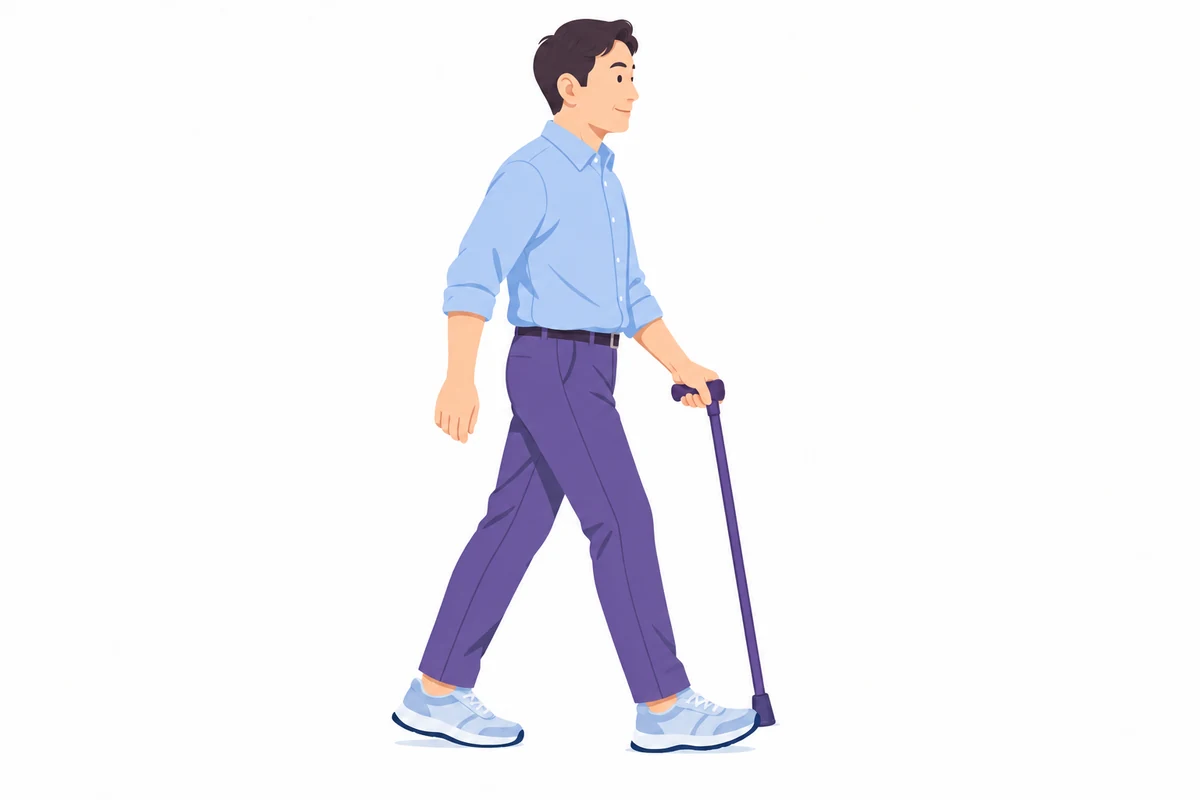
A stick is generally held in the hand opposite the painful or weaker leg: the left hand for a painful right knee. Learn to bring the stick forwards with the affected leg, take the required support through it, then move the other leg.
Pain in the hand or shoulder, or problems in both legs, may make another aid more suitable. Consider a frame or crutches if one stick does not provide safe support. The basic rule for one painful knee does not apply automatically to every balance problem or postoperative restriction.
Check height and the rubber tip
An unsuitable height can cause leaning or unnecessary arm strain. Adjust it so you can stand comfortably with a slight elbow bend while supporting yourself. A clinician or physiotherapist can assess the actual gait and hand strength when fitting it.
Check for a worn rubber tip and slipping on wet surfaces. On an adjustable stick, check that the locking mechanism is secure. Weight and appearance are not the only factors: grip, ability to move the aid and space at home matter too.
Practice chairs and stairs separately
Pulling on the stick to rise can make it slip. Learn to stand using a stable chair arm or seat support, establish balance, then take the stick. When sitting, confirm the position of the chair behind you.
Stairs may require a taught one-step-at-a-time method using the rail. A common pattern leads up with the less affected leg and down with the stick and affected leg, but bilateral symptoms and weight-bearing restrictions change this. Check the technique through supervised practice.
Combine support with strengthening
A stick does not remove arthritis or prevent every fall. Use it alongside pain management and strength and balance work. Check whether outings are easier and whether it creates new hand or shoulder discomfort.
If buckling or near-falls continue, or weight bearing becomes newly difficult, seek review. Do not remove support abruptly simply because pain is better; assess walking and balance. The goal is safe participation in daily life rather than discarding the aid quickly.
Common Questions
Which hand if both knees hurt?
Consider the more affected side, balance and hand function. A different walking aid may be more suitable.
Is the opposite hand enough after surgery?
The operation’s weight-bearing instructions take priority. Check with the rehabilitation team whether a stick provides enough support.
Does using a stick weaken my muscles?
Continue suitable strength and balance exercise while using the support needed for safe activity.
Evidence and references
01When to seek medical care
Each warning sign is a separate reason to seek care. Follow the action below if any one applies.
Emergency department · call 119 in Korea
- Call 119 for sudden breathlessness or chest pain, severe faintness or loss of consciousness. Do not wait for calf swelling to appear.
- Go to an emergency department if you suddenly cannot bear any weight, or if an injured knee swells rapidly or looks deformed. A cold or numb foot after injury also needs immediate assessment.
- Seek emergency care for a hot, swollen and severely painful joint with high fever, shaking chills, confusion or inability to bear weight.
- With back or leg pain, go immediately to an emergency department for new difficulty passing urine, loss of bladder or bowel control, or numbness around the genitals or anus. Severe or rapidly worsening weakness or numbness in both legs also needs immediate assessment.
Same-day assessment
- Arrange assessment today for a newly hot, swollen joint, sudden severe pain, or a knee locked so that it cannot fully straighten. Joint infection can occur without fever.
- Have new swelling or pain in one calf assessed today for a possible blood clot. Call 119 immediately if breathlessness or chest pain develops.
- Severe knee pain or a new limp in a growing adolescent may come from a hip condition such as slipped capital femoral epiphysis. Stop walking and sport and arrange assessment today. Go directly to emergency care if they cannot bear weight.
- Stop running and seek assessment today for new recurring groin pain, pain with walking or at night, or a limp. A femoral neck stress fracture needs to be considered. Keep weight off the painful leg until assessed. Go to emergency care if you cannot bear weight.
Book an outpatient appointment
- If none of the warning signs above is present, book an appointment for pain lasting a few weeks, repeated swelling or reduced daily activity and exercise.