Daily life and exercise
Why is going downstairs harder on my knee?
Consider controlled lowering, strength and safe movement together.
At a glance
- Stair pain alone does not diagnose cartilage damage or a particular disease.
- Use support and a suitable method to make movement safer.
- Plan pain control alongside strength and balance recovery.
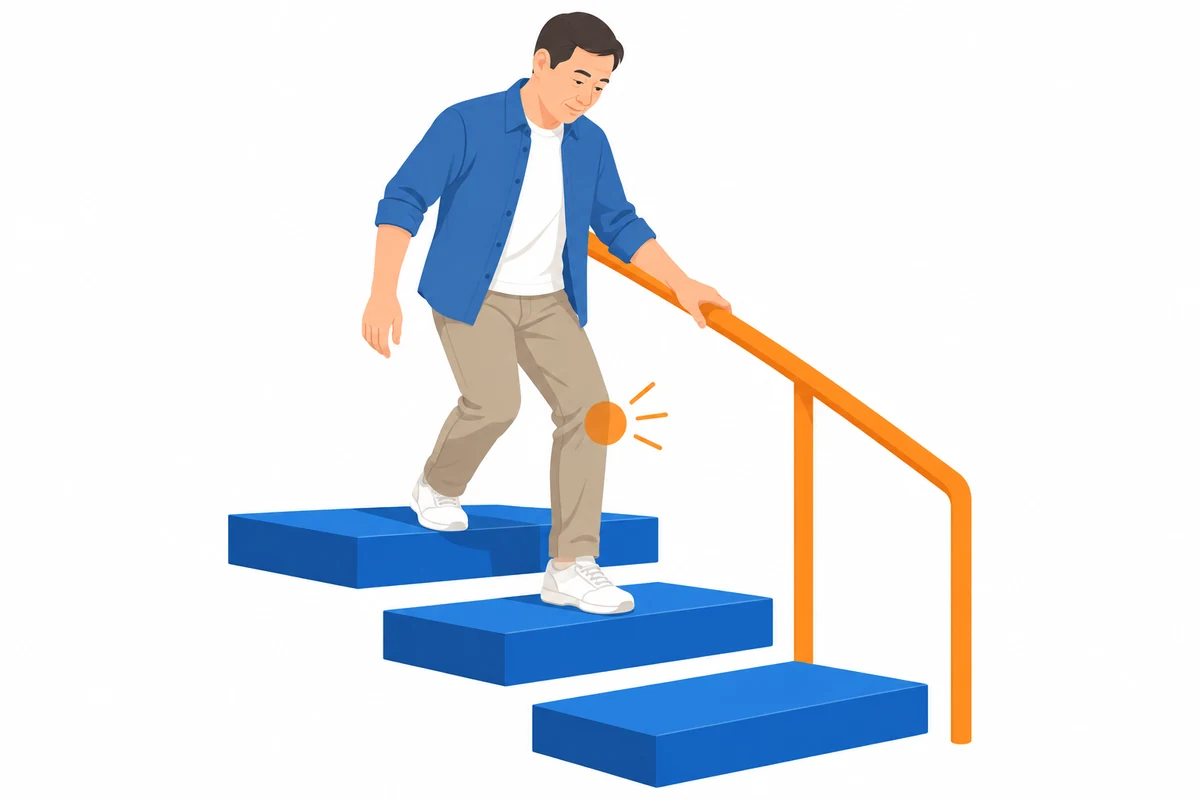
Many people manage level walking but have pain on stairs. Stairs require the knee to bear weight while bent, and descending requires muscles to control the body’s lowering. Stair pain alone does not identify a particular damaged tissue; location and function need assessment.
Three checks before using stairs
- 01
Location
Distinguish front or inner pain and ascending or descending.
- 02
Safe movement
Check the rail, foot space and carried items.
- 03
Progression
Begin with manageable strength and balance activities.
Three panels show location, safe support and progressive recovery
Distinguish front pain from other knee discomfort
The joint between the patella and femur participates in activities with a bent knee. Front pain may occur on stairs or when rising, but arthritis and problems in muscles or tendons are other possibilities. Describe the location and any swelling first.
Descending also requires the thigh muscles to control body weight. Pain that limits muscle use or reduced strength can make movement less secure. This is why movement, balance and instability matter alongside cartilage findings.
Choose a safe way to travel first
Use the rail, take your time and check space for your feet. Be more careful in poor light or on a wet surface. Carrying bags in both hands removes access to the rail, so separating the load from the stair trip can be safer.
For a suitable person with one affected leg, a taught one-step-at-a-time method uses the less affected leg first going up and the affected leg first going down. Do not apply this automatically to bilateral pain or postoperative weight-bearing restrictions; practice with the rehabilitation team.
Reduce provoking stairs while building strength
When pain is substantial, use a lift or reduce stair trips where possible. Repeating stairs to test the pain is not the only way to exercise. Ask about sit-to-stand or other strengthening activities that gradually build the required ability.
Match range and difficulty to the response. You do not need to begin with a high step or deep bend. Once level walking and easier movements are manageable, supported practice can progressively assess stair function.
Separate pain from actual buckling
Distinguish stopping briefly because of pain, actual giving way, and a knee that catches and cannot straighten. Differences between going up and down stairs, or between pain at the front and inside, are also helpful. These details help your clinician choose what to examine and which tests are needed.
After an injury, inability to step, new swelling or instability needs assessment rather than repeated practice. Also mention avoiding outings because of fear of falling. Treatment goals include safe access to your home and surroundings as well as pain relief.
Common Questions
Does pain going down mean chondromalacia?
Several causes, including patellofemoral problems, are possible. Location, examination and selected imaging help assess them.
Are stairs always good exercise?
They can be too demanding for current pain, balance or strength. Adjust from easier activities.
Which leg leads when taking one step at a time?
When suitable for one affected leg, the less affected leg leads up and the affected leg leads down. Follow separate postoperative restrictions.
Evidence and references
01When to seek medical care
Each warning sign is a separate reason to seek care. Follow the action below if any one applies.
Emergency department · call 119 in Korea
- Call 119 for sudden breathlessness or chest pain, severe faintness or loss of consciousness. Do not wait for calf swelling to appear.
- Go to an emergency department if you suddenly cannot bear any weight, or if an injured knee swells rapidly or looks deformed. A cold or numb foot after injury also needs immediate assessment.
- Seek emergency care for a hot, swollen and severely painful joint with high fever, shaking chills, confusion or inability to bear weight.
- With back or leg pain, go immediately to an emergency department for new difficulty passing urine, loss of bladder or bowel control, or numbness around the genitals or anus. Severe or rapidly worsening weakness or numbness in both legs also needs immediate assessment.
Same-day assessment
- Arrange assessment today for a newly hot, swollen joint, sudden severe pain, or a knee locked so that it cannot fully straighten. Joint infection can occur without fever.
- Have new swelling or pain in one calf assessed today for a possible blood clot. Call 119 immediately if breathlessness or chest pain develops.
- Severe knee pain or a new limp in a growing adolescent may come from a hip condition such as slipped capital femoral epiphysis. Stop walking and sport and arrange assessment today. Go directly to emergency care if they cannot bear weight.
- Stop running and seek assessment today for new recurring groin pain, pain with walking or at night, or a limp. A femoral neck stress fracture needs to be considered. Keep weight off the painful leg until assessed. Go to emergency care if you cannot bear weight.
Book an outpatient appointment
- If none of the warning signs above is present, book an appointment for pain lasting a few weeks, repeated swelling or reduced daily activity and exercise.