Medicines and injections
PRP injections: what does treatment with your own blood mean?
Using your own blood does not guarantee effectiveness or eliminate risk.
At a glance
- PRP composition and preparation vary.
- Discuss uncertain evidence and differing recommendations.
- Consider injection risk, cost and alternatives.
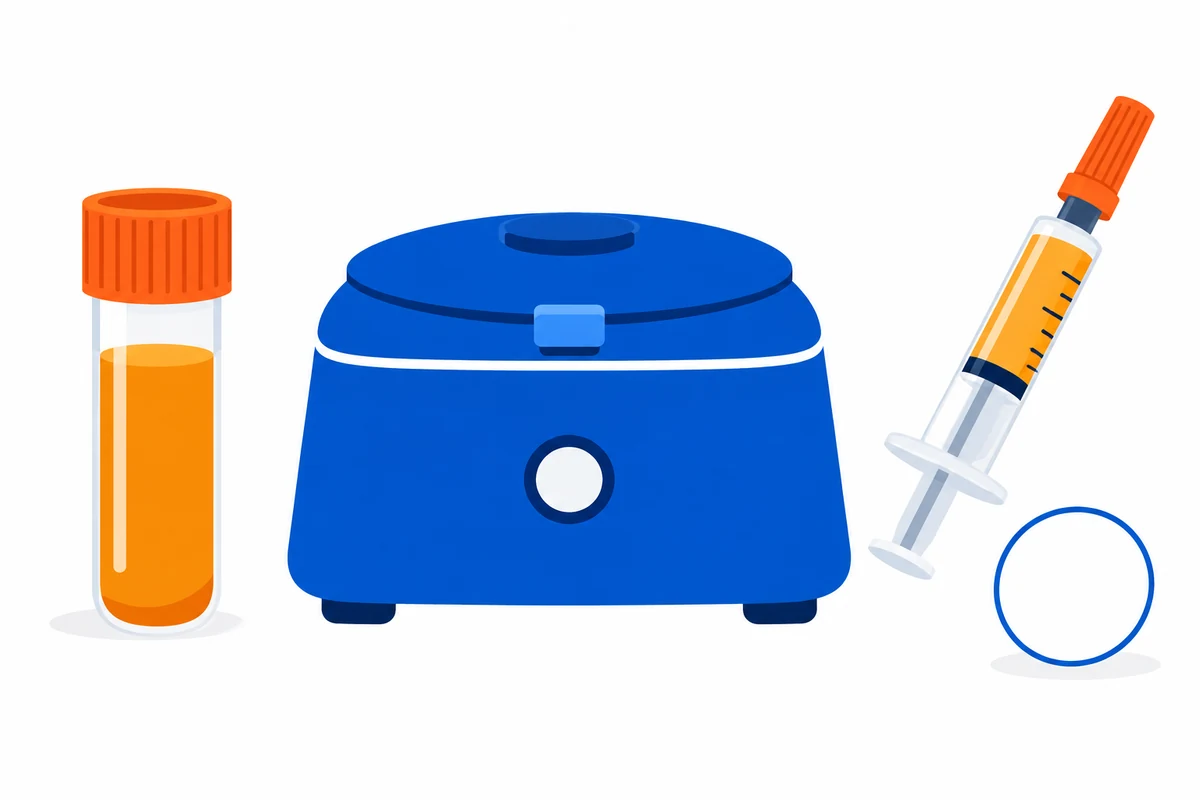
Platelet-rich plasma, or PRP, is prepared from your blood to obtain a platelet-rich portion. It is easy to assume that this regrows cartilage without side effects. In practice, preparation, patient selection and comparative studies all matter.
Three questions about PRP
- 01
Which PRP?
Preparation, composition and injection plan
- 02
Which benefit?
Pain versus structural outcomes
- 03
Which choice?
Alternatives, cost, risk and review
Preparation, measured benefit and personal choice
The method concentrates platelets
Platelets contain substances involved in biological signaling. This provides a rationale for treatment, but a biological mechanism does not prove cartilage regeneration in a joint.
Platelet and white-cell content vary with preparation. Treatments called PRP are not necessarily identical, so findings from one protocol cannot automatically be applied to all others.
Research findings are mixed
Some studies report improvements in pain and function, but differences in treatment and evidence quality have led to differing recommendations. AAOS rates the evidence supporting possible benefit as limited.
The RESTORE randomized trial compared 288 adults with mild-to-moderate knee osteoarthritis. At 12 months, it found no significant advantage over saline for pain or cartilage volume. This does not prove that every PRP method is ineffective.
Autologous treatment still has risks
Using your blood does not remove pain, swelling or infection risks from blood collection and joint injection. Report blood disorders, medicines and previous injection reactions.
Ask about preparation, expected benefit, cost and the plan if treatment does not help. Any instruction to stop medicine should be checked with the clinicians managing your prescriptions.
Compare it with the whole treatment plan
Review exercise, activity adjustment and medicines first. Do not assume that PRP removes the need for other care or guarantees avoidance of surgery.
Record walking, stairs and exercise participation as well as pain. Reassess against an agreed goal instead of interpreting a transient improvement as cartilage regeneration or adding repeated injections without clear benefit.
Is PRP treatment for knee osteoarthritis recognized in Korea?
Intra-articular PRP for knee osteoarthritis is a recognized new health technology in Korea. The specified patients have KL grade 2–3 osteoarthritis that has not responded to at least one year of prior treatment with oral medication and intra-articular steroid or hyaluronic acid injections. Platelet-rich plasma separated from the patient’s own blood is injected alone to relieve pain and improve function.
Knee PRP is managed as a non-covered reporting item. Korean reimbursement criteria for PRP in tennis or golfer’s elbow are separate and cannot be applied directly to the knee. After checking eligibility and cost, compare this option with exercise therapy, medication and other injections.
Common Questions
Does PRP regrow cartilage?
There is no basis for guaranteeing cartilage regeneration in knee osteoarthritis. Symptom and structural effects are separate.
Is it free of adverse effects because it is my blood?
Pain, swelling and infection risks from the procedure remain.
Why do positive and negative studies differ?
Participants, preparation, comparison groups and study quality differ. Decisions should consider the full uncertainty.
Evidence and references
01When to seek medical care
Each warning sign is a separate reason to seek care. Follow the action below if any one applies.
Emergency department · call 119 in Korea
- Call 119 for sudden breathlessness or chest pain, severe faintness or loss of consciousness. Do not wait for calf swelling to appear.
- Go to an emergency department if you suddenly cannot bear any weight, or if an injured knee swells rapidly or looks deformed. A cold or numb foot after injury also needs immediate assessment.
- Seek emergency care for a hot, swollen and severely painful joint with high fever, shaking chills, confusion or inability to bear weight.
- With back or leg pain, go immediately to an emergency department for new difficulty passing urine, loss of bladder or bowel control, or numbness around the genitals or anus. Severe or rapidly worsening weakness or numbness in both legs also needs immediate assessment.
Same-day assessment
- Arrange assessment today for a newly hot, swollen joint, sudden severe pain, or a knee locked so that it cannot fully straighten. Joint infection can occur without fever.
- Have new swelling or pain in one calf assessed today for a possible blood clot. Call 119 immediately if breathlessness or chest pain develops.
- Severe knee pain or a new limp in a growing adolescent may come from a hip condition such as slipped capital femoral epiphysis. Stop walking and sport and arrange assessment today. Go directly to emergency care if they cannot bear weight.
- Stop running and seek assessment today for new recurring groin pain, pain with walking or at night, or a limp. A femoral neck stress fracture needs to be considered. Keep weight off the painful leg until assessed. Go to emergency care if you cannot bear weight.
Book an outpatient appointment
- If none of the warning signs above is present, book an appointment for pain lasting a few weeks, repeated swelling or reduced daily activity and exercise.