2024 · Knee Surgery & Related Research
Can X-rays Help Plan the Size of a Knee Implant in Advance?
Exact size agreement was 39.5% for the femur and 43.2% for the tibia. Agreement within one size was 88.9% for both.
Original Figure 1
 Enlarge Figure
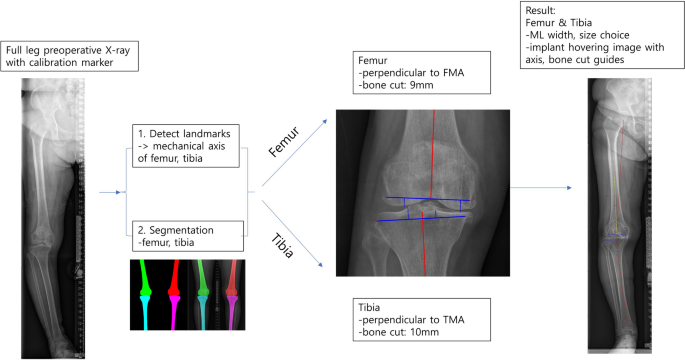
The coronal-image processing pipeline of an automatic templating study that detects bone outlines and anatomical landmarks to estimate knee-implant size. The final surgical plan requires specialist judgment.
Jaeseok Park, Sung Eun Kim, Back Kim, Sanggyu Lee, Jae-Jun Lee, Du Hyun Ro. A deep learning based automatic two-dimensional digital templating model for total knee arthroplasty. Knee Surgery & Related Research (2024). https://doi.org/10.1186/s43019-024-00240-7
The research question
Participants and Methods
Main Findings
Implications for clinical and surgical practice
Limitations
Let's put it briefly.
Which clinical question does this address?
This study evaluated a preoperative tool to help prepare component sizes and resources. It does not mean that AI was more accurate than a specialist.
Keywords
- Artificial intelligence
- Implant size prediction
- Preoperative templating
- Total knee arthroplasty
- AI
- TKA
- surgical planning
- implant templating
Abstract · Original text
Jaeseok Park, Sung Eun Kim, Back Kim, Sanggyu Lee, Jae-Jun Lee, Du Hyun Ro. A deep learning based automatic two-dimensional digital templating model for total knee arthroplasty. Knee surgery & related research. 2024;36(1):38. doi:10.1186/s43019-024-00240-7.
BACKGROUND
Preoperative templating is an important step for total knee arthroplasty (TKA), facilitating hospital personnel in the anticipation and preparation of necessary surgical resources. Despite its importance, this process currently lacks automation. This study aimed to develop an artificial intelligence (AI) model to automate implant size prediction.
METHODS
A total of 13,281 (2938 anteroposterior, 10,343 lateral) knee radiographs obtained from the authors' institute were utilized for model training, with 2302 (1034 anteroposterior, 1268 lateral) images set apart for validation and testing. The templating AI model integrates a pipeline composed of multiple steps for automated implant size estimation. To predict implant size, anterioposterior (AP) and lateral radiograph predictions were merged, selecting the smaller of the predicted sizes to prevent implant overhang. The model's size predictions were validated with 81 real TKA data set apart from the training data, and its accuracy was compared to that of manual templating by an orthopedic specialist. Predictions matching the actual implanted sizes were labeled "exact" and those within one size, "accurate." The influence of patient characteristics on the model's prediction accuracy was also analyzed. The measurement time elapsed for implant sizing was recorded for both the AI model and the orthopedic specialist. Implant position predicted by the model was validated by comparing insert locations with postoperative images.
RESULTS
Compared with data from 81 actual TKA procedures, the model provided exact predictions for 39.5% of femoral and 43.2% of tibial components. Allowing a one-size margin of error, 88.9% of predictions were deemed "accurate" for both components. Interobserver reliability (Cohen's kappa) were 0.60 and 0.70 for femoral and tibial implants, respectively, both classified as "substantial." The orthopedic specialist produced results accurate within one-size margin of error in 95.1% and 100% of cases for femoral and tibial components, respectively. Interobserver reliability between the orthopedic specialist and ground truth was 0.76 and 0.8 for femoral and tibial components, respectively. The measurement time per case was 48.7 s for the AI model, compared with 97.5 s for the orthopedic specialist. Compared with postoperative radiographs, predicted implant position had an error of less than 4 mm on average.
CONCLUSIONS
An AI-based templating tool for TKA was successfully developed, demonstrating satisfactory accuracy and efficiency. Its application could significantly reduce the clinical workload in TKA preparation.
© The Author(s) 2024
The original paper.
A deep learning based automatic two-dimensional digital templating model for total knee arthroplasty
Jaeseok Park, Sung Eun Kim, Back Kim, Sanggyu Lee, Jae-Jun Lee, Du Hyun Ro
Knee Surgery & Related Research · 2024