2024 · Knee Surgery & Related Research
X線で人工膝関節のサイズを事前に計画できるか?
サイズの完全一致率は大腿骨39.5%、脛骨43.2%でした。1サイズ以内の一致率は両方とも88.9%でした。
原図Figure 1
 図を拡大する
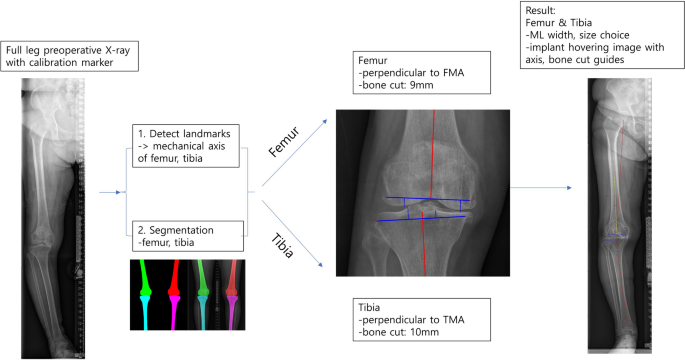
骨の輪郭と解剖学的ランドマークを検出し、人工膝関節のサイズを推定する自動テンプレーティング研究の冠状面画像処理です。最終的な手術計画は専門医が判断します。
Jaeseok Park, Sung Eun Kim, Back Kim, Sanggyu Lee, Jae-Jun Lee, Du Hyun Ro. A deep learning based automatic two-dimensional digital templating model for total knee arthroplasty. Knee Surgery & Related Research (2024). https://doi.org/10.1186/s43019-024-00240-7
研究で問うこと
対象と方法
主な結果
診療・手術で考える点
解釈の限界
簡単に説明しましょう
どの診療上の問いにつながりますか?
インプラントのサイズや必要な物品の準備を支援する術前ツールの研究です。AIが専門医より正確であることを意味するものではありません。
Keywords・キーワード
- Artificial intelligence
- Implant size prediction
- Preoperative templating
- Total knee arthroplasty
- AI
- TKA
- surgical planning
- implant templating
Abstract・原文の抄録
Jaeseok Park, Sung Eun Kim, Back Kim, Sanggyu Lee, Jae-Jun Lee, Du Hyun Ro. A deep learning based automatic two-dimensional digital templating model for total knee arthroplasty. Knee surgery & related research. 2024;36(1):38. doi:10.1186/s43019-024-00240-7.
BACKGROUND
Preoperative templating is an important step for total knee arthroplasty (TKA), facilitating hospital personnel in the anticipation and preparation of necessary surgical resources. Despite its importance, this process currently lacks automation. This study aimed to develop an artificial intelligence (AI) model to automate implant size prediction.
METHODS
A total of 13,281 (2938 anteroposterior, 10,343 lateral) knee radiographs obtained from the authors' institute were utilized for model training, with 2302 (1034 anteroposterior, 1268 lateral) images set apart for validation and testing. The templating AI model integrates a pipeline composed of multiple steps for automated implant size estimation. To predict implant size, anterioposterior (AP) and lateral radiograph predictions were merged, selecting the smaller of the predicted sizes to prevent implant overhang. The model's size predictions were validated with 81 real TKA data set apart from the training data, and its accuracy was compared to that of manual templating by an orthopedic specialist. Predictions matching the actual implanted sizes were labeled "exact" and those within one size, "accurate." The influence of patient characteristics on the model's prediction accuracy was also analyzed. The measurement time elapsed for implant sizing was recorded for both the AI model and the orthopedic specialist. Implant position predicted by the model was validated by comparing insert locations with postoperative images.
RESULTS
Compared with data from 81 actual TKA procedures, the model provided exact predictions for 39.5% of femoral and 43.2% of tibial components. Allowing a one-size margin of error, 88.9% of predictions were deemed "accurate" for both components. Interobserver reliability (Cohen's kappa) were 0.60 and 0.70 for femoral and tibial implants, respectively, both classified as "substantial." The orthopedic specialist produced results accurate within one-size margin of error in 95.1% and 100% of cases for femoral and tibial components, respectively. Interobserver reliability between the orthopedic specialist and ground truth was 0.76 and 0.8 for femoral and tibial components, respectively. The measurement time per case was 48.7 s for the AI model, compared with 97.5 s for the orthopedic specialist. Compared with postoperative radiographs, predicted implant position had an error of less than 4 mm on average.
CONCLUSIONS
An AI-based templating tool for TKA was successfully developed, demonstrating satisfactory accuracy and efficiency. Its application could significantly reduce the clinical workload in TKA preparation.
© The Author(s) 2024
オリジナル紙だ
A deep learning based automatic two-dimensional digital templating model for total knee arthroplasty
Jaeseok Park, Sung Eun Kim, Back Kim, Sanggyu Lee, Jae-Jun Lee, Du Hyun Ro
Knee Surgery & Related Research · 2024