
2025 · Journal of Orthopaedic Research
Predicting radiographic knee osteoarthritis progression: external validation of a machine-learning model
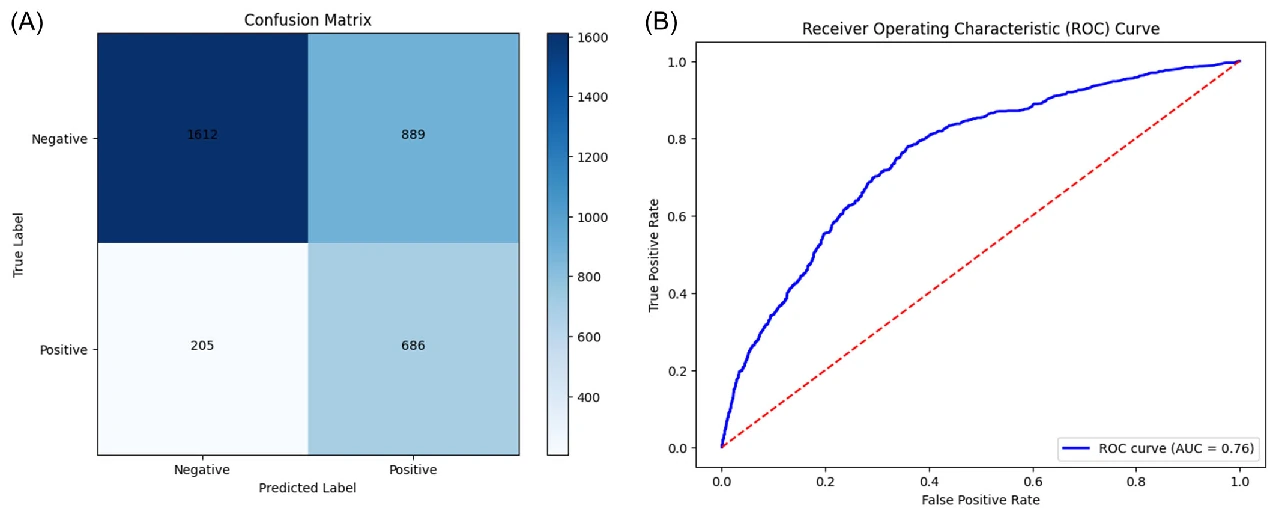
External validation in MOST yielded an AUC of 0.76, accuracy of 0.68 and F1 of 0.56.
Original Figure 2
 Enlarge Figure
Confusion matrix and ROC curve in the independent MOST cohort. Radiographic progression was evaluated with AUC 0.76 and accuracy 0.68.
Journal of Orthopaedic Research (2025). DOI: 10.1002/jor.25982 · Original Figure 2
Original Figure 3
 Enlarge Figure
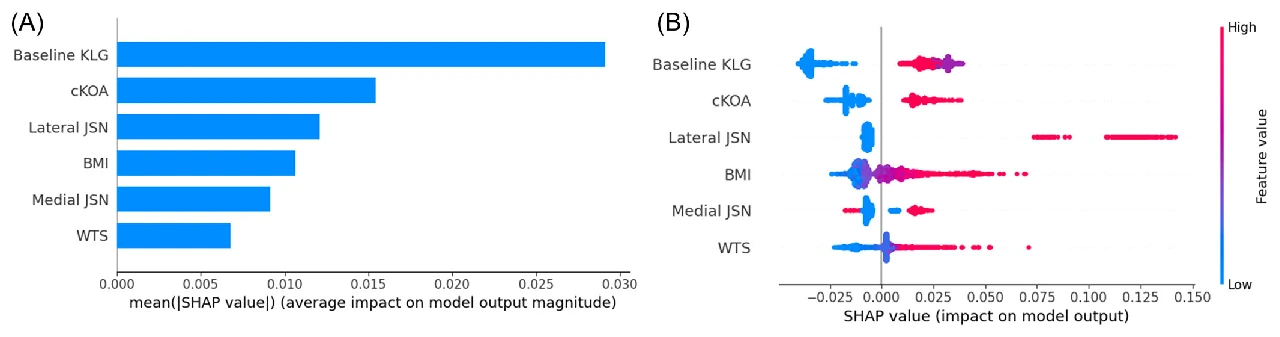
SHAP analysis of the six predictors shows contributions of baseline KL grade, contralateral OA, joint space narrowing, BMI and WOMAC.
Journal of Orthopaedic Research (2025). DOI: 10.1002/jor.25982 · Original Figure 3
Original Figure 5
 Enlarge Figure
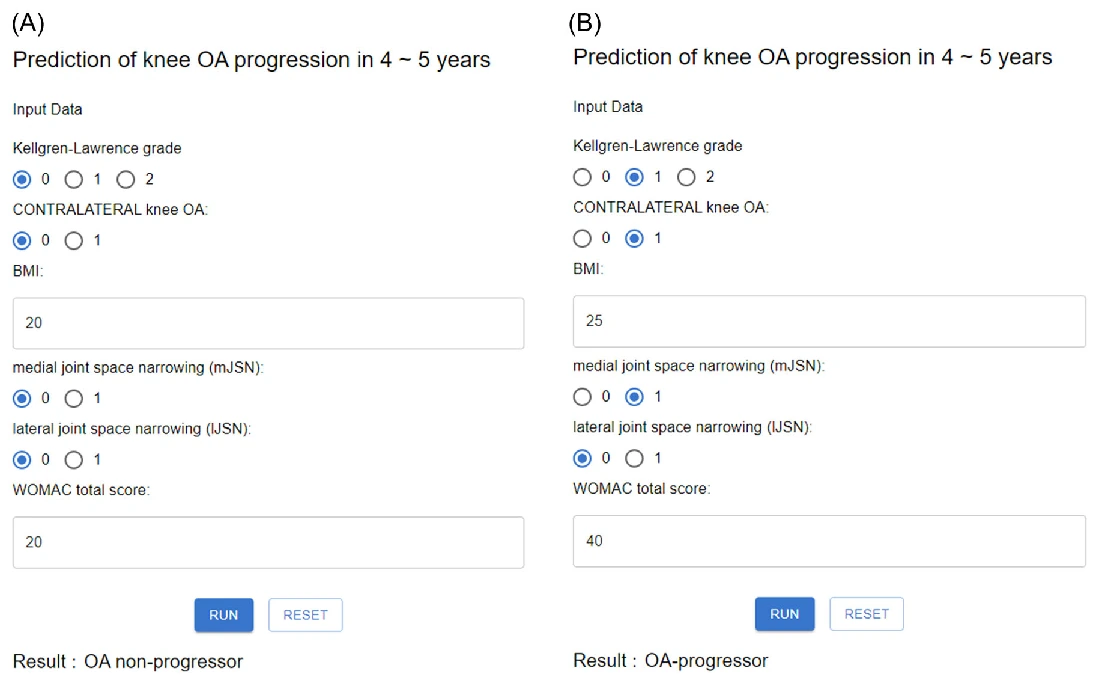
The paper shows example inputs and outputs from its web model. The prediction target was radiographic progression over 4–5 years.
Journal of Orthopaedic Research (2025). DOI: 10.1002/jor.25982 · Original Figure 5
The research question
Participants and Methods
Main Findings
Implications for clinical and surgical practice
Limitations
Let's put it briefly.
Which clinical question does this address?
This risk-stratification study may inform OA follow-up strategies. It cannot independently replace individualized surgical decisions.
Keywords
- knee
- machine learning
- osteoarthritis
- prediction
- validation
- Osteoarthritis, Knee
- Machine Learning
- Disease Progression
Abstract · Original text
Do Weon Lee, Hyuk-Soo Han, Du Hyun Ro, Yong Seuk Lee. Development of the machine learning model that is highly validated and easily applicable to predict radiographic knee osteoarthritis progression. Journal of orthopaedic research : official publication of the Orthopaedic Research Society. 2025;43(1):128-138. doi:10.1002/jor.25982.
Many models using the aid of artificial intelligence have been recently proposed to predict the progression of knee osteoarthritis. However, previous models have not been properly validated with an external data set or have reported poor predictive performances. Therefore, the purpose of this study was to design a machine learning model for knee osteoarthritis progression, focusing on high validation quality and clinical applicability. A retrospective analysis was conducted on prospectively collected data, using the Osteoarthritis Initiative data set (5966 knees) for model development and the Multicenter Osteoarthritis Study data set (3392 knees) for validation. The analysis aimed to predict Kellgren-Lawrence grade (KLG) progression over 4-5 years in knees with initial KLG of 0, 1, or 2. Possible predictors included demographics, comorbidities, history of meniscectomy, gait speed, Western Ontario and McMaster Universities Osteoarthritis Index (WOMAC) scores, and radiological findings. The Random Forest algorithm was employed for the predictive model development. Baseline KLG, contralateral knee osteoarthritis, lateral joint space narrowing (JSN) grade, BMI, medial JSN grade, and total WOMAC score were six features selected for the model in descending order of importance. Odds ratios of baseline KLG, contralateral knee osteoarthritis, and lateral JSN grade were 1.76, 2.59, and 4.74, respectively (all p < 0.001). The area-under-the-curve of the ROC curve in the validation set was 0.76 with an accuracy of 0.68 and an F1-score of 0.56. The progression of knee osteoarthritis in 4 ~ 5 years could be well-predicted using easily available variables. This simple and validated model may aid surgeons in knee osteoarthritis patient management.
The original paper.
Development of the machine learning model that is highly validated and easily applicable to predict radiographic knee osteoarthritis progression
Do Weon Lee, Hyuk-Soo Han, Du Hyun Ro, Yong Seuk Lee
Journal of Orthopaedic Research · 2025 · online 2024