
2025 · Journal of Orthopaedic Research
膝関節症の画像上の進行予測:機械学習モデルの外部検証
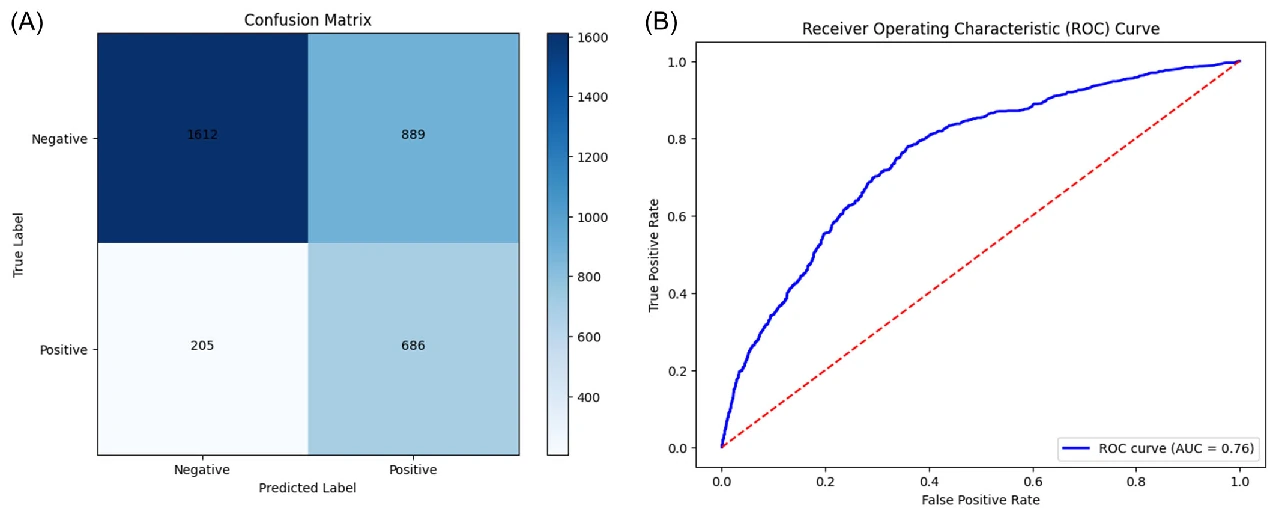
MOSTでの外部検証ではAUC 0.76、正確度0.68、F1 0.56でした。
原図Figure 2
 図を拡大する
独立したMOSTデータの混同行列とROC曲線です。AUC 0.76、正解率0.68で画像上の進行を評価しました。
Journal of Orthopaedic Research (2025). DOI: 10.1002/jor.25982 · Original Figure 2
原図Figure 3
 図を拡大する
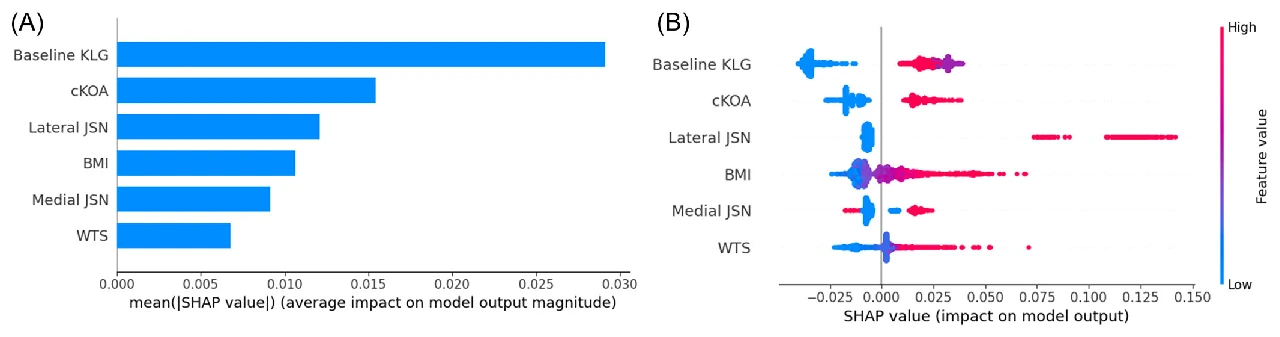
6つの予測変数のSHAP解析です。初期KLグレード、反対側関節症、関節裂隙狭小化、BMI、WOMACの寄与を示します。
Journal of Orthopaedic Research (2025). DOI: 10.1002/jor.25982 · Original Figure 3
原図Figure 5
 図を拡大する
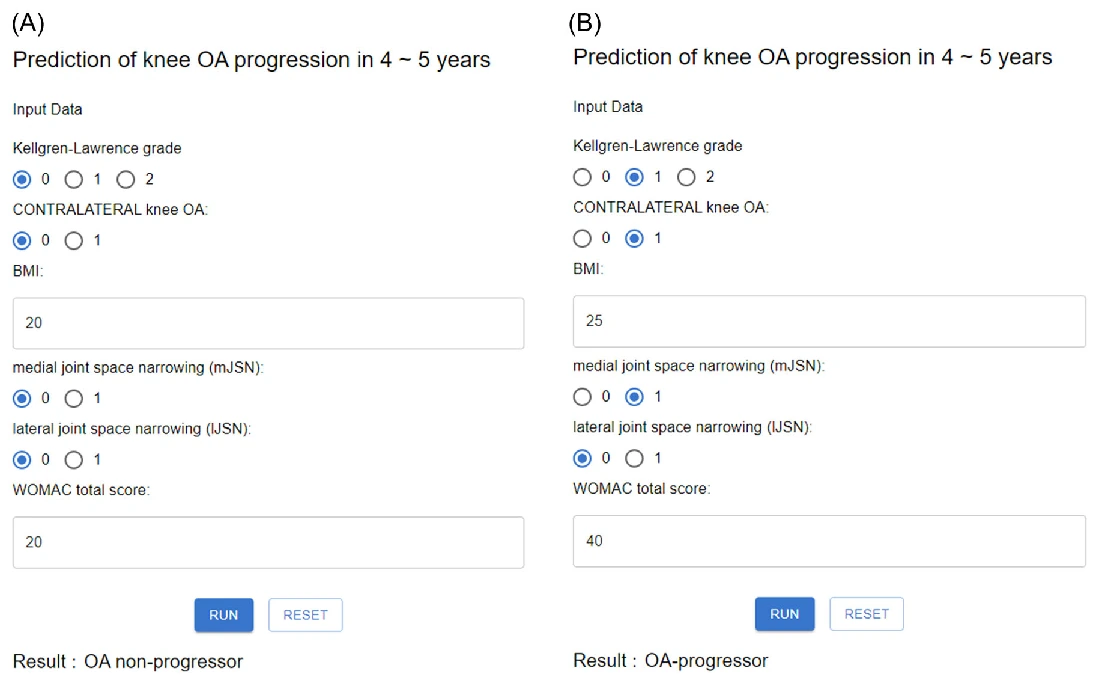
論文に示されたウェブモデルの入力・結果例です。予測対象は4–5年後の画像上の進行です。
Journal of Orthopaedic Research (2025). DOI: 10.1002/jor.25982 · Original Figure 5
研究で問うこと
対象と方法
主な結果
診療・手術で考える点
解釈の限界
簡単に説明しましょう
どの診療上の問いにつながりますか?
OA追跡戦略のためのリスク分類研究です。個人ごとの手術判断を、これだけで置き換えることはできません。
Keywords・キーワード
- knee
- machine learning
- osteoarthritis
- prediction
- validation
- Osteoarthritis, Knee
- Machine Learning
- Disease Progression
Abstract・原文の抄録
Do Weon Lee, Hyuk-Soo Han, Du Hyun Ro, Yong Seuk Lee. Development of the machine learning model that is highly validated and easily applicable to predict radiographic knee osteoarthritis progression. Journal of orthopaedic research : official publication of the Orthopaedic Research Society. 2025;43(1):128-138. doi:10.1002/jor.25982.
Many models using the aid of artificial intelligence have been recently proposed to predict the progression of knee osteoarthritis. However, previous models have not been properly validated with an external data set or have reported poor predictive performances. Therefore, the purpose of this study was to design a machine learning model for knee osteoarthritis progression, focusing on high validation quality and clinical applicability. A retrospective analysis was conducted on prospectively collected data, using the Osteoarthritis Initiative data set (5966 knees) for model development and the Multicenter Osteoarthritis Study data set (3392 knees) for validation. The analysis aimed to predict Kellgren-Lawrence grade (KLG) progression over 4-5 years in knees with initial KLG of 0, 1, or 2. Possible predictors included demographics, comorbidities, history of meniscectomy, gait speed, Western Ontario and McMaster Universities Osteoarthritis Index (WOMAC) scores, and radiological findings. The Random Forest algorithm was employed for the predictive model development. Baseline KLG, contralateral knee osteoarthritis, lateral joint space narrowing (JSN) grade, BMI, medial JSN grade, and total WOMAC score were six features selected for the model in descending order of importance. Odds ratios of baseline KLG, contralateral knee osteoarthritis, and lateral JSN grade were 1.76, 2.59, and 4.74, respectively (all p < 0.001). The area-under-the-curve of the ROC curve in the validation set was 0.76 with an accuracy of 0.68 and an F1-score of 0.56. The progression of knee osteoarthritis in 4 ~ 5 years could be well-predicted using easily available variables. This simple and validated model may aid surgeons in knee osteoarthritis patient management.
オリジナル紙だ
Development of the machine learning model that is highly validated and easily applicable to predict radiographic knee osteoarthritis progression
Do Weon Lee, Hyuk-Soo Han, Du Hyun Ro, Yong Seuk Lee
Journal of Orthopaedic Research · 2025 · online 2024