2024 · Aging Cell
Could Selectively Identifying and Removing Senescent Chondrocytes with DPP-4 Reduce OA Progression?
SA-β-gal positivity was observed in approximately 57% of human OA chondrocytes.
Original FIGURE 6
 Enlarge Figure
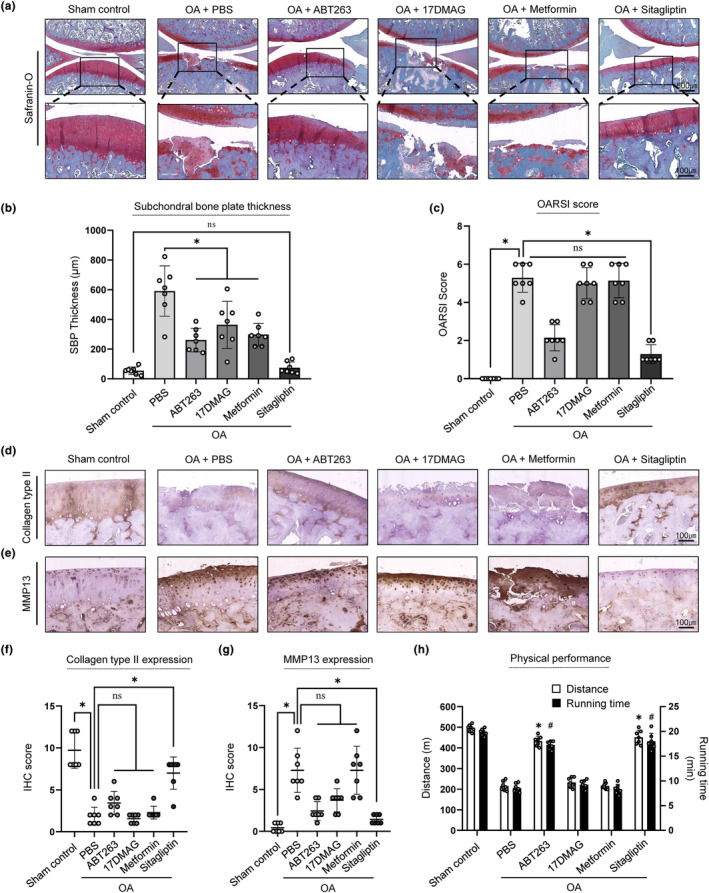
Staining, histology scores and functional measures in a mouse DMM osteoarthritis model.
Du Hyun Ro, Gun Hee Cho, Ji Yoon Kim, Seong Ki Min, Ha Ru Yang, Hee Jung Park, Sun Young Wang, You Jung Kim, Myung Chul Lee, Hyun Cheol Bae, Hyuk-Soo Han. Selective targeting of dipeptidyl-peptidase 4 (DPP-4) positive senescent chondrocyte ameliorates osteoarthritis progression. Aging Cell (2024). DOI: 10.1111/acel.14161. © 2024 The Authors. Aging Cell published by Anatomical Society and John Wiley & Sons Ltd.
Original Figure Legend
Intra‐articular injection of the DPP‐4‐inhibitor sitagliptin prevented OA development in the rat DMM model. (a) Representative histological analysis using safranin‐O …
Participants and Methods
The order in which you read the painting.
Main Findings
The point of reading on surgery
Limitations
Let's put it briefly.
What did this study confirm?
SA-β-gal positivity was observed in approximately 57% of human OA chondrocytes.
Can it be applied directly to individual patients' treatment decisions?
These findings come from human tissue and preclinical experiments. Downstream DPP-4 mechanisms and its role in non-OA cartilage homeostasis remain incompletely understood. Safety and efficacy for treating human OA have not been demonstrated.
Keywords
- dipeptidyl peptidase 4
- osteoarthritis
- senescence
- senolytics
- sitagliptin
- Chondrocytes
- Osteoarthritis
- Dipeptidyl Peptidase 4
Abstract · Original text
Du Hyun Ro, Gun Hee Cho, Ji Yoon Kim, Seong Ki Min, Ha Ru Yang, Hee Jung Park, Sun Young Wang, You Jung Kim, Myung Chul Lee, Hyun Cheol Bae, Hyuk-Soo Han. Selective targeting of dipeptidyl-peptidase 4 (DPP-4) positive senescent chondrocyte ameliorates osteoarthritis progression. Aging cell. 2024;23(7):e14161. doi:10.1111/acel.14161.
Senescent cells increase in many tissues with age and induce age-related pathologies, including osteoarthritis (OA). Senescent chondrocytes (SnCs) are found in OA cartilage, and the clearance of those chondrocytes prevents OA progression. However, targeting SnCs is challenging due to the absence of a senescent chondrocyte-specific marker. Therefore, we used flow cytometry to screen and select senescent chondrocyte surface markers and cross-validated with published transcriptomic data. Chondrocytes expressing dipeptidyl peptidase-4 (DPP-4), the selected senescent chondrocyte-specific marker, had multiple senescence phenotypes, such as increased senescence-associated-galactosidase, p16, p21, and senescence-associated secretory phenotype expression, and showed OA chondrocyte phenotypes. To examine the effects of DPP-4 inhibition on DPP-4+ SnCs, sitagliptin, a DPP-4 inhibitor, was treated in vitro. As a result, DPP-4 inhibition selectively eliminates DPP-4+ SnCs without affecting DPP-4- chondrocytes. To assess in vivo therapeutic efficacy of targeting DPP-4+ SnCs, three known senolytics (ABT263, 17DMAG, and metformin) and sitagliptin were comparatively verified in a DMM-induced rat OA model. Sitagliptin treatment specifically and effectively eliminated DPP-4+ SnCs, compared to the other three senolytics. Furthermore, Intra-articular sitagliptin injection to the rat OA model increased collagen type II and proteoglycan expression and physical functions and decreased cartilage destruction, subchondral bone plate thickness and MMP13 expression, leading to the amelioration of OA phenotypes. Collectively, OARSI score was lowest in the sitagliptin treatment group. Taken together, we verified DPP-4 as a surface marker for SnCs and suggested that the selective targeting of DPP-4+ chondrocytes could be a promising strategy to prevent OA progression.
© 2024 The Authors. Aging Cell published by Anatomical Society and John Wiley & Sons Ltd.
The original paper.
Selective targeting of dipeptidyl-peptidase 4 (DPP-4) positive senescent chondrocyte ameliorates osteoarthritis progression
Du Hyun Ro, Gun Hee Cho, Ji Yoon Kim, Seong Ki Min, Ha Ru Yang, Hee Jung Park, Sun Young Wang, You Jung Kim, Myung Chul Lee, Hyun Cheol Bae, Hyuk-Soo Han
Aging Cell · 2024