2024 · Aging Cell
DPP-4を利用して老化軟骨細胞を選択的に識別・除去すると、OAの進行を抑えられるか?
ヒトOA軟骨細胞の約57%でSA-β-gal陽性が認められました。
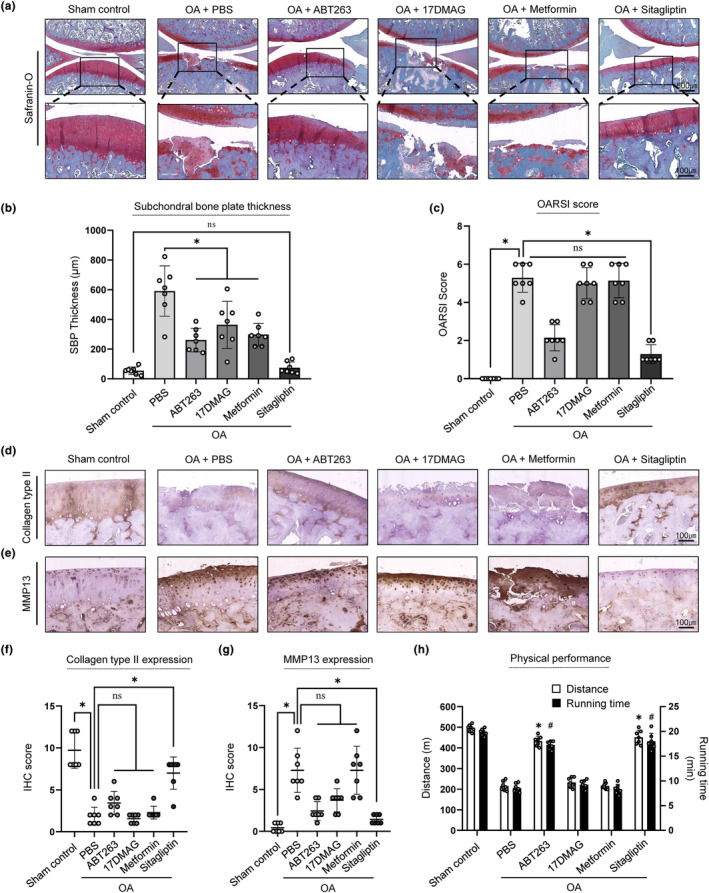
原著 FIGURE 6
 図を拡大する
マウスDMM変形性関節症モデルにおける染色・組織スコアと機能指標です。
Du Hyun Ro, Gun Hee Cho, Ji Yoon Kim, Seong Ki Min, Ha Ru Yang, Hee Jung Park, Sun Young Wang, You Jung Kim, Myung Chul Lee, Hyun Cheol Bae, Hyuk-Soo Han. Selective targeting of dipeptidyl-peptidase 4 (DPP-4) positive senescent chondrocyte ameliorates osteoarthritis progression. Aging Cell (2024). DOI: 10.1111/acel.14161. © 2024 The Authors. Aging Cell published by Anatomical Society and John Wiley & Sons Ltd.
原著の図の説明
Intra‐articular injection of the DPP‐4‐inhibitor sitagliptin prevented OA development in the rat DMM model. (a) Representative histological analysis using safranin‐O …
対象と方法
絵を読んだ順序です
主な結果
手術に関する読書のポイント
解釈の限界
簡単に説明しましょう
この研究で何が確認されましたか?
ヒトOA軟骨細胞の約57%でSA-β-gal陽性が認められました。
治療決定に直接適用できるか?
人の組織と前臨床実験の結果です。DPP-4の下流機序と非OA軟骨の恒常性における役割は十分に解明されていません。人のOA治療の安全性と有効性を証明したものではありません。
Keywords・キーワード
- dipeptidyl peptidase 4
- osteoarthritis
- senescence
- senolytics
- sitagliptin
- Chondrocytes
- Osteoarthritis
- Dipeptidyl Peptidase 4
Abstract・原文の抄録
Du Hyun Ro, Gun Hee Cho, Ji Yoon Kim, Seong Ki Min, Ha Ru Yang, Hee Jung Park, Sun Young Wang, You Jung Kim, Myung Chul Lee, Hyun Cheol Bae, Hyuk-Soo Han. Selective targeting of dipeptidyl-peptidase 4 (DPP-4) positive senescent chondrocyte ameliorates osteoarthritis progression. Aging cell. 2024;23(7):e14161. doi:10.1111/acel.14161.
Senescent cells increase in many tissues with age and induce age-related pathologies, including osteoarthritis (OA). Senescent chondrocytes (SnCs) are found in OA cartilage, and the clearance of those chondrocytes prevents OA progression. However, targeting SnCs is challenging due to the absence of a senescent chondrocyte-specific marker. Therefore, we used flow cytometry to screen and select senescent chondrocyte surface markers and cross-validated with published transcriptomic data. Chondrocytes expressing dipeptidyl peptidase-4 (DPP-4), the selected senescent chondrocyte-specific marker, had multiple senescence phenotypes, such as increased senescence-associated-galactosidase, p16, p21, and senescence-associated secretory phenotype expression, and showed OA chondrocyte phenotypes. To examine the effects of DPP-4 inhibition on DPP-4+ SnCs, sitagliptin, a DPP-4 inhibitor, was treated in vitro. As a result, DPP-4 inhibition selectively eliminates DPP-4+ SnCs without affecting DPP-4- chondrocytes. To assess in vivo therapeutic efficacy of targeting DPP-4+ SnCs, three known senolytics (ABT263, 17DMAG, and metformin) and sitagliptin were comparatively verified in a DMM-induced rat OA model. Sitagliptin treatment specifically and effectively eliminated DPP-4+ SnCs, compared to the other three senolytics. Furthermore, Intra-articular sitagliptin injection to the rat OA model increased collagen type II and proteoglycan expression and physical functions and decreased cartilage destruction, subchondral bone plate thickness and MMP13 expression, leading to the amelioration of OA phenotypes. Collectively, OARSI score was lowest in the sitagliptin treatment group. Taken together, we verified DPP-4 as a surface marker for SnCs and suggested that the selective targeting of DPP-4+ chondrocytes could be a promising strategy to prevent OA progression.
© 2024 The Authors. Aging Cell published by Anatomical Society and John Wiley & Sons Ltd.
オリジナル紙だ
Selective targeting of dipeptidyl-peptidase 4 (DPP-4) positive senescent chondrocyte ameliorates osteoarthritis progression
Du Hyun Ro, Gun Hee Cho, Ji Yoon Kim, Seong Ki Min, Ha Ru Yang, Hee Jung Park, Sun Young Wang, You Jung Kim, Myung Chul Lee, Hyun Cheol Bae, Hyuk-Soo Han
Aging Cell · 2024