2023 · The Knee
Does alignment in people without osteoarthritis differ by age and sex?
Mean HKA was 178.01° in males and 178.82° in females. Mean MPTA in males was approximately 1° smaller.
Results explained with study numbers
 Enlarge Figure
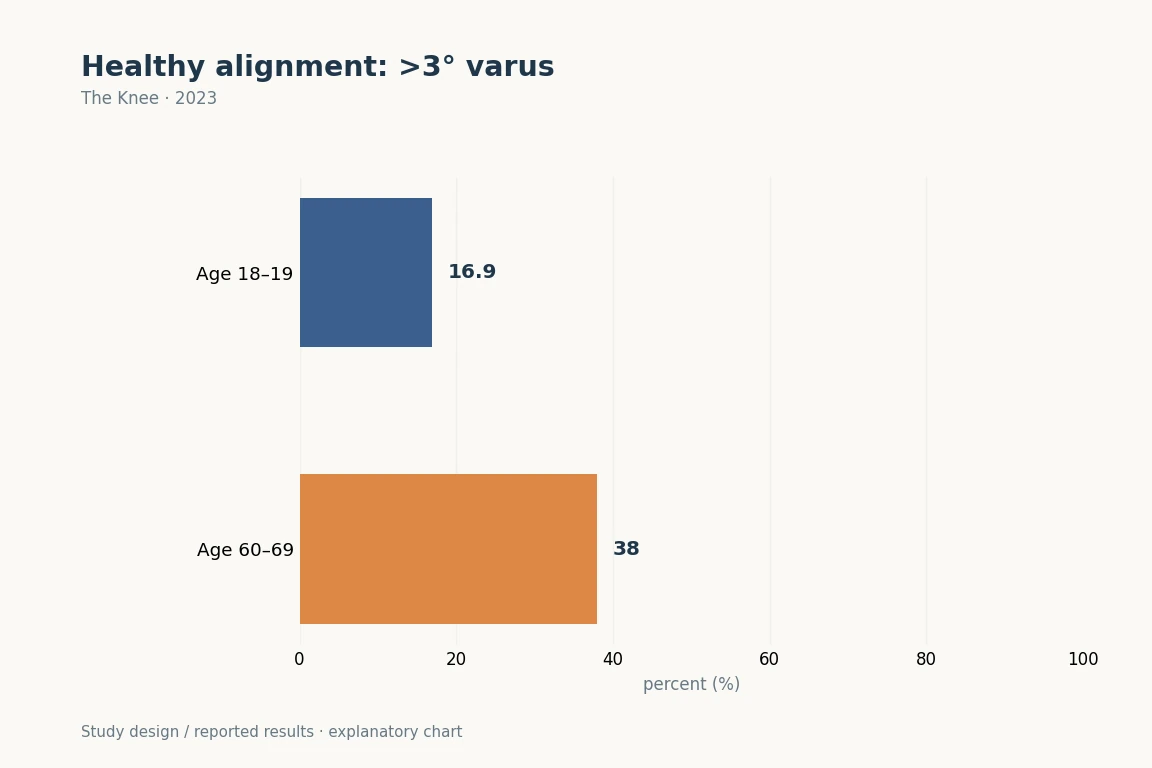
Varus alignment greater than 3° was present in 16.9% of the 18–19-year group and 38.0% of the 60–69-year group.
The Knee (2023). DOI: 10.1016/j.knee.2023.09.009 · Original explanatory chart based on reported data
The research question
Participants and Methods
Main Findings
Implications for clinical and surgical practice
Limitations
Let's put it briefly.
Which clinical question does this address?
These data can inform estimates of pre-arthritic alignment in individual surgical planning. Group means should not be used as a uniform target angle for all patients.
Keywords
- Kinematic alignment
- Lower limb alignment
- Mechanical alignment
- Normal alignment
- Total knee arthroplasty
- Genu Varum
- Osteoarthritis, Knee
- Child
Abstract · Original text
Doohyun Hwang, Min Wook Choi, Seong-Hwan Kim, Hyuk-Soo Han, Chong Bum Chang, Myung Chul Lee, Na-Kyoung Lee, Du Hyun Ro. Age and sex differences in coronal lower extremity alignment in a healthy Asian population. The Knee. 2023;45:198-206. doi:10.1016/j.knee.2023.09.009.
BACKGROUND
The purpose of this study was to analyze the coronal alignment of lower extremities according to age and sex in a healthy population and demonstrate the differences.
METHODS
Standing full-lower limb anteroposterior (AP) radiographs of healthy volunteers (670 males and 782 females) aged 18-69 years were retrospectively analyzed. The hip-knee-ankle angle (HKA), lateral distal femoral angle (LDFA), medial proximal tibial angle (MPTA), joint line convergence angle and femoral bowing angle (FBA) were measured. The radiographic parameters were compared according to groups of age and sex. The proportion of volunteers with varus or valgus alignment more than 3° were also analyzed.
RESULTS
With increasing age, HKA and LDFA varus increased. With increasing age, femoral medial bowing decreased. In addition, the HKA showed more varus alignment in males than in females (178.01° vs. 178.82°, P < 0.001). The MPTA was about 1° smaller in males than in females (P < 0.001). The proportion of patients with varus alignment of more than 3° increased with increasing age, with 16.9% in the 10-19 years old and 38.0% in the 60-69 years old groups.
CONCLUSION
This study demonstrated that males showed more varus tibial alignments than females. Varus limb alignment, LDFA, and FBA also increases with age. In contrast, tibial alignment was constant across all age groups. Therefore, differences in lower extremity alignment according to age and sex should be considered in estimating individual prearthritic alignments.
The original paper.
Age and sex differences in coronal lower extremity alignment in a healthy Asian population
Doohyun Hwang, Min Wook Choi, Seong-Hwan Kim, Hyuk-Soo Han, Chong Bum Chang, Myung Chul Lee, Na-Kyoung Lee, Du Hyun Ro
The Knee · 2023