2023 · The Knee
関節症のない人の下肢アライメントも年齢や性別で異なりますか?
平均HKAは男性178.01°、女性178.82°でした。男性の平均MPTAは女性より約1°小さくなりました。
研究の数値から読む結果
 図を拡大する
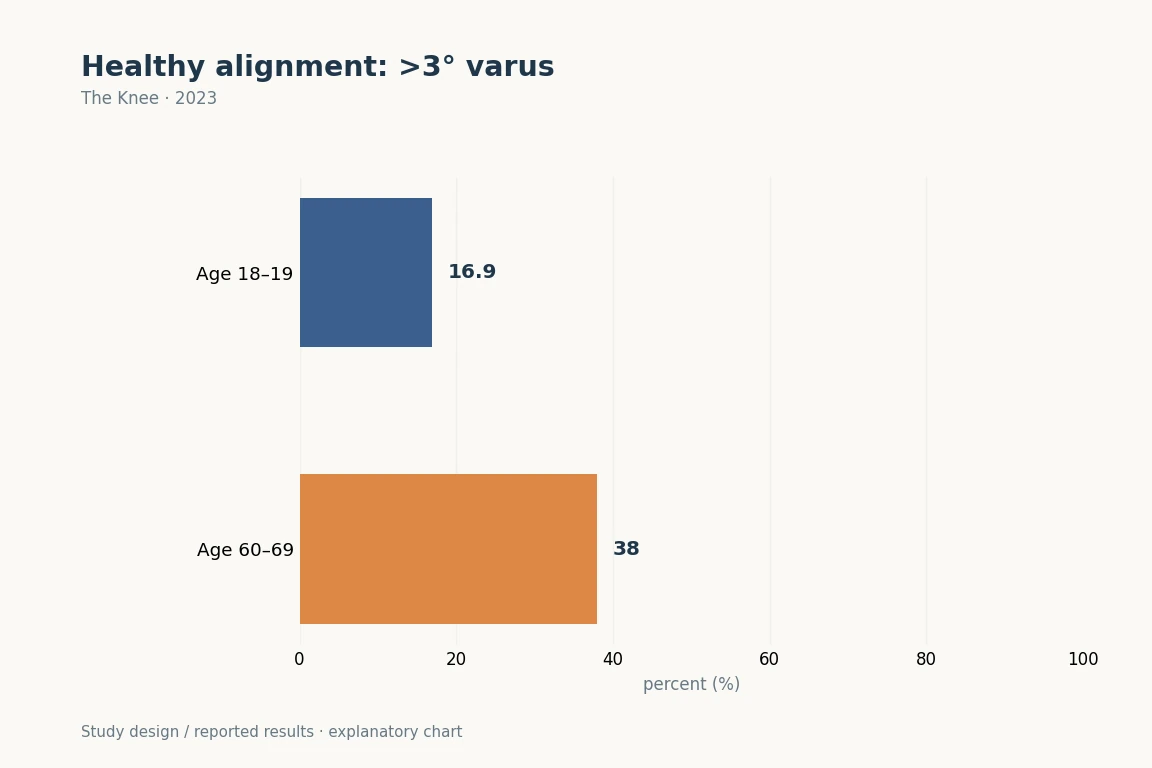
3°を超える内反アライメントの割合は、18–19歳群で16.9%、60–69歳群で38.0%でした。
The Knee (2023). DOI: 10.1016/j.knee.2023.09.009 · Original explanatory chart based on reported data
研究で問うこと
対象と方法
主な結果
診療・手術で考える点
解釈の限界
簡単に説明しましょう
どの診療上の問いにつながりますか?
個別の手術計画で関節症発症前のアライメントを推定する際の参考資料です。集団平均を全患者の目標角度として一律に用いることはしません。
Keywords・キーワード
- Kinematic alignment
- Lower limb alignment
- Mechanical alignment
- Normal alignment
- Total knee arthroplasty
- Genu Varum
- Osteoarthritis, Knee
- Child
Abstract・原文の抄録
Doohyun Hwang, Min Wook Choi, Seong-Hwan Kim, Hyuk-Soo Han, Chong Bum Chang, Myung Chul Lee, Na-Kyoung Lee, Du Hyun Ro. Age and sex differences in coronal lower extremity alignment in a healthy Asian population. The Knee. 2023;45:198-206. doi:10.1016/j.knee.2023.09.009.
BACKGROUND
The purpose of this study was to analyze the coronal alignment of lower extremities according to age and sex in a healthy population and demonstrate the differences.
METHODS
Standing full-lower limb anteroposterior (AP) radiographs of healthy volunteers (670 males and 782 females) aged 18-69 years were retrospectively analyzed. The hip-knee-ankle angle (HKA), lateral distal femoral angle (LDFA), medial proximal tibial angle (MPTA), joint line convergence angle and femoral bowing angle (FBA) were measured. The radiographic parameters were compared according to groups of age and sex. The proportion of volunteers with varus or valgus alignment more than 3° were also analyzed.
RESULTS
With increasing age, HKA and LDFA varus increased. With increasing age, femoral medial bowing decreased. In addition, the HKA showed more varus alignment in males than in females (178.01° vs. 178.82°, P < 0.001). The MPTA was about 1° smaller in males than in females (P < 0.001). The proportion of patients with varus alignment of more than 3° increased with increasing age, with 16.9% in the 10-19 years old and 38.0% in the 60-69 years old groups.
CONCLUSION
This study demonstrated that males showed more varus tibial alignments than females. Varus limb alignment, LDFA, and FBA also increases with age. In contrast, tibial alignment was constant across all age groups. Therefore, differences in lower extremity alignment according to age and sex should be considered in estimating individual prearthritic alignments.
オリジナル紙だ
Age and sex differences in coronal lower extremity alignment in a healthy Asian population
Doohyun Hwang, Min Wook Choi, Seong-Hwan Kim, Hyuk-Soo Han, Chong Bum Chang, Myung Chul Lee, Na-Kyoung Lee, Du Hyun Ro
The Knee · 2023