R.Du Hyun RoOrthopedics & Research
Text
← The Story of Research

AI and video testing. · 2026

Does AI grading of osteoarthritis work well at other hospitals?

The study separately evaluated OA detection and grade-specific classification in 2,546 knees from two Korean university hospitals.

Journal of Arthroplasty · Byung Sun Choi, Seong Hwan Hong, Hae Jung Lee, Seong Hwan Kim

Results explained with study numbers

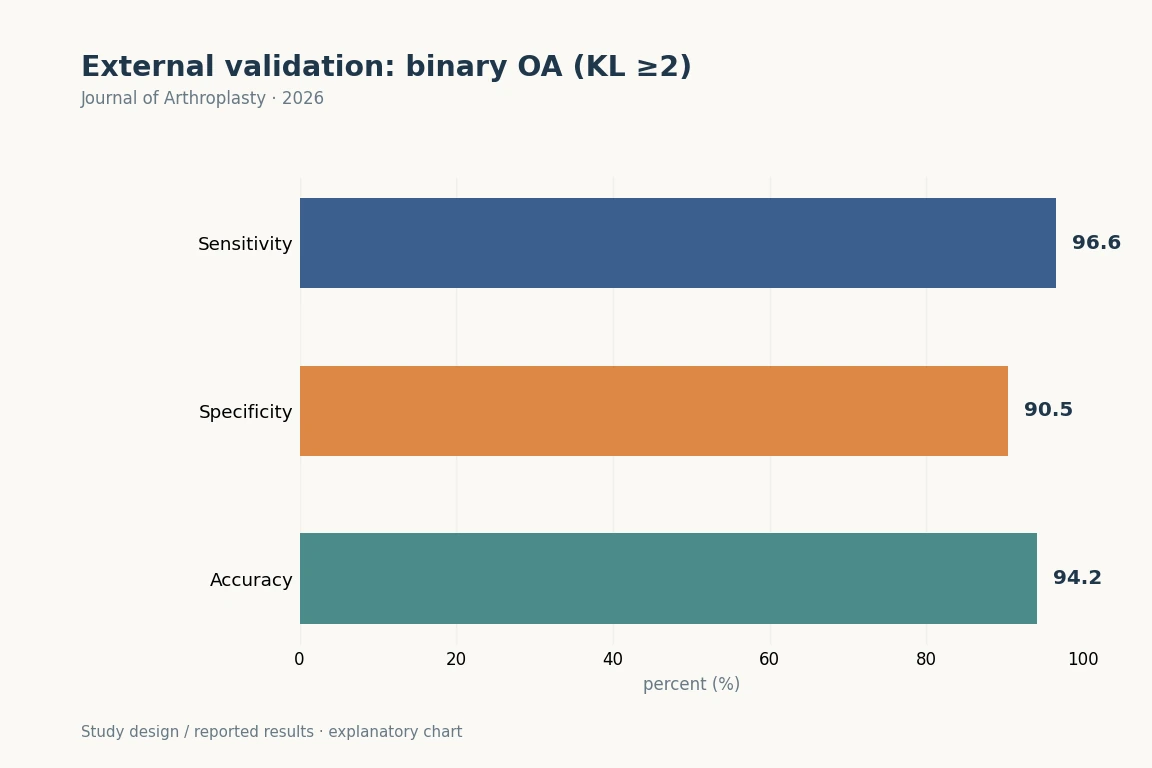
Across 2,546 knees, binary OA detection (KL ≥2) had sensitivity 96.6%, specificity 90.5% and accuracy 94.2%. These differ from grade-specific classification: KL 2 sensitivity was 77.2%.Enlarge Figure

Across 2,546 knees, binary OA detection (KL ≥2) had sensitivity 96.6%, specificity 90.5% and accuracy 94.2%. These differ from grade-specific classification: KL 2 sensitivity was 77.2%.

Journal of Arthroplasty (2026). DOI: 10.1016/j.arth.2026.01.078 · Original explanatory chart based on reported data

Evidence & Original SourceImage use terms
01

The research question

Explaining an OA grade requires consistent image interpretation. Performance on development images and on images from a new hospital are different questions. This study tested the latter at two Korean hospitals.

02

What was tested?

A model trained on US OAI/MOST data was applied to both knees of 1,273 Korean patients. OA detection (KL ≥2) had accuracy 94.2% and AUC 0.94. KL 2 sensitivity was 77.2%, showing a different challenge at the borderline grade.

03

Reading this in a clinical context

Consistent image measurements help explain which findings support an OA grade. Grading an X-ray differs from understanding pain or deciding on surgery; the grade must be related to symptoms and examination.

04

Scope of Interpretation

This retrospective study compared AI results with specialist consensus. It did not test improvements in AI-assisted clinicians' reading or patient outcomes. KL 0 and 1 were evaluated together.

Look at the study numbers again.

2,546Externally validated knees
0.94AUC for OA detection
77.2%KL 2 sensitivity
RESEARCH FINDINGProportion (%)

External validation of OA detection

It's the sensitivity.
96.6%
It's weird.
90.5%
Accuracy.
94.2%
050100
These are different measures of KL ≥2 classification. Accuracy of 94.2% is not accuracy for every OA grade.

Common Questions

How should this result inform an individual's care?

This retrospective study compared AI results with specialist consensus. It did not test improvements in AI-assisted clinicians' reading or patient outcomes. KL 0 and 1 were evaluated together.

Terms in This Article
External verification
Performance is assessed on data from another institution or population not used for model development.
It's the sensitivity.
The proportion of knees with the condition that the model correctly identifies.
KL grade
An OA classification based on osteophytes, joint space and other radiographic findings.
Methods and Numbers in Detail

Performance of an Artificial Intelligence-Based Software for Automated Kellgren-Lawrence Grading of Knee Osteoarthritis: A Multicenter Cohort Study

Participants and Methods

This retrospective multicentre external validation analysed 2,546 knees in 1,273 patients.

A model trained on OAI/MOST was applied to Rosenberg images at two Korean university hospitals. Consensus of two orthopaedic surgeons and one radiologist provided the reference. KL 0 and 1 were merged.

Results Reported in the Paper

  1. Binary OA detection (KL ≥2) had AUC 0.94 (95% CI 0.92–0.96), sensitivity 96.6%, specificity 90.5% and accuracy 94.2%.
  2. For borderline KL 2, AUC was 0.87, sensitivity 77.2% and specificity 95.3%. Grades were not equally easy to distinguish.

Scope of Interpretation

This retrospective study compared AI results with specialist consensus. It did not test improvements in AI-assisted clinicians' reading or patient outcomes. KL 0 and 1 were evaluated together.

Keywords

Abstract · Original text

Byung Sun Choi, Seong Hwan Hong, Hae Jung Lee, Seong Hwan Kim. Performance of an Artificial Intelligence-Based Software for Automated Kellgren-Lawrence Grading of Knee Osteoarthritis: A Multicenter Cohort Study. Journal of Arthroplasty. 2026. doi:10.1016/j.arth.2026.01.078.

Excerpt from the original abstract

The Kellgren-Lawrence (KL) grading system is the standard for assessing knee osteoarthritis (OA) severity. However, it is limited by major observer variability.…