2024 · Medicina
What Are the Outcomes of TKA with Pathology-specific Additional Procedures for End-stage OA and Neglected Patellar Dislocation?
The KSS knee score changed from 36.7 → 88.3, the function score from 35.0 → 85.5, WOMAC from 52.8 → 14.3, and ROM from 112.1° → 125.0°.
Original Figure 1
 Enlarge Figure
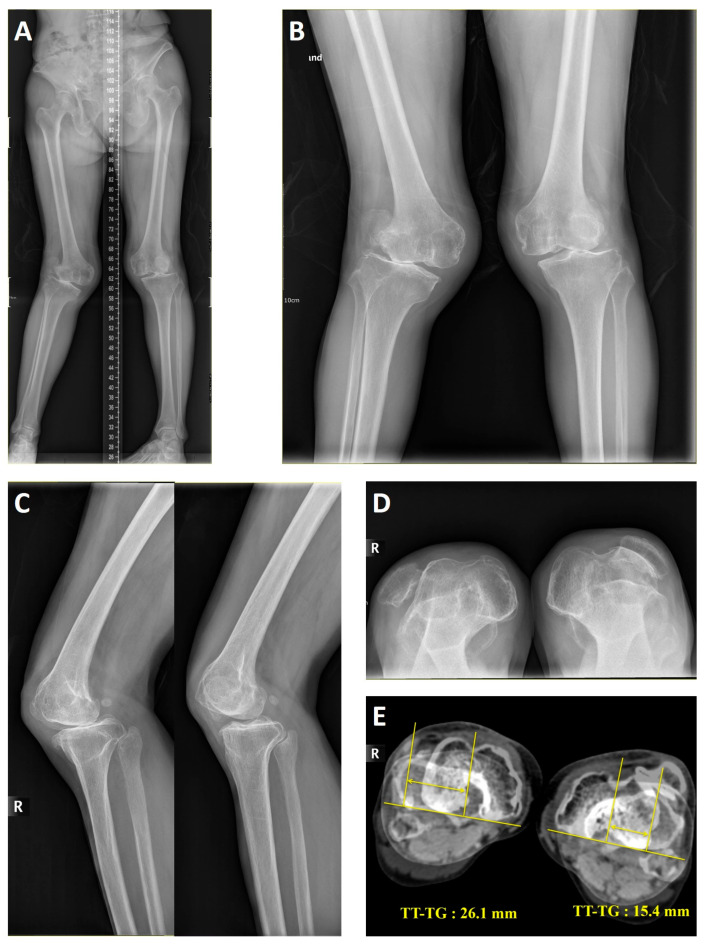
Full-length, lateral, skyline and CT images of neglected patellar dislocation with end-stage OA. Multiple views show deformity and rotational factors.
Sung Eun Kim, Seong Hwan Kim, Jung-In Lee, Hyuk-Soo Han, Myung Chul Lee, Du Hyun Ro. Primary Total Knee Arthroplasty for Treating Osteoarthritic Knees with Neglected Patellar Dislocation. Medicina (2024). DOI: 10.3390/medicina60091492. © 2024 by the authors.
Original Figure Legend
(A–E). Bilateral secondary osteoarthritis with neglected dislocation of the patella in a 68-year-old female patient (Cases No. 1 and No. …
Participants and Methods
The order in which you read the painting.
Main Findings
The point of reading on surgery
Limitations
Let's put it briefly.
What did this study confirm?
The KSS knee score changed from 36.7 → 88.3, the function score from 35.0 → 85.5, WOMAC from 52.8 → 14.3, and ROM from 112.1° → 125.0°.
Can it be applied directly to individual patients' treatment decisions?
This was a small case series without a control group. The effects of individual additional techniques cannot be separated.
Keywords
- neglected patellar dislocation
- osteoarthritis
- outcomes
- total knee arthroplasty
- Arthroplasty, Replacement, Knee
- Osteoarthritis, Knee
- Patellar Dislocation
- Retrospective Studies
Abstract · Original text
Sung Eun Kim, Seong Hwan Kim, Jung-In Lee, Hyuk-Soo Han, Myung Chul Lee, Du Hyun Ro. Primary Total Knee Arthroplasty for Treating Osteoarthritic Knees with Neglected Patellar Dislocation. Medicina (Kaunas, Lithuania). 2024;60(9):1492. doi:10.3390/medicina60091492.
Background and Objectives: Neglected patellar dislocation in the presence of end-stage osteoarthritis (OA) is a rare condition characterized by the patella remaining laterally dislocated without reduction. Due to the scarcity of reported cases, the optimal management approach is still uncertain. However, primary total knee arthroplasty (TKA) can serve as an effective treatment option. This study aimed to present the clinical and radiological outcomes achieved using our surgical technique. Materials and Methods: A retrospective review of 12 knees in 8 patients with neglected patellar dislocation and end-stage OA who underwent primary TKA was conducted. The surgical procedure involved conventional TKA techniques (e.g., medial parapatellar arthrotomy) and additional procedures specific to the individual pathologies of neglected patellar dislocation (e.g., lateral release, medial plication, and quadriceps lengthening). Clinical outcomes, including patient-reported outcome measures (PROMs) (Knee Society Scores and the Western Ontario and McMaster Universities Osteoarthritis Index) and knee range of motion (ROM), were assessed preoperatively and two years postoperatively. Radiological measures including mechanical femorotibial angle and patellar tilt angle were assessed preoperatively and until the last follow-up examinations. Any complications were also reviewed. Results: There were significant improvements in all PROMs, knee ROM, and radiological outcomes, including mechanical femorotibial angle and patellar tilt angle (all p < 0.05). At a mean follow-up of 68 months, no major complications requiring revision surgery, including patellar dislocation, were reported. Conclusions: Primary TKA is an effective procedure for correcting various pathologies associated with neglected patellar dislocation in end-stage OA without necessitating additional bony procedures. Satisfactory clinical and radiological outcomes can be expected using pathology-specific procedures.
© 2024 by the authors.
The original paper.
Primary Total Knee Arthroplasty for Treating Osteoarthritic Knees with Neglected Patellar Dislocation
Sung Eun Kim, Seong Hwan Kim, Jung-In Lee, Hyuk-Soo Han, Myung Chul Lee, Du Hyun Ro
Medicina · 2024