2022 · KSSTA
Does an orthopaedic imaging question require classification, detection or segmentation?
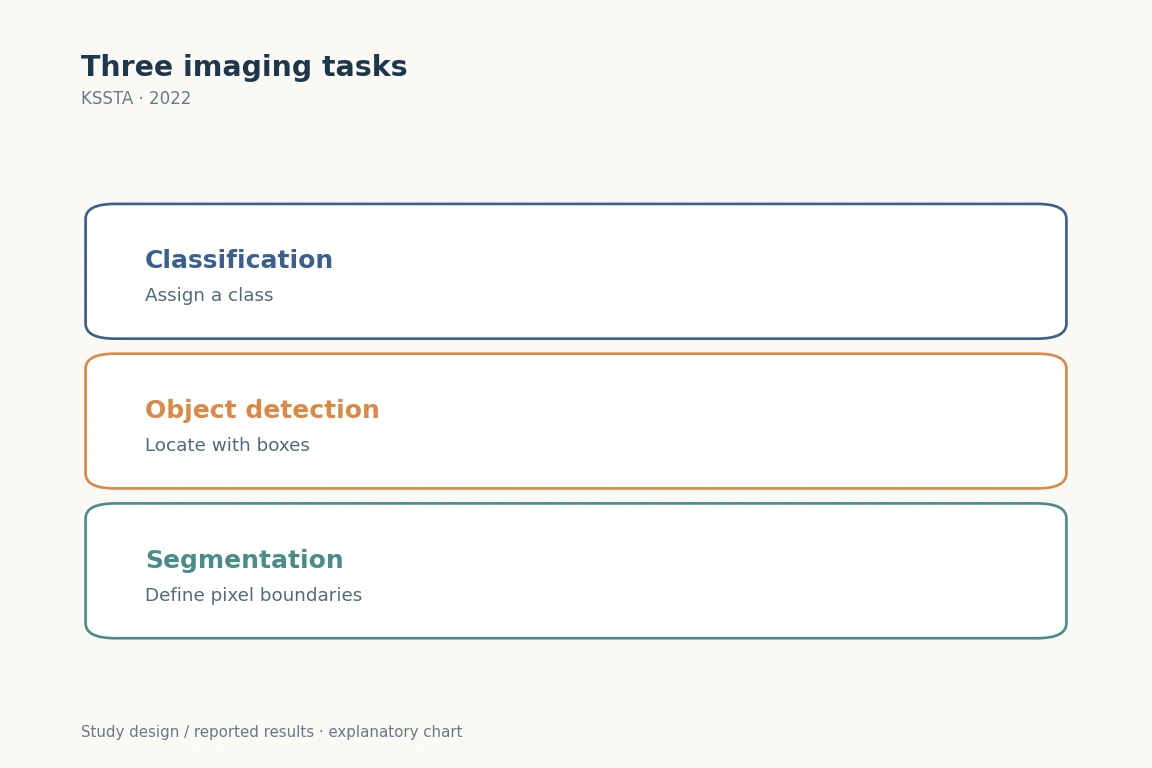
It distinguishes classifying whether a meniscal tear exists, detecting its location with a box and segmenting precise structural boundaries.
Research question and design
 Enlarge Figure
Classification identifies image types, detection locates objects and segmentation outlines boundaries. The required reference labels and evaluation metrics depend on the question, even for the same image.
KSSTA (2022). DOI: 10.1007/s00167-021-06838-8 · Original explanatory chart based on reported data
The research question
Participants and Methods
Main Findings
Implications for clinical and surgical practice
Limitations
Let's put it briefly.
Which clinical question does this address?
Classification can support OA grading, detection surgical-tool localisation, and segmentation joint or muscle measurements. A clear research question is needed to define reference data and performance measures.
Keywords
- Deep Learning
- Orthopedic Procedures
- Orthopedics
- Artificial Intelligence
- Machine Learning
- AI
- classification
- object detection
Abstract · Original text
Sunho Ko, Ayoosh Pareek, Du Hyun Ro, Yining Lu, Christopher L Camp, R Kyle Martin, Aaron J Krych. Artificial intelligence in orthopedics: three strategies for deep learning with orthopedic specific imaging. Knee surgery, sports traumatology, arthroscopy : official journal of the ESSKA. 2022;30(3):758-761. doi:10.1007/s00167-021-06838-8.
No abstract is listed for this article.
The original paper.
Artificial intelligence in orthopedics: three strategies for deep learning with orthopedic specific imaging
Sunho Ko, Ayoosh Pareek, Du Hyun Ro, Yining Lu, Christopher L. Camp, R. Kyle Martin, Aaron J. Krych
KSSTA · 2022