2023 · KSSTA
Which findings predict a poorer course after nonoperative treatment of a meniscal root tear?
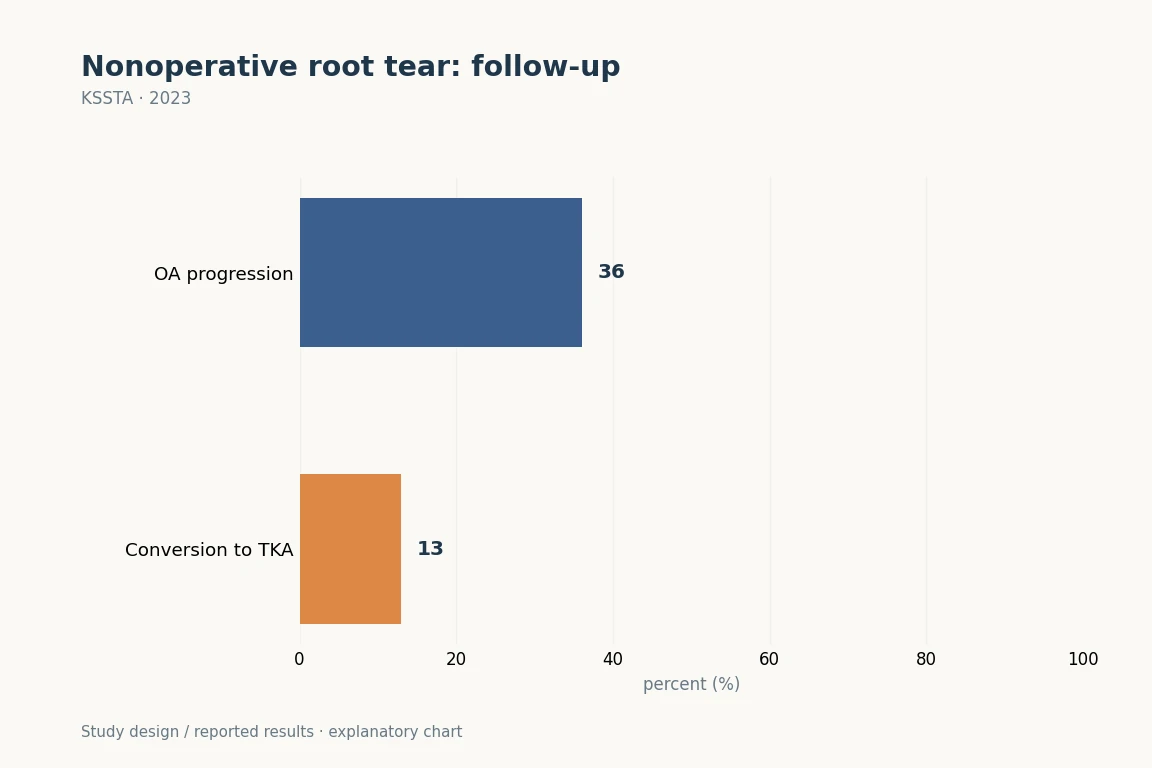
Radiographic OA progressed in 34 patients (36%); 12 (13%) underwent arthroplasty during follow-up.
Results explained with study numbers
 Enlarge Figure
Of 94 nonoperatively treated patients, 34 (36%) had OA progression and 12 (13%) underwent arthroplasty. These outcomes may overlap and should not be added.
KSSTA (2023). DOI: 10.1007/s00167-023-07444-6 · Original explanatory chart based on reported data
The research question
Participants and Methods
Main Findings
Implications for clinical and surgical practice
Limitations
Let's put it briefly.
Which clinical question does this address?
This supports checking for SIFK on MRI when discussing treatment and follow-up for root tears. The study used measurement software; Du Hyun Ro was not a coauthor.
Keywords
- Medial meniscus posterior root tear
- Non-surgical treatment
- Subchondral insufficiency fracture
- meniscus root
- SIFK
- OA
- prognosis
Abstract · Original text
Byung Sun Choi, Jeehyeok Chung, Junpyo Kwak, Hyuk-Soo Han. Subchondral insufficiency fracture is a predictive factor of osteoarthritis progression and conversion to arthroplasty in non-surgically treated medial meniscus root tear. KSSTA. 2023. doi:10.1007/s00167-023-07444-6.
Excerpt from the original abstract
To investigate the radiographic and clinical outcomes of non-surgical treatment for medial meniscus posterior root tear (MMPRT), and prognostic factors for osteoarthritis…The original paper.
Subchondral insufficiency fracture is a predictive factor of osteoarthritis progression and conversion to arthroplasty in non-surgically treated medial meniscus root tear
Byung Sun Choi, Jeehyeok Chung, Junpyo Kwak, Hyuk-Soo Han
KSSTA · 2023