2024 · Clinics in Orthopedic Surgery
What recovery was observed after adding bone marrow aspirate to horizontal or radial meniscal repair?
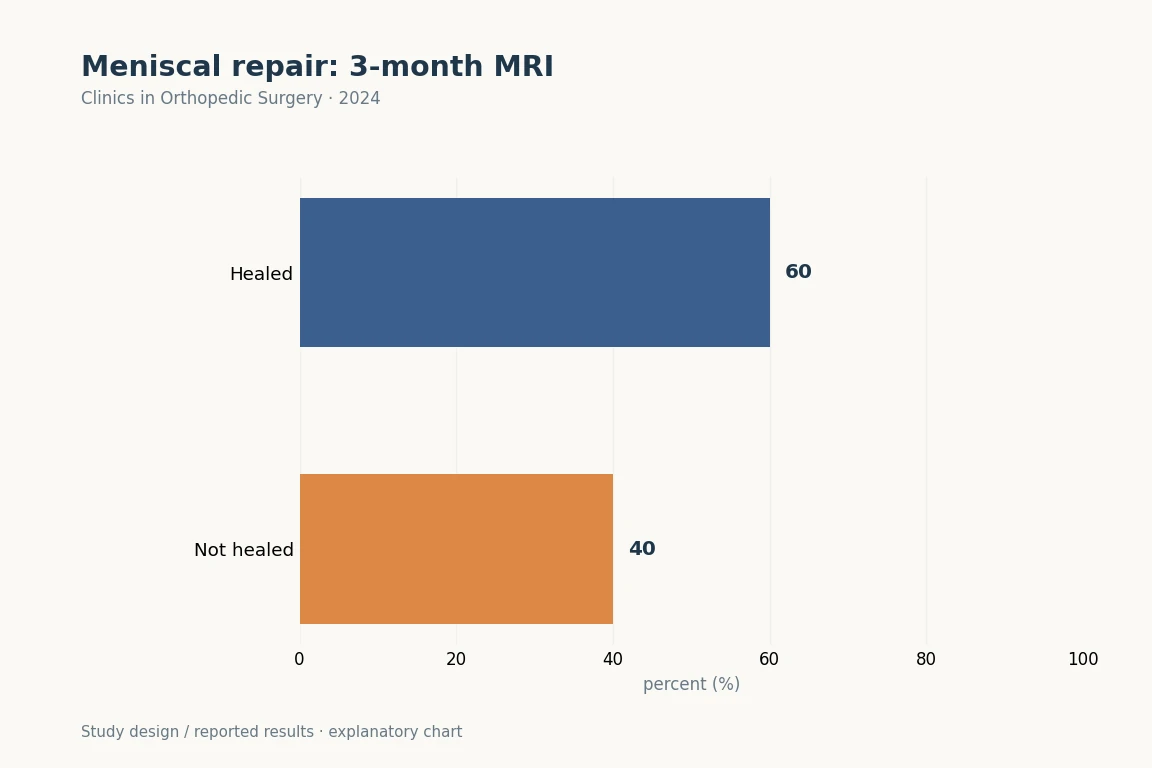
Healing on three-month MRI was 60%. Pain and function scores improved at two years compared with baseline.
Results explained with study numbers
 Enlarge Figure
Healing on three-month MRI was 60% in 30 patients. Without a control group, the added effect of bone marrow aspirate cannot be isolated. MRI findings and clinical-score improvement are separate outcomes.
Clinics in Orthopedic Surgery (2024). DOI: 10.4055/cios23213 · Original explanatory chart based on reported data
The research question
Participants and Methods
Main Findings
Implications for clinical and surgical practice
Limitations
Let's put it briefly.
Which clinical question does this address?
The study distinguishes structural healing after repair from patients' pain and function. Rehabilitation adherence and imaging timing also matter. Du Hyun Ro was not a coauthor.
Keywords
- Bone marrow cell
- Bone marrow aspirate
- Meniscus
- Arthroscopy
- meniscus
- repair
- bone marrow aspirate
Abstract · Original text
Byung Sun Choi, Juneseok Won, Hyuk-Soo Han. Augmentation with Bone Marrow Aspirate Harvested from the Iliac Crest for Horizontal or Radial Meniscal Tears Yields Favorable Healing Rates in Magnetic Resonance Imaging and Clinical Outcomes. Clinics in Orthopedic Surgery. 2024. doi:10.4055/cios23213.
Excerpt from the original abstract
As the importance of meniscus in joint function becomes more apparent, there is a growing interest in meniscus repair techniques.…The original paper.
Augmentation with Bone Marrow Aspirate Harvested from the Iliac Crest for Horizontal or Radial Meniscal Tears Yields Favorable Healing Rates in Magnetic Resonance Imaging and Clinical Outcomes
Byung Sun Choi, Juneseok Won, Hyuk-Soo Han
Clinics in Orthopedic Surgery · 2024