2026 · Journal of Arthroplasty
Can OA grades be classified consistently on knee X-rays from other hospitals?
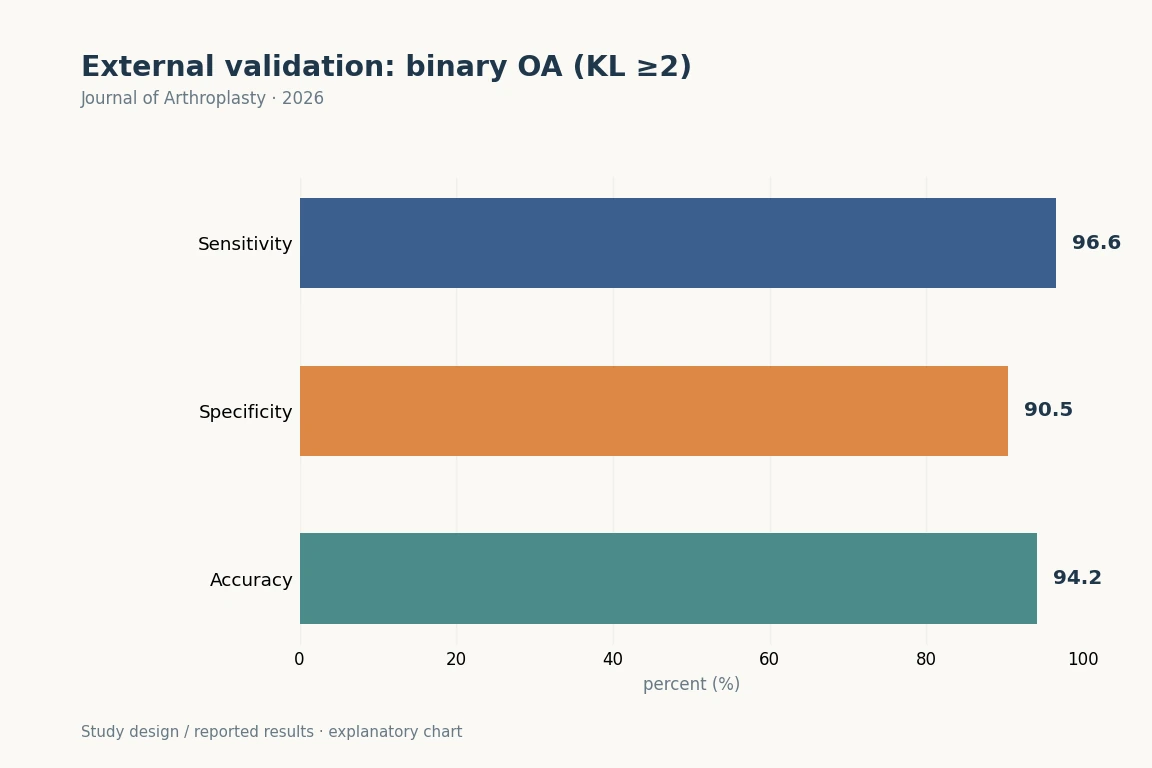
Binary OA detection (KL ≥2) had AUC 0.94 (95% CI 0.92–0.96), sensitivity 96.6%, specificity 90.5% and accuracy 94.2%.
Results explained with study numbers
 Enlarge Figure
Across 2,546 knees, binary OA detection (KL ≥2) had sensitivity 96.6%, specificity 90.5% and accuracy 94.2%. These differ from grade-specific classification: KL 2 sensitivity was 77.2%.
Journal of Arthroplasty (2026). DOI: 10.1016/j.arth.2026.01.078 · Original explanatory chart based on reported data
The research question
Participants and Methods
Main Findings
Implications for clinical and surgical practice
Limitations
Let's put it briefly.
Which clinical question does this address?
This provides clinical validation evidence for CONNEVO KOA. Consistent assessment of borderline radiographic grades supports clinicians who also consider pain, function and examination findings.
Keywords
- Knee osteoarthritis
- Kellgren-Lawrence
- Artificial intelligence
- Software
- Diagnosis
- AI
- KOA
- KL
Abstract · Original text
Byung Sun Choi, Seong Hwan Hong, Hae Jung Lee, Seong Hwan Kim. Performance of an Artificial Intelligence-Based Software for Automated Kellgren-Lawrence Grading of Knee Osteoarthritis: A Multicenter Cohort Study. Journal of Arthroplasty. 2026. doi:10.1016/j.arth.2026.01.078.
Excerpt from the original abstract
The Kellgren-Lawrence (KL) grading system is the standard for assessing knee osteoarthritis (OA) severity. However, it is limited by major observer variability.…The original paper.
Performance of an Artificial Intelligence-Based Software for Automated Kellgren-Lawrence Grading of Knee Osteoarthritis: A Multicenter Cohort Study
Byung Sun Choi, Seong Hwan Hong, Hae Jung Lee, Seong Hwan Kim
Journal of Arthroplasty · 2026