2026 · Pacific Symposium on Biocomputing
How Do We Evaluate AI That Locates and Explains Findings on MRI?
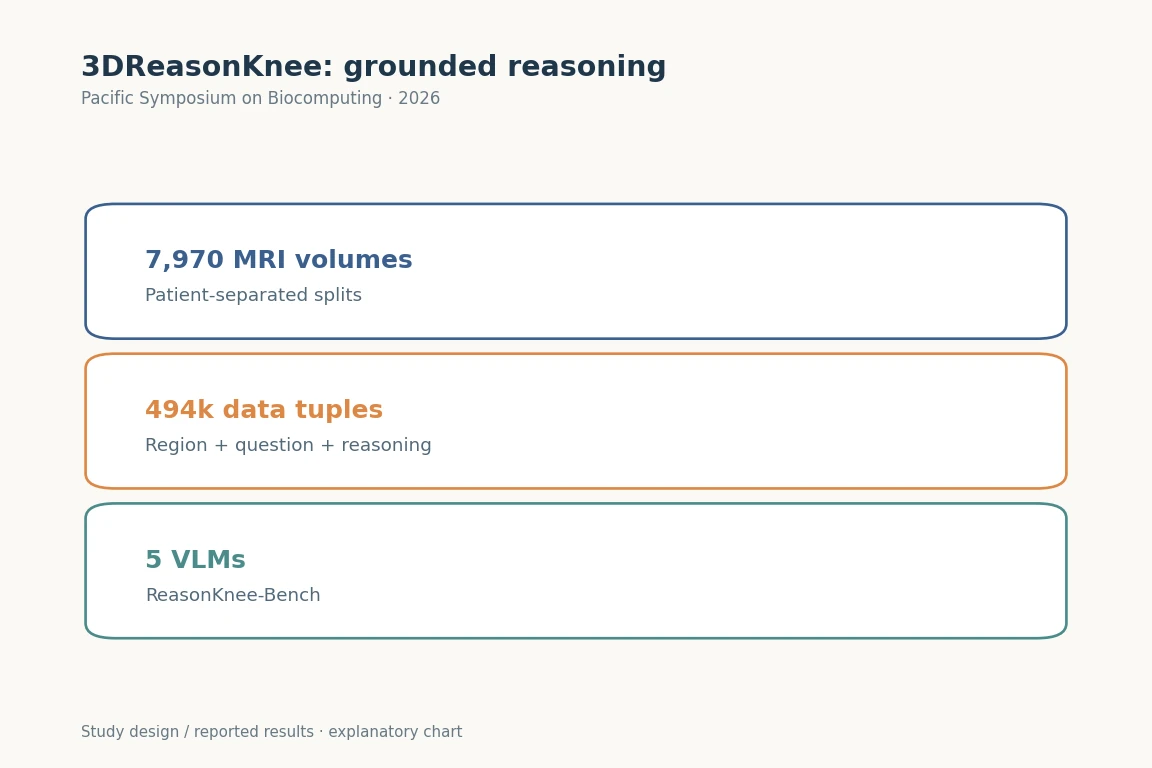
The 7,970 MRI volumes were split into 5,977 training, 797 validation and 1,196 test volumes without patient overlap.
Research question and design
 Enlarge Figure
The dataset links MRI volumes, diagnostic questions, 3D locations, clinical reasoning and severity. Spatial localisation and diagnostic reasoning are evaluated separately.
Pacific Symposium on Biocomputing (2026). DOI: 10.1142/9789819824755_0008 · Original explanatory chart based on reported data
Research structure
- 01MRI footage.
3-dimensional volume
- 02Diagnostic questions
Sector of interest and disease
- 033D location
Bounding box
- 04Doctor's explanation
The stage of judgment.
- 05It's a pain in the ass.
Structured evaluation
MRI images, diagnostic questions, 3D locations, stages of the physician’s explanation, and severity assessments were combined into one dataset. Localization and diagnostic performance were evaluated separately.
Explanatory schematic
The research question
Participants and Methods
Main Findings
Implications for clinical and surgical practice
Limitations
Let's put it briefly.
Which clinical question does this address?
The study provides research data for AI that interprets MRI. It does not establish the effectiveness of autonomous intraoperative decision-making.
Keywords
- Imaging, Three-Dimensional
- Magnetic Resonance Imaging
- Computational Biology
- Knee
- Artificial Intelligence
- AI
- MRI
- vision-language models
Abstract · Original text
Sraavya Sambara, Sung Eun Kim, Xiaoman Zhang, Luyang Luo, Shreya Johri, Mohammed Baharoon, Du Hyun Ro, Pranav Rajpurkar. 3DReasonKnee: Advancing Grounded Reasoning in Medical Vision Language Models. Pacific Symposium on Biocomputing. Pacific Symposium on Biocomputing. 2026;31:99-113. doi:10.1142/9789819824755_0008.
Excerpt from the original abstract
Current Vision-Language Models (VLMs) struggle to ground anatomical regions in 3D medical images and reason about them in a step-by-step manner-a key requirement of realworld…The original paper.
3DReasonKnee: Advancing Grounded Reasoning in Medical Vision Language Models
Sraavya Sambara, Sung Eun Kim, Xiaoman Zhang, Luyang Luo, Shreya Johri, Mohammed Baharoon, Du Hyun Ro, Pranav Rajpurkar
Pacific Symposium on Biocomputing · 2026