2026 · Knee Surgery & Related Research
같은 무릎도 촬영 각도가 바뀌면 측정값이 달라질까?
AI와 전문가 간 ICC는 0.78(95% CI 0.73–0.82)이었습니다. 내회전 1°당 PTS는 약 0.2° 증가했습니다(R² = 0.43).
원문 Figure 3
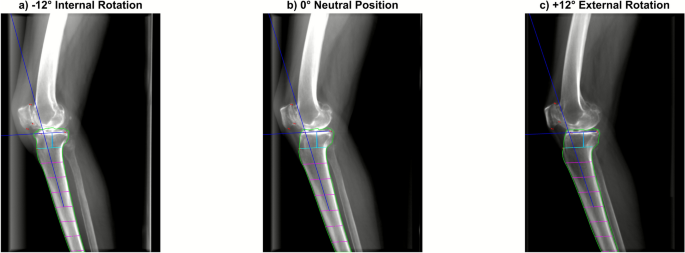 그림 크게 보기
같은 CT에서 회전 각도를 달리해 생성한 DRR과 자동 PTS 측정 결과입니다.
Jaeseok Park, Andreas Persson, R Kyle Martin, Eivind Inderhaug, Sung Eun Kim, Sangyoon Kim, Donghyuk Kwak, Du Hyun Ro. Effects of axial malrotation on posterior tibial slope measurement: a digitally reconstructed radiograph study enabling automated quality assessment. Knee Surgery & Related Research (2026). https://doi.org/10.1186/s43019-026-00303-x
대상과 방법
주요 결과
진료·수술에서 읽을 지점
해석의 제한
짧게 정리하면
이 연구가 확인한 것은 무엇인가요?
AI와 전문가 간 ICC는 0.78(95% CI 0.73–0.82)이었습니다. 내회전 1°당 PTS는 약 0.2° 증가했습니다(R² = 0.43).
개별 환자의 치료 결정에 바로 적용할 수 있나요?
실제 반복 촬영이 아닌 DRR 기반 개념 검증입니다. Coronal tilt를 고정했으며 일부 측정 outlier가 있습니다. 젊은 ACL 환자로의 일반화에는 제한이 있습니다.
Keywords · 주제어
- Artificial intelligence
- Axial malrotation
- Digitally reconstructed radiograph
- Lateral knee radiograph
- Posterior tibial slope
- posterior tibial slope
- HTO
- ACL
Abstract · 원문 초록
Jaeseok Park, Andreas Persson, R Kyle Martin, Eivind Inderhaug, Sung Eun Kim, Sangyoon Kim, Donghyuk Kwak, Du Hyun Ro. Effects of axial malrotation on posterior tibial slope measurement: a digitally reconstructed radiograph study enabling automated quality assessment. Knee surgery & related research. 2026;38(1):3. doi:10.1186/s43019-026-00303-x.
BACKGROUND
Accurate measurement of posterior tibial slope (PTS) is highly sensitive to axial malrotation of the knee during acquisition, but its impact has not been systematically quantified across different anatomical variations. This simulation study aimed to quantify the effect of axial malrotation on PTS using digitally reconstructed radiographs (DRRs) and suggest a practical marker for filtering out low-quality images with excessive malrotation.
MATERIALS AND METHODS
A total of 55 preoperative computed tomography (CT) scans from January 2021 to December 2024 in a single, tertiary hospital were retrospectively reviewed. DRRs were generated from those scans to simulate lateral knee radiographs with malrotation ranging from -12° to +12° relative to an anatomically aligned baseline. An artificial-intelligence (AI)-based tool automatically measured PTS on each DRR, with agreement evaluated using intraclass correlation coefficient (ICC). PCDR was calculated from femoral contours and analyzed for correlation with malrotation angles and resulting PTS measurement error.
RESULTS
AI-based PTS measurements on DRRs showed good agreement with expert annotations (ICC = 0.78, 95% CI 0.73-0.82). PTS increased linearly with internal rotation, with each 1° of rotation resulting in approximately 0.2° change in PTS (R2 = 0.43, p < 0.01). Errors exceeded 1° when malrotation surpassed ±6°. PCDR was strongly correlated with malrotation angle (R2 > 0.98, p < 0.001) and achieved fair discriminative performance as a binary classifier for > 1° PTS error [area under the receiver operating curve (AUROC) = 0.77].
CONCLUSIONS
CT-derived DRRs combined with AI analysis showed that PTS measurement error proportionately increased with axial malrotation. Identifying and excluding radiographs with excessive rotation improves the reliability of slope-based assessments and supports more accurate surgical planning.
LEVEL OF EVIDENCE
III, retrospective cohort study.
© The Author(s) 2026
원래 논문
Effects of axial malrotation on posterior tibial slope measurement: a digitally reconstructed radiograph study enabling automated quality assessment
Jaeseok Park, Andreas Persson, R Kyle Martin, Eivind Inderhaug, Sung Eun Kim, Sangyoon Kim, Donghyuk Kwak, Du Hyun Ro
Knee Surgery & Related Research · 2026