2026 · Knee Surgery & Related Research
同じ膝でも撮影角度が変わると測定値は変わるか?
AIと専門家の計測間のICCは0.78(95% CI 0.73–0.82)でした。内旋1°につきPTSは約0.2°増加しました(R² = 0.43)。
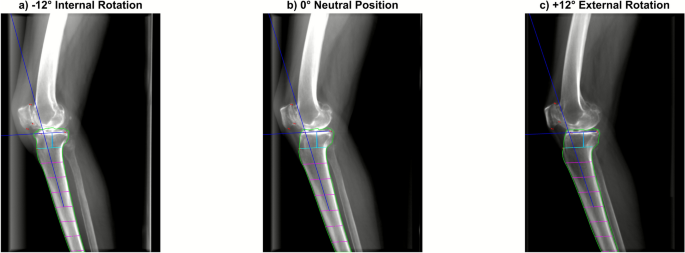
原図Figure 3
 図を拡大する
同一CTから回旋角度を変えて作成したDRRと、自動PTS計測の結果です。
Jaeseok Park, Andreas Persson, R Kyle Martin, Eivind Inderhaug, Sung Eun Kim, Sangyoon Kim, Donghyuk Kwak, Du Hyun Ro. Effects of axial malrotation on posterior tibial slope measurement: a digitally reconstructed radiograph study enabling automated quality assessment. Knee Surgery & Related Research (2026). https://doi.org/10.1186/s43019-026-00303-x
対象と方法
主な結果
手術に関する読書のポイント
解釈の限界
簡単に説明しましょう
この研究で何が確認されましたか?
AIと専門家の計測間のICCは0.78(95% CI 0.73–0.82)でした。内旋1°につきPTSは約0.2°増加しました(R² = 0.43)。
治療決定に直接適用できるか?
実際の反復撮影ではなく、DRRに基づく概念実証です。冠状面の傾きを固定しており、一部に計測の外れ値があります。若いACL患者への一般化には限界があります。
Keywords・キーワード
- Artificial intelligence
- Axial malrotation
- Digitally reconstructed radiograph
- Lateral knee radiograph
- Posterior tibial slope
- posterior tibial slope
- HTO
- ACL
Abstract・原文の抄録
Jaeseok Park, Andreas Persson, R Kyle Martin, Eivind Inderhaug, Sung Eun Kim, Sangyoon Kim, Donghyuk Kwak, Du Hyun Ro. Effects of axial malrotation on posterior tibial slope measurement: a digitally reconstructed radiograph study enabling automated quality assessment. Knee surgery & related research. 2026;38(1):3. doi:10.1186/s43019-026-00303-x.
BACKGROUND
Accurate measurement of posterior tibial slope (PTS) is highly sensitive to axial malrotation of the knee during acquisition, but its impact has not been systematically quantified across different anatomical variations. This simulation study aimed to quantify the effect of axial malrotation on PTS using digitally reconstructed radiographs (DRRs) and suggest a practical marker for filtering out low-quality images with excessive malrotation.
MATERIALS AND METHODS
A total of 55 preoperative computed tomography (CT) scans from January 2021 to December 2024 in a single, tertiary hospital were retrospectively reviewed. DRRs were generated from those scans to simulate lateral knee radiographs with malrotation ranging from -12° to +12° relative to an anatomically aligned baseline. An artificial-intelligence (AI)-based tool automatically measured PTS on each DRR, with agreement evaluated using intraclass correlation coefficient (ICC). PCDR was calculated from femoral contours and analyzed for correlation with malrotation angles and resulting PTS measurement error.
RESULTS
AI-based PTS measurements on DRRs showed good agreement with expert annotations (ICC = 0.78, 95% CI 0.73-0.82). PTS increased linearly with internal rotation, with each 1° of rotation resulting in approximately 0.2° change in PTS (R2 = 0.43, p < 0.01). Errors exceeded 1° when malrotation surpassed ±6°. PCDR was strongly correlated with malrotation angle (R2 > 0.98, p < 0.001) and achieved fair discriminative performance as a binary classifier for > 1° PTS error [area under the receiver operating curve (AUROC) = 0.77].
CONCLUSIONS
CT-derived DRRs combined with AI analysis showed that PTS measurement error proportionately increased with axial malrotation. Identifying and excluding radiographs with excessive rotation improves the reliability of slope-based assessments and supports more accurate surgical planning.
LEVEL OF EVIDENCE
III, retrospective cohort study.
© The Author(s) 2026
オリジナル紙だ
Effects of axial malrotation on posterior tibial slope measurement: a digitally reconstructed radiograph study enabling automated quality assessment
Jaeseok Park, Andreas Persson, R Kyle Martin, Eivind Inderhaug, Sung Eun Kim, Sangyoon Kim, Donghyuk Kwak, Du Hyun Ro
Knee Surgery & Related Research · 2026