2025 · Knee Surgery & Related Research
PFPS의 근활성 변화는 보행 중 무릎의 sagittal moment와 어떤 관계를 가질까?
PFPS군은 체중 수용기의 무릎 신전 모멘트가 낮았으며 굴곡각의 유의한 차이는 없었습니다. ST 활성은 모든 보행 구간에서 높았습니다.
원문 Fig. 1
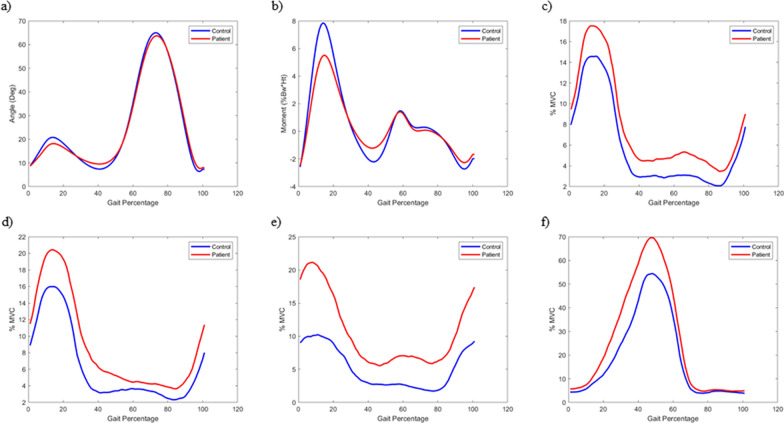 그림 크게 보기
파란 선은 대조군, 빨간 선은 PFPS 환자의 보행 주기 평균입니다. 각도·무릎 신전 모멘트와 네 근육 EMG를 같은 시간축에서 봅니다.
Byung Sun Choi, Soon Bin Kwon, Sehyeon Jeon, Myeongjun Kim, Yunseo Ku, Du Hyun Ro, Hyuk-Soo Han. Relationship between muscle activation and sagittal knee joint biomechanics in patients with patellofemoral pain syndrome: a cross-sectional study. Knee Surgery & Related Research (2025). DOI: 10.1186/s43019-025-00259-4. © The Author(s) 2025
원문 캡션
Kinetic, kinematic, and EMG data. All curves represent the mean values of biomechanical features at the point of the gait …
대상과 방법
그림을 읽는 순서
주요 결과
진료·수술에서 읽을 지점
해석의 제한
짧게 정리하면
이 연구가 확인한 것은 무엇인가요?
PFPS군은 체중 수용기의 무릎 신전 모멘트가 낮았으며 굴곡각의 유의한 차이는 없었습니다. ST 활성은 모든 보행 구간에서 높았습니다.
개별 환자의 치료 결정에 바로 적용할 수 있나요?
단면 비교입니다. 보상 기전은 결과에 대한 해석이며 인과적 증명은 아닙니다. 재활이나 수술 중재를 비교하지 않았습니다.
Keywords · 주제어
- Electromyography
- Gait analysis
- Patellofemoral pain syndrome
- PFJ
- patellofemoral pain
- gait
- EMG
Abstract · 원문 초록
Byung Sun Choi, Soon Bin Kwon, Sehyeon Jeon, Myeongjun Kim, Yunseo Ku, Du Hyun Ro, Hyuk-Soo Han. Relationship between muscle activation and sagittal knee joint biomechanics in patients with patellofemoral pain syndrome: a cross-sectional study. Knee surgery & related research. 2025;37(1):7. doi:10.1186/s43019-025-00259-4.
BACKGROUND
Patellofemoral pain syndrome (PFPS) is one of the most common conditions affecting the knee joint, yet its pathomechanics remain unclear. The aim of this study was to investigate changes in muscle activation and gait patterns and to analyze the relationship between muscle activation and kinetic gait patterns in patients with PFPS.
METHODS
This study included 31 patients with PFPS and 28 healthy volunteers without any symptoms. The sagittal plane motion of the knee joint, representing primary movement of the knee joint, was evaluated to identify changes in gait patterns. Electromyography (EMG) was used to measure muscle activation of vastus medialis (VM), vastus lateralis (VL), semitendinosus (ST), and gastrocnemius (GCM) muscles during gait analysis. Biomechanical features were analyzed during the three phases of the gait cycle; weight acceptance (WA), single limb support (SLS), and swing limb advancement (SLA) (0 ~ 12%, 13 ~ 50%, and 51 ~ 100% of the gait cycle, respectively).
RESULTS
The average knee extension moment (KEM) during WA was lower in the patient group and no significant differences were observed in the knee flexion angle (KFA). With respect to muscle activation, the patient group showed significantly higher muscle activation of the ST muscle in all phases. As the absolute value of the moment increased, the activation of the VM, VL, and ST muscles increased more rapidly in the patient group, especially when KEM was under -1% body weight × height (Bw × Ht) or over 5% Bw × Ht.
CONCLUSIONS
Patients with PFPS exhibit elevated muscle activation, particularly in response to changes in the knee extension moment, which is likely a compensatory mechanism to manage knee joint loading during gait. These results highlight altered neuromuscular adaptations in PFPS, suggesting targeted therapies may help improve functional outcomes. Level of evidence III, cross-sectional study.
© The Author(s) 2025
원래 논문
Relationship between muscle activation and sagittal knee joint biomechanics in patients with patellofemoral pain syndrome: a cross-sectional study
Byung Sun Choi, Soon Bin Kwon, Sehyeon Jeon, Myeongjun Kim, Yunseo Ku, Du Hyun Ro, Hyuk-Soo Han
Knee Surgery & Related Research · 2025