2025 · Knee Surgery & Related Research
PFPSの筋活動の変化は、歩行中の膝の矢状面モーメントとどう関連するか?
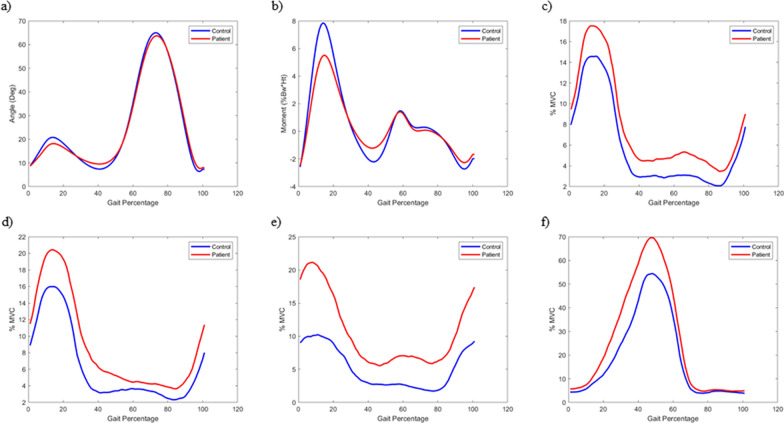
PFPS群は荷重応答期の膝伸展モーメントが低く、屈曲角に有意差はありませんでした。ST活動は全歩行相で高値でした。
図1はオリジナルです
 図を拡大する
青線は対照群、赤線はPFPS患者群の歩行周期の平均です。角度、膝伸展モーメント、4筋のEMGを同じ時間軸で確認します。
Byung Sun Choi, Soon Bin Kwon, Sehyeon Jeon, Myeongjun Kim, Yunseo Ku, Du Hyun Ro, Hyuk-Soo Han. Relationship between muscle activation and sagittal knee joint biomechanics in patients with patellofemoral pain syndrome: a cross-sectional study. Knee Surgery & Related Research (2025). DOI: 10.1186/s43019-025-00259-4. © The Author(s) 2025
原著の図の説明
Kinetic, kinematic, and EMG data. All curves represent the mean values of biomechanical features at the point of the gait …
対象と方法
絵を読んだ順序です
主な結果
手術に関する読書のポイント
解釈の限界
簡単に説明しましょう
この研究で何が確認されましたか?
PFPS群は荷重応答期の膝伸展モーメントが低く、屈曲角に有意差はありませんでした。ST活動は全歩行相で高値でした。
治療決定に直接適用できるか?
横断比較です。代償機序は結果の解釈で、因果関係の証明ではありません。リハビリや手術介入を比較していません。
Keywords・キーワード
- Electromyography
- Gait analysis
- Patellofemoral pain syndrome
- PFJ
- patellofemoral pain
- gait
- EMG
Abstract・原文の抄録
Byung Sun Choi, Soon Bin Kwon, Sehyeon Jeon, Myeongjun Kim, Yunseo Ku, Du Hyun Ro, Hyuk-Soo Han. Relationship between muscle activation and sagittal knee joint biomechanics in patients with patellofemoral pain syndrome: a cross-sectional study. Knee surgery & related research. 2025;37(1):7. doi:10.1186/s43019-025-00259-4.
BACKGROUND
Patellofemoral pain syndrome (PFPS) is one of the most common conditions affecting the knee joint, yet its pathomechanics remain unclear. The aim of this study was to investigate changes in muscle activation and gait patterns and to analyze the relationship between muscle activation and kinetic gait patterns in patients with PFPS.
METHODS
This study included 31 patients with PFPS and 28 healthy volunteers without any symptoms. The sagittal plane motion of the knee joint, representing primary movement of the knee joint, was evaluated to identify changes in gait patterns. Electromyography (EMG) was used to measure muscle activation of vastus medialis (VM), vastus lateralis (VL), semitendinosus (ST), and gastrocnemius (GCM) muscles during gait analysis. Biomechanical features were analyzed during the three phases of the gait cycle; weight acceptance (WA), single limb support (SLS), and swing limb advancement (SLA) (0 ~ 12%, 13 ~ 50%, and 51 ~ 100% of the gait cycle, respectively).
RESULTS
The average knee extension moment (KEM) during WA was lower in the patient group and no significant differences were observed in the knee flexion angle (KFA). With respect to muscle activation, the patient group showed significantly higher muscle activation of the ST muscle in all phases. As the absolute value of the moment increased, the activation of the VM, VL, and ST muscles increased more rapidly in the patient group, especially when KEM was under -1% body weight × height (Bw × Ht) or over 5% Bw × Ht.
CONCLUSIONS
Patients with PFPS exhibit elevated muscle activation, particularly in response to changes in the knee extension moment, which is likely a compensatory mechanism to manage knee joint loading during gait. These results highlight altered neuromuscular adaptations in PFPS, suggesting targeted therapies may help improve functional outcomes. Level of evidence III, cross-sectional study.
© The Author(s) 2025
オリジナル紙だ
Relationship between muscle activation and sagittal knee joint biomechanics in patients with patellofemoral pain syndrome: a cross-sectional study
Byung Sun Choi, Soon Bin Kwon, Sehyeon Jeon, Myeongjun Kim, Yunseo Ku, Du Hyun Ro, Hyuk-Soo Han
Knee Surgery & Related Research · 2025