2026 · Knee Surgery & Related Research
정형외과 AI의 임상 적용을 가로막는 요인과 필요한 검증은 무엇일까?
수혈·재입원 위험 예측, 골절·관절염 영상 평가, 진료 문서와 환자 설명을 위한 LLM을 비교한 종설입니다. 모델의 정확도에서 실제 진료의 이득으로 넘어가려면 어떤 검증과 운영 체계가 필요한지 살펴봅니다.
원문 Fig. 3
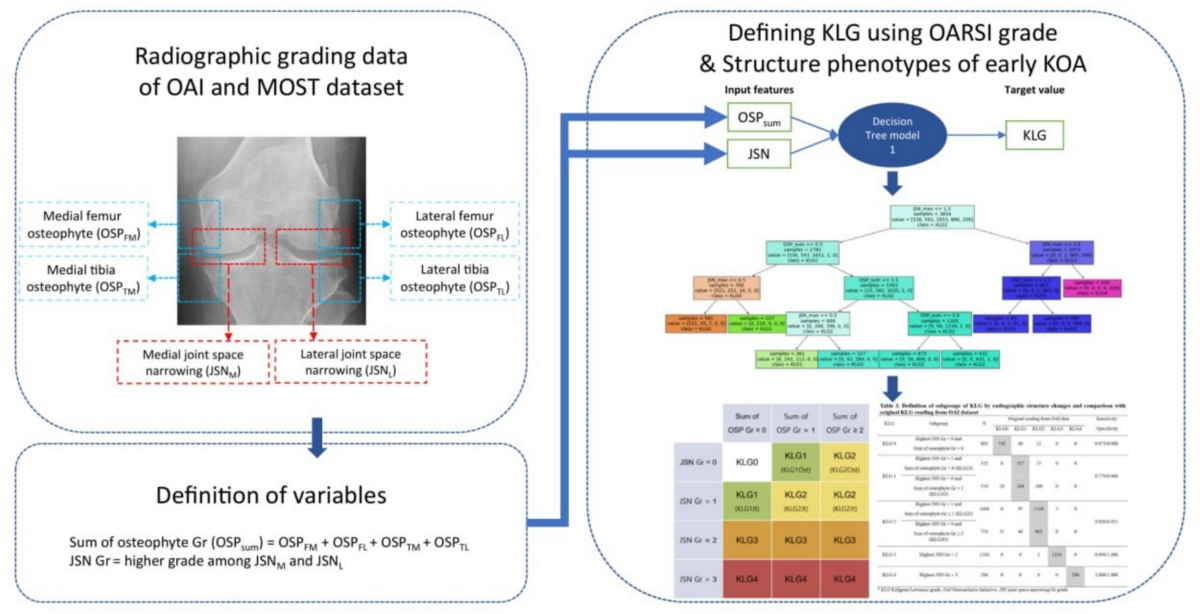 그림 크게 보기
골극과 관절간격 협소화의 구조적 특징을 KL 등급과 연결한 도식입니다.
Sang Yoon Kim, Byung Sun Choi, Hyuk-Soo Han, Du Hyun Ro. Artificial intelligence in orthopedics: current applications, challenges, and future directions. Knee Surgery & Related Research (2026). DOI: 10.1186/s43019-026-00317-5 · Figure 3. Figure created by the article authors based on Ko et al.
원문 Fig. 1
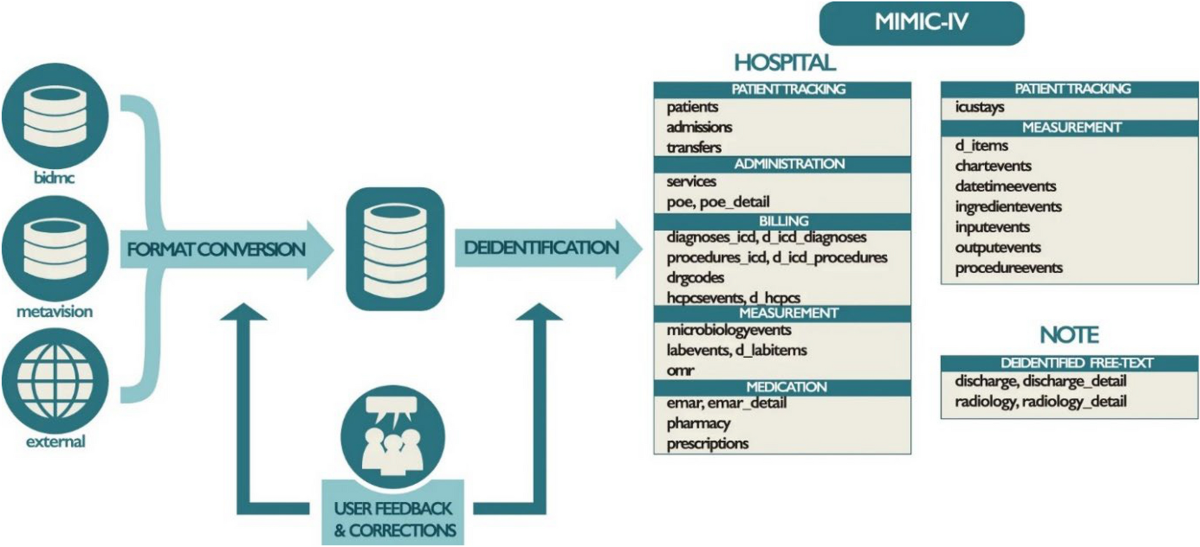 그림 크게 보기
MIMIC-IV의 병원·중환자실·진료 문서 자료를 연결하는 구조입니다.
Sang Yoon Kim, Byung Sun Choi, Hyuk-Soo Han, Du Hyun Ro. Artificial intelligence in orthopedics: current applications, challenges, and future directions. Knee Surgery & Related Research (2026). DOI: 10.1186/s43019-026-00317-5 · Figure 1. Adapted from Johnson et al. under CC BY 4.0; changes were made by the article authors.
원문 Fig. 5
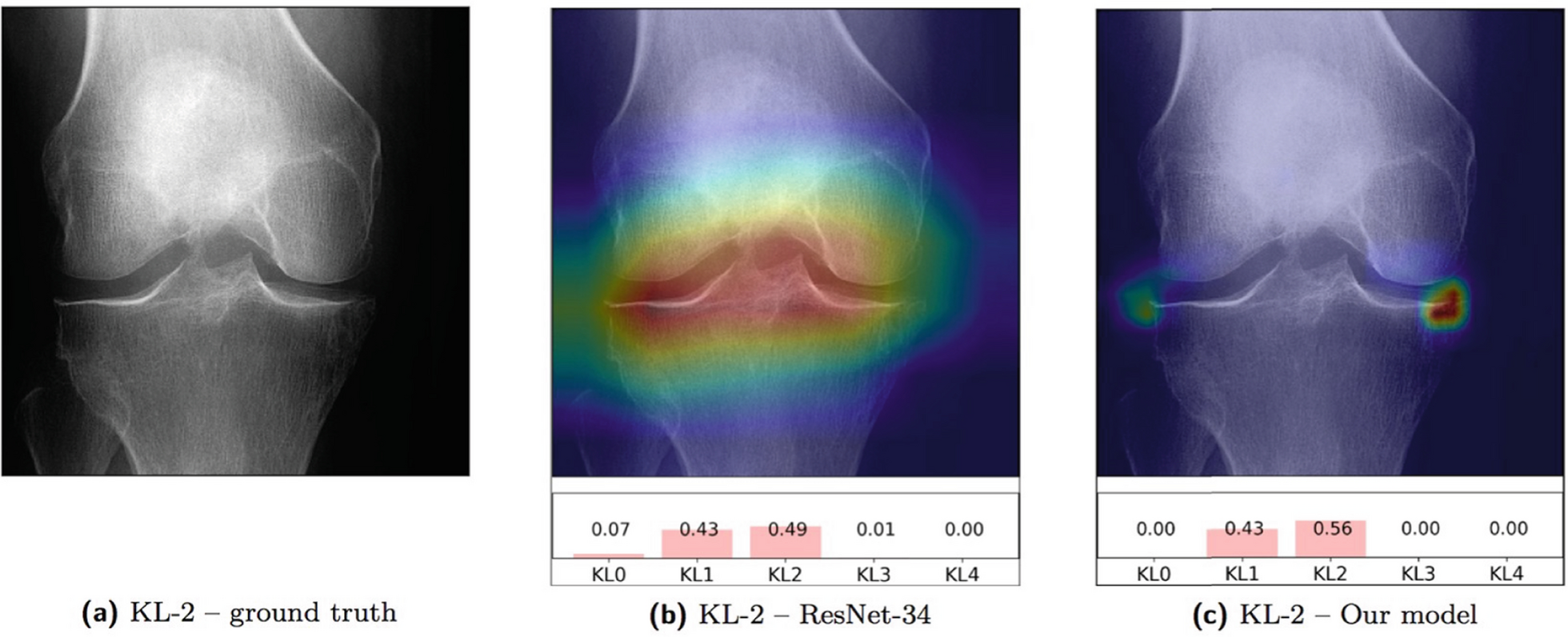 그림 크게 보기
X-ray, saliency map, KL 등급 확률을 함께 보여주는 그림입니다.
Sang Yoon Kim, Byung Sun Choi, Hyuk-Soo Han, Du Hyun Ro. Artificial intelligence in orthopedics: current applications, challenges, and future directions. Knee Surgery & Related Research (2026). DOI: 10.1186/s43019-026-00317-5. © The Author(s) 2026 Figure credit: Adapted in style from Tiulpin et al., Scientific Reports 2018;8:1727 (CC BY 4.0), with modifications.
원문 캡션
Chain-of-thought (CoT) rationale for automated Kellgren–Lawrence (KL) grading. a Input anteroposterior weight-bearing radiograph; b Standard Grad-CAM saliency showing nonspecific feature …
이 종설이 다루는 질문과 검토 범위
어떤 자료에 어떤 모델을 사용할 것인가
수술 전후 위험 예측: 숫자가 진료 행동으로 이어져야 한다
영상 AI: 진단 보조와 반복 측정의 표준화
LLM: 기록·정보 추출·환자 설명에서 시작하기
데이터 누출과 외부 검증
판별력·보정·임상 순편익은 다른 질문이다
설명가능성 그림을 어떻게 읽을 것인가
실제 도입: silent mode에서 의사–AI 공동 평가로
도입 후에도 필요한 감시와 책임
다중모달 모델과 digital twin의 가능성과 남은 검증
이 논문을 임상에서 활용할 때 확인할 점
짧게 정리하면
정형외과에서 먼저 적용하기 좋은 AI 업무는 무엇인가요?
종설은 구조화된 자료의 위험 예측과 영상 측정 자동화를 상대적으로 도입에 가까운 영역으로 봅니다. 다만 해당 제품의 외부 검증, 실제 업무 적합성과 의료진이 사용할 때의 이득을 확인해야 합니다.
AUROC가 높으면 바로 사용할 수 있나요?
그렇지 않습니다. 보정과 임계값, 외부기관·하위군 성능, 사용 시 놓치는 사례와 불필요한 대응을 평가하고 전향적 진료 환경에서 확인해야 합니다.
설명가능성 그림이 있으면 AI를 신뢰해도 되나요?
그림은 확인할 단서를 주지만 올바른 인과적 판단이나 안전성을 증명하지 않습니다. 실제 오류, 구조적 특징의 측정과 독립된 자료에서의 성능을 함께 보아야 합니다.
LLM의 가장 현실적인 역할은 무엇인가요?
의료진이 검토하는 기록 요약, 정보 추출과 설명문 초안 작성입니다. 문장 품질뿐 아니라 중요 정보 누락·수정 부담·개인정보와 잘못된 권고를 평가해야 합니다.
Digital twin이 이미 환자의 경과를 확정적으로 예측하나요?
아닙니다. 종설이 제시한 향후 연구 방향이며, 연결된 자료의 신뢰성·추가 예측 가치·전향적 임상 이득을 검증해야 합니다.
Keywords · 주제어
- Artificial intelligence
- Clinical translation
- Deep learning
- External validation
- Large language models
- Machine learning
- Musculoskeletal imaging
- Orthopedics
Abstract · 원문 초록
Sang Yoon Kim, Byung Sun Choi, Hyuk-Soo Han, Du Hyun Ro. Artificial intelligence in orthopedics: current applications, challenges, and future directions. Knee surgery & related research. 2026;38(1):14. doi:10.1186/s43019-026-00317-5.
BACKGROUND
Artificial intelligence research in orthopedics has grown rapidly, yet a substantial gap remains between technical development and clinical translation. This narrative review summarizes current applications of artificial intelligence in orthopedic practice and highlights barriers to implementation.
MAIN BODY
Current work converges on three domains: machine learning for structured perioperative risk prediction, deep learning for standardized musculoskeletal imaging, and large language models for workflow and decision support. Applications such as automated fracture detection, Kellgren-Lawrence grading for osteoarthritis, and transfusion risk modeling are approaching clinical maturity. However, routine adoption is limited by algorithmic opacity, performance degradation in new clinical environments, and poor fit within existing workflows. We argue that progress should shift from increasing model complexity toward rigorous evaluation, including external validation on independent cohorts. In addition, probability calibration and uncertainty estimation are important for trustworthy risk communication. Future directions may include multimodal "digital twin" approaches that integrate electronic medical records, imaging phenotypes, and intraoperative data into patient-specific trajectories.
CONCLUSIONS
The clinical impact of artificial intelligence in orthopedics will depend on life-cycle governance and demonstrated net benefit, prioritizing reliability and implementation science over retrospective benchmark performance.
© The Author(s) 2026
원래 논문
Artificial intelligence in orthopedics: current applications, challenges, and future directions
Sang Yoon Kim, Byung Sun Choi, Hyuk-Soo Han, Du Hyun Ro
Knee Surgery & Related Research · 2026