2025 · Journal of Clinical Medicine
요천추 이행척추를 측면 X-ray에서 자동으로 찾을 수 있을까요?
시험 AUC 0.84, 민감도 85.1%, 특이도 61.9%, 정확도 76.4%였습니다.
연구 수치로 읽는 결과
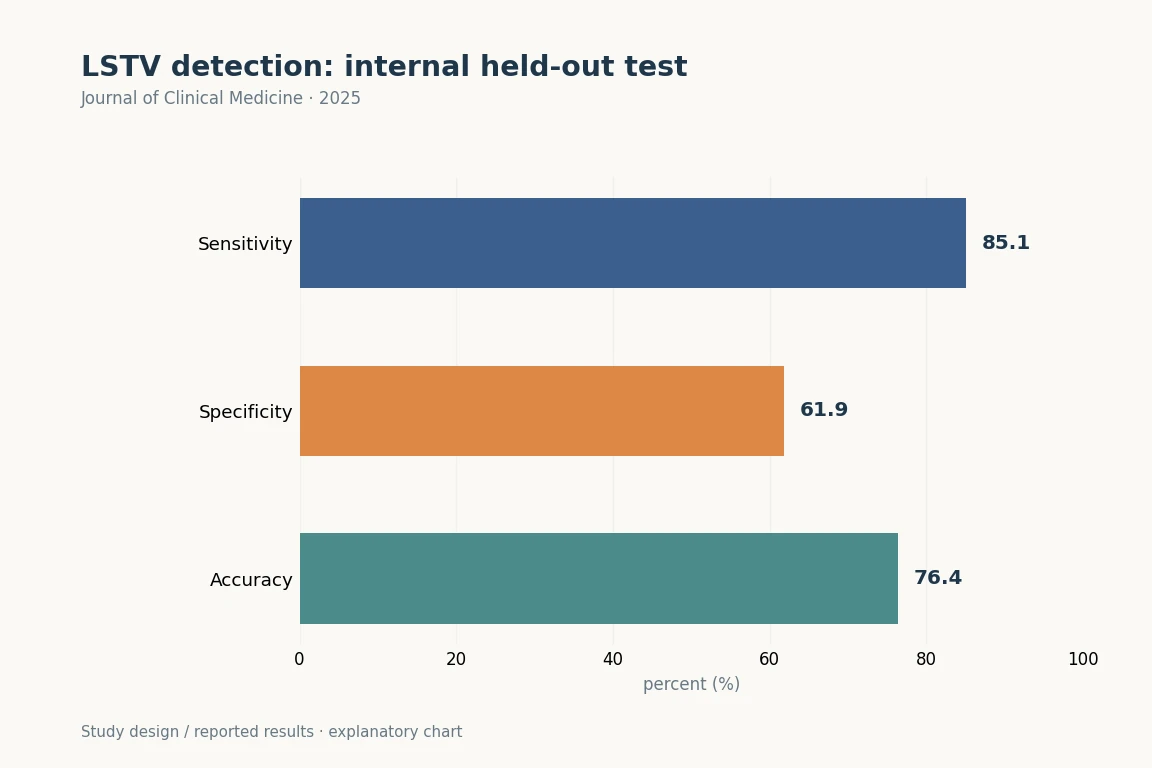 그림 크게 보기
분리 시험군 313장에서 민감도 85.1%, 특이도 61.9%, 정확도 76.4%를 보였습니다.
Journal of Clinical Medicine (2025). DOI: 10.3390/jcm14217671 · Original explanatory chart based on reported data
연구에서 묻는 질문
대상과 방법
주요 결과
진료와 수술에서 읽을 지점
해석의 제한
짧게 정리하면
어떤 진료 질문과 연결되나요?
척추 수술 전 분절 확인을 돕는 연구입니다. SPIN의 각도 측정과 별개의 검출 과제입니다.
Keywords · 주제어
- artificial intelligence
- automated detection
- convolutional neural network
- deep learning
- lumbosacral transitional vertebrae
- plain radiograph
- spine imaging
- AI
Abstract · 원문 초록
Donghyuk Kwak, Du Hyun Ro, Dong-Ho Kang. Automated Detection of Lumbosacral Transitional Vertebrae on Plain Lumbar Radiographs Using a Deep Learning Model. Journal of clinical medicine. 2025;14(21):7671. doi:10.3390/jcm14217671.
Background/Objectives: Lumbosacral transitional vertebra (LSTV) is a common anatomical variant, but its identification on plain radiographs is often inconsistent. This inconsistency can lead to clinical complications such as chronic low back pain, misinterpretation of spinal parameters, and an increased risk of wrong-level surgery. This study aimed to develop and validate a deep learning-based artificial intelligence (AI) model for the automated detection of LSTV on plain lumbar radiographs. Methods: This retrospective observational study included a total of 3116 standing lumbar lateral radiographs. The presence or absence of lumbosacral transitional vertebra (LSTV) was definitively established using whole-spine imaging, CT, or MRI. Multiple deep learning architectures, including DINOv2, CLIP (ViT-B/32), and ResNet-50, were initially evaluated for binary classification of LSTV. Among these, the ResNet-50 model with partial fine-tuning achieved the best test performance and was subsequently selected for fivefold cross-validation using the training set. Model performance was assessed using accuracy, sensitivity, specificity, and the area under the receiver operating characteristic curve (AUROC), and interpretability was evaluated using gradient-weighted class activation mapping (Grad-CAM). Results: On the independent test set of 313 radiographs, the final model demonstrated robust diagnostic performance. It achieved an accuracy of 76.4%, a sensitivity of 85.1%, a specificity of 61.9%, and an AUC of 0.84. The model correctly identified 166 out of 195 LSTV cases and 73 out of 118 normal cases. Conclusions: This AI-based system offers a highly accurate and reliable method for the automated detection of LSTV on plain radiographs. It shows strong potential as a clinical decision-support tool to reduce diagnostic errors, improve pre-operative planning, and enhance patient safety.
© 2025 by the authors.
원래 논문
Automated Detection of Lumbosacral Transitional Vertebrae on Plain Lumbar Radiographs Using a Deep Learning Model
Donghyuk Kwak, Du Hyun Ro, Dong-Ho Kang
Journal of Clinical Medicine · 2025