2025 · Journal of Clinical Medicine
腰仙移行椎を側面X線で自動検出できますか?
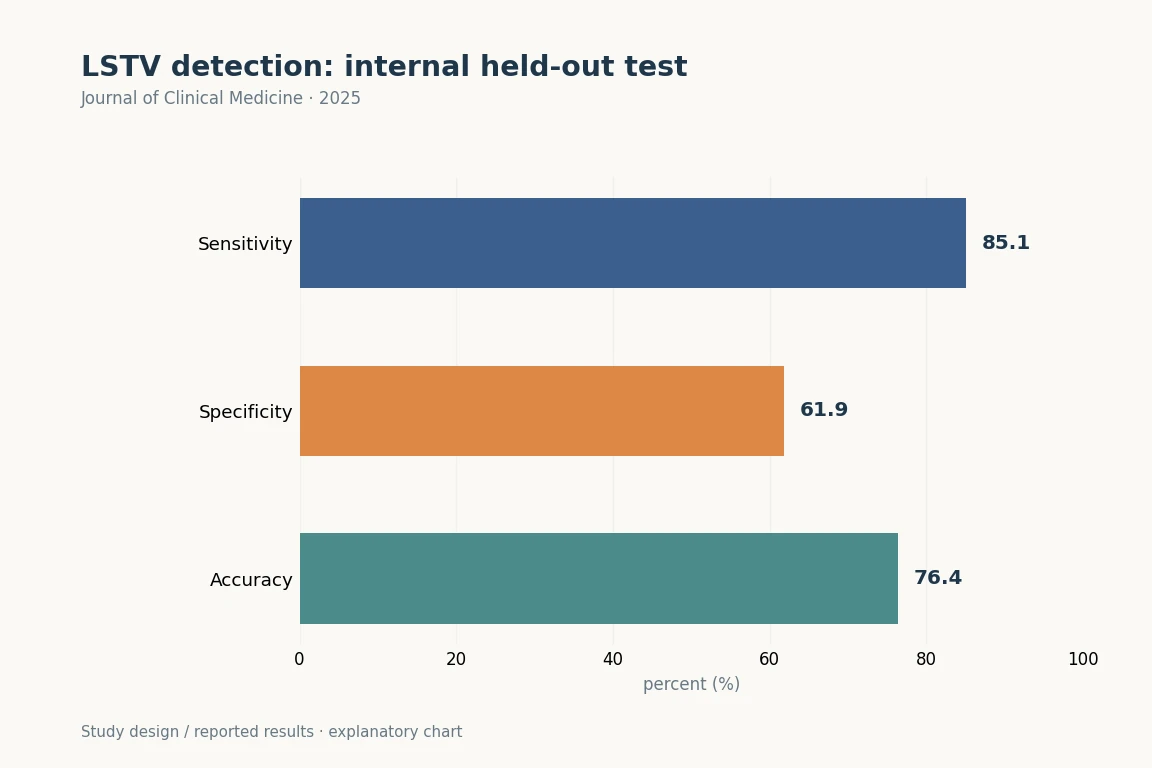
試験AUCは0.84、感度85.1%、特異度61.9%、正確度76.4%でした。
研究の数値から読む結果
 図を拡大する
分離した313画像のテストセットで、感度85.1%、特異度61.9%、正確度76.4%でした。
Journal of Clinical Medicine (2025). DOI: 10.3390/jcm14217671 · Original explanatory chart based on reported data
研究で問うこと
対象と方法
主な結果
診療・手術で考える点
解釈の限界
簡単に説明しましょう
どの診療上の問いにつながりますか?
脊椎手術前の分節確認を助ける研究です。SPINの角度測定とは別の検出課題です。
Keywords・キーワード
- artificial intelligence
- automated detection
- convolutional neural network
- deep learning
- lumbosacral transitional vertebrae
- plain radiograph
- spine imaging
- AI
Abstract・原文の抄録
Donghyuk Kwak, Du Hyun Ro, Dong-Ho Kang. Automated Detection of Lumbosacral Transitional Vertebrae on Plain Lumbar Radiographs Using a Deep Learning Model. Journal of clinical medicine. 2025;14(21):7671. doi:10.3390/jcm14217671.
Background/Objectives: Lumbosacral transitional vertebra (LSTV) is a common anatomical variant, but its identification on plain radiographs is often inconsistent. This inconsistency can lead to clinical complications such as chronic low back pain, misinterpretation of spinal parameters, and an increased risk of wrong-level surgery. This study aimed to develop and validate a deep learning-based artificial intelligence (AI) model for the automated detection of LSTV on plain lumbar radiographs. Methods: This retrospective observational study included a total of 3116 standing lumbar lateral radiographs. The presence or absence of lumbosacral transitional vertebra (LSTV) was definitively established using whole-spine imaging, CT, or MRI. Multiple deep learning architectures, including DINOv2, CLIP (ViT-B/32), and ResNet-50, were initially evaluated for binary classification of LSTV. Among these, the ResNet-50 model with partial fine-tuning achieved the best test performance and was subsequently selected for fivefold cross-validation using the training set. Model performance was assessed using accuracy, sensitivity, specificity, and the area under the receiver operating characteristic curve (AUROC), and interpretability was evaluated using gradient-weighted class activation mapping (Grad-CAM). Results: On the independent test set of 313 radiographs, the final model demonstrated robust diagnostic performance. It achieved an accuracy of 76.4%, a sensitivity of 85.1%, a specificity of 61.9%, and an AUC of 0.84. The model correctly identified 166 out of 195 LSTV cases and 73 out of 118 normal cases. Conclusions: This AI-based system offers a highly accurate and reliable method for the automated detection of LSTV on plain radiographs. It shows strong potential as a clinical decision-support tool to reduce diagnostic errors, improve pre-operative planning, and enhance patient safety.
© 2025 by the authors.
オリジナル紙だ
Automated Detection of Lumbosacral Transitional Vertebrae on Plain Lumbar Radiographs Using a Deep Learning Model
Donghyuk Kwak, Du Hyun Ro, Dong-Ho Kang
Journal of Clinical Medicine · 2025