
2026 · Knee Surgery, Sports Traumatology, Arthroscopy
JLCA와 관상면 정렬 진행: 10,841개 무릎의 종단 분석
빠른 내반 진행은 34.0%(95% CI 32.8–35.1%), 외반 진행은 25.7%(95% CI 21.2–30.7%)였습니다.
원문 Figure 2
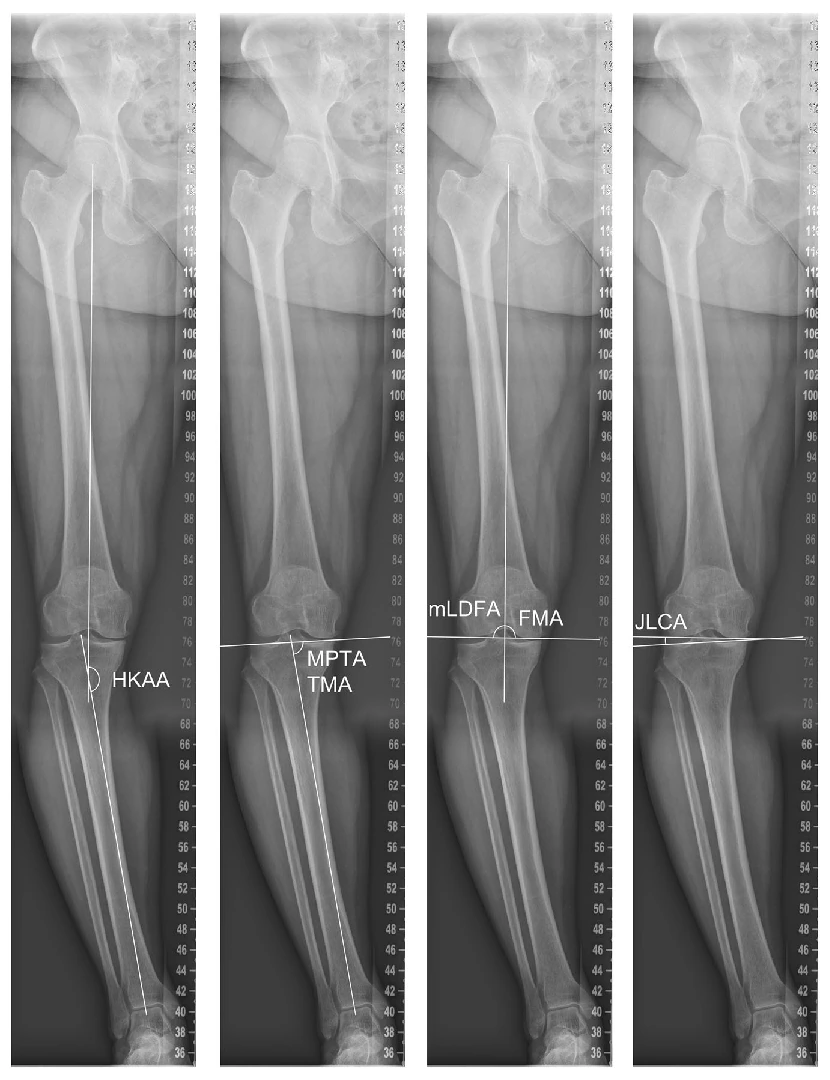 그림 크게 보기
기립 전장 X선에서 정렬 지표를 측정한 원문 예시입니다. 다리 전체의 축과 관절선을 함께 읽습니다.
Knee Surgery, Sports Traumatology, Arthroscopy (2026). DOI: 10.1002/ksa.70293 · Original Figure 2
원문 Figure 3
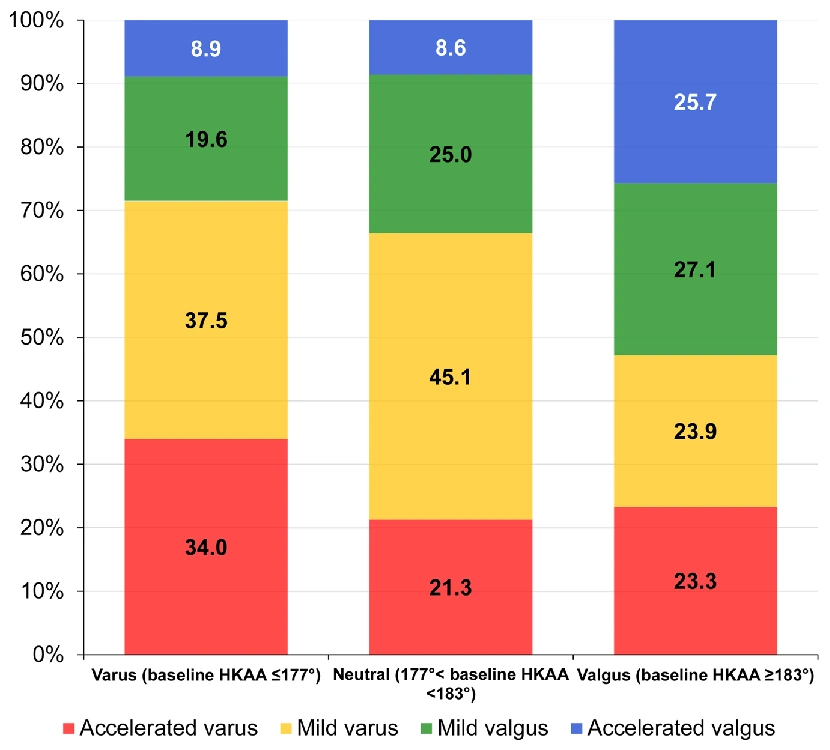 그림 크게 보기
초기 정렬별 진행 방향과 속도를 나눈 원문 그래프입니다. 내반군의 34.0%, 외반군의 25.7%에서 같은 방향으로 연간 0.50° 이상 진행했습니다.
Knee Surgery, Sports Traumatology, Arthroscopy (2026). DOI: 10.1002/ksa.70293 · Original Figure 3
원문 Figure 9
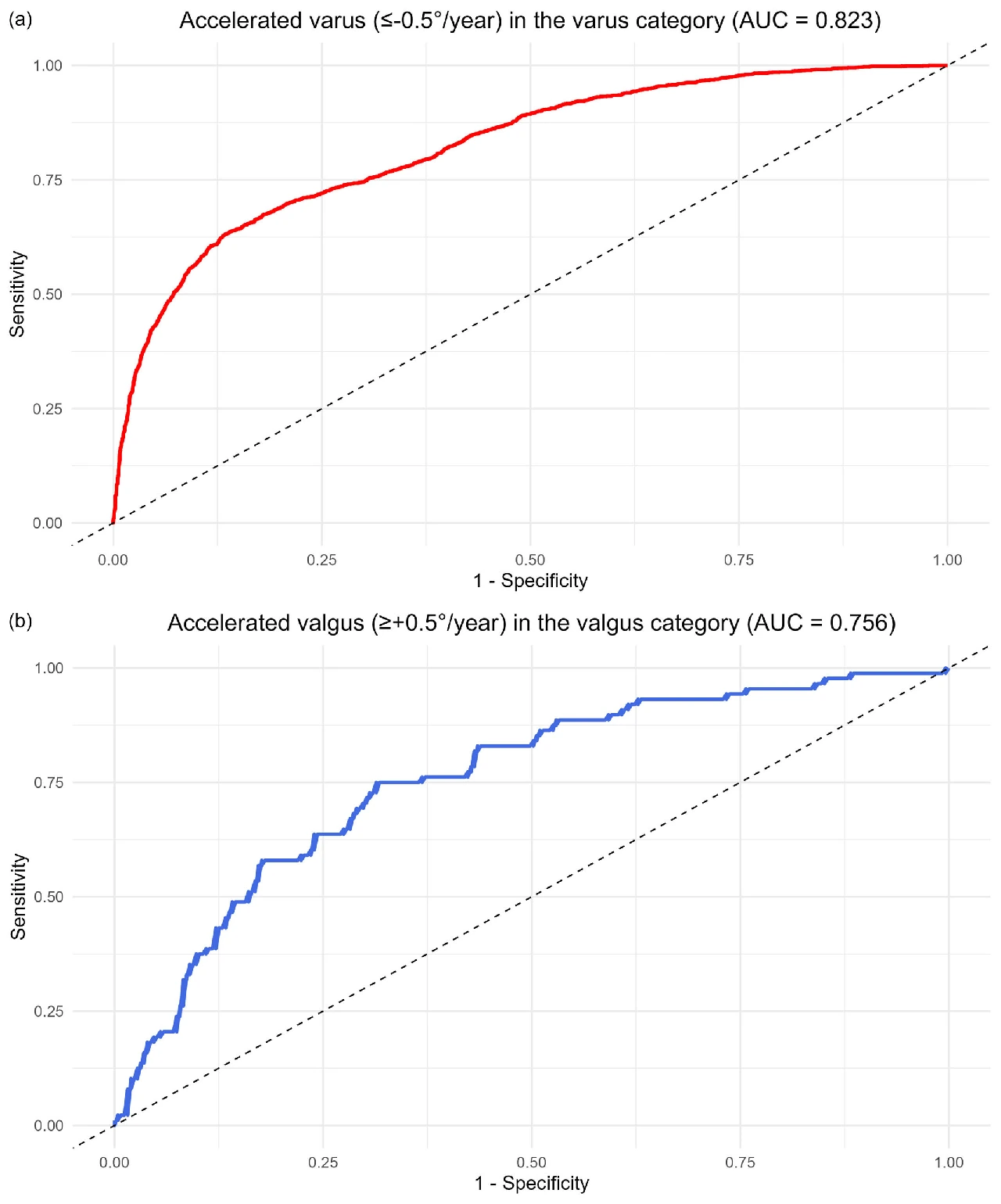 그림 크게 보기
빠른 내반·외반 진행을 구분한 ROC 곡선입니다. AUC는 각각 0.823과 0.756입니다.
Knee Surgery, Sports Traumatology, Arthroscopy (2026). DOI: 10.1002/ksa.70293 · Original Figure 9
연구에서 묻는 질문
대상과 방법
주요 결과
진료와 수술에서 읽을 지점
해석의 제한
짧게 정리하면
어떤 진료 질문과 연결되나요?
OA 추적에 정렬 진행과 JLCA를 함께 평가하는 근거입니다. HTO·TKA의 목표 각도를 직접 처방하는 연구는 아닙니다.
Keywords · 주제어
- coronal alignment
- functional knee phenotypes
- hip‐knee‐ankle angle
- joint line convergence angle
- knee osteoarthritis
- alignment
- JLCA
- OA progression
Abstract · 원문 초록
Kee Soo Kang, Sang Yoon Kim, Byung Sun Choi, Hyuk-Soo Han, Chong Bum Chang, Du Hyun Ro. Large joint line convergence angle is associated with accelerated coronal alignment progression in osteoarthritic knees: A longitudinal analysis of 10,841 knees. Knee surgery, sports traumatology, arthroscopy : official journal of the ESSKA. 2026. doi:10.1002/ksa.70293.
PURPOSE
Coronal knee alignment, determined by both joint line orientation and morphology of femur and tibia, alters with osteoarthritic progression, but its rate of change has not been systematically evaluated. This study aimed to categorise limbs according to the rate of hip-knee-ankle angle (HKAA) alteration and identify factors associated with accelerated alignment progression.
METHODS
10,841 limbs from a tertiary hospital were analysed. Alignment parameters and Kellgren-Lawrence (K-L) grades were measured on standing long-leg radiographs. Limbs were grouped by baseline HKAA as varus (HKAA ≤ 177°), neutral (177° < HKAA < 183°), or valgus (HKAA ≥ 183°). Accelerated and mild progression were defined as ≥ 0.50°/year and < 0.50°/year, respectively. Factors associated with accelerated coronal alignment progression were analysed using multivariable logistic regression.
RESULTS
Accelerated varus and valgus progression occurred in 34.0% (95% CI: 32.8%-35.1%) of the varus and 25.7% (21.2%-30.7%) of the valgus category, respectively. After adjustment for age, sex, and body mass index, greater baseline varus alignment, medial proximal tibial angle, and joint line convergence angle (JLCA) were associated with increased odds of accelerated varus progression by 4.9% (4.8%-5.0%), 10.8% (10.6%-10.9%), and 12.9% (12.7%-13.1%), respectively, in the varus category (n = 6519; AUC = 0.823). Higher K-L grade was associated with increased risk of accelerated varus progression compared with Grade 0 (I: 44.8% [44.5%-45.0%], II: 88.9% [88.6%-89.2%], III: 391.8% [346.1%-443.5%], and IV: 378.0% [305.0%-468.5%]; all p < 0.001). In the valgus category (n = 343), greater baseline HKAA and medially-opened JLCA increased the risk of accelerated valgus progression by 17.4% (3.6%-33.5%) and 19.4% (9.2%-28.8%), respectively (AUC = 0.756).
CONCLUSIONS
Approximately one-third of limbs with baseline HKAA ≤ 177° and about one-quarter of those with HKAA ≥ 183° exhibited ≥0.50° progression toward varus and valgus, respectively. Accelerated alignment change was associated with greater baseline HKAA, JLCA and higher baseline K-L grade, suggesting characteristics of this potential phenotype.
LEVEL OF EVIDENCE
Level III.
원래 논문
Large joint line convergence angle is associated with accelerated coronal alignment progression in osteoarthritic knees: A longitudinal analysis of 10,841 knees
Kee Soo Kang, Sang Yoon Kim, Byung Sun Choi, Hyuk-Soo Han, Chong Bum Chang, Du Hyun Ro
Knee Surgery, Sports Traumatology, Arthroscopy · 2026