
2026 · Knee Surgery, Sports Traumatology, Arthroscopy
JLCAと冠状面アライメントの進行:10,841膝の縦断解析
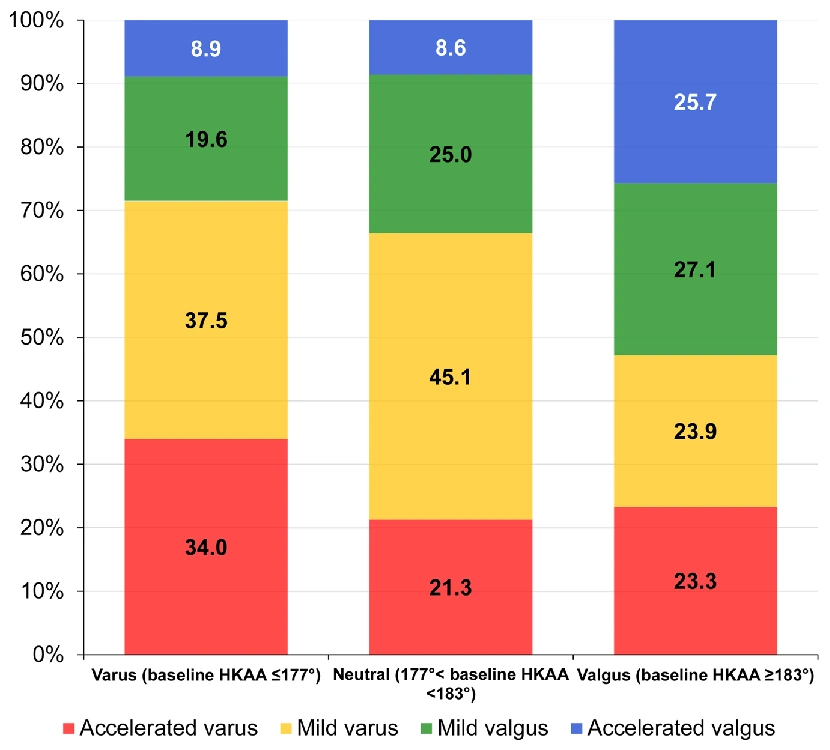
急速な内反進行は34.0%(95% CI 32.8–35.1%)、外反進行は25.7%(95% CI 21.2–30.7%)でした。
原図Figure 2
 図を拡大する
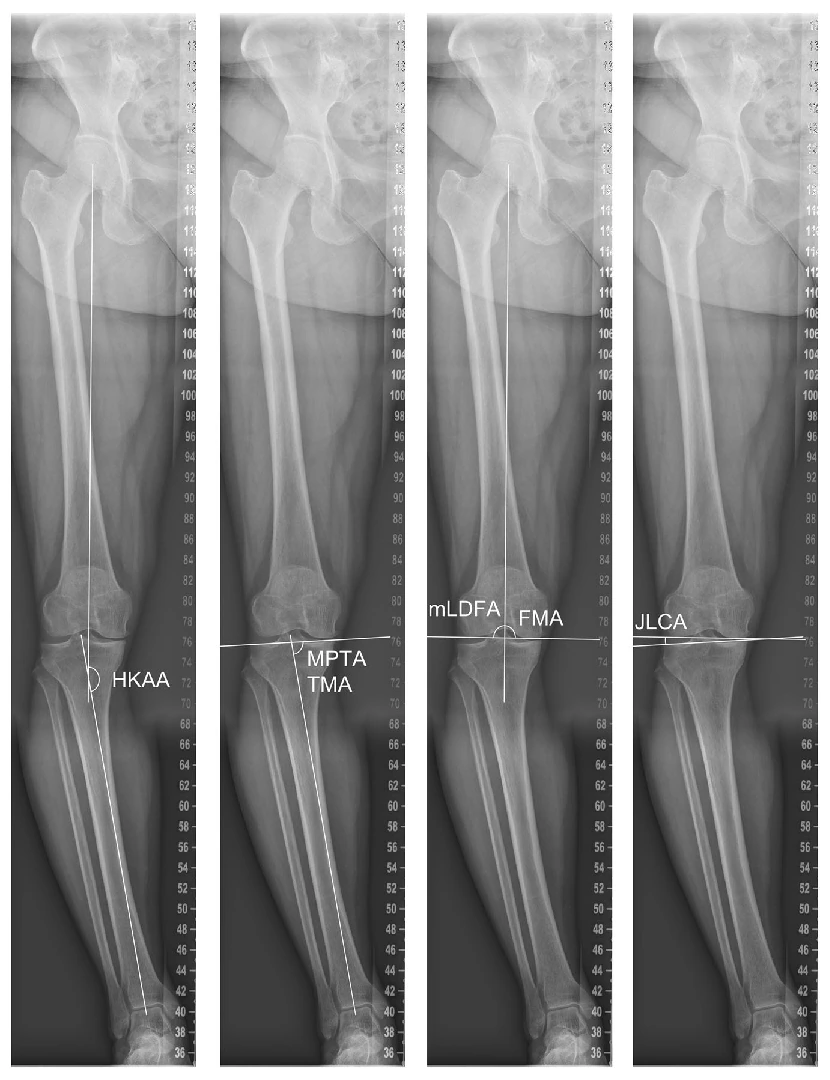
立位全下肢X線でのアライメント計測の原図です。下肢全体の軸と関節線を合わせて読みます。
Knee Surgery, Sports Traumatology, Arthroscopy (2026). DOI: 10.1002/ksa.70293 · Original Figure 2
原図Figure 3
 図を拡大する
初期アライメント別の進行方向と速度を示した原図です。内反群の34.0%、外反群の25.7%で同じ方向へ年間0.50°以上進行しました。
Knee Surgery, Sports Traumatology, Arthroscopy (2026). DOI: 10.1002/ksa.70293 · Original Figure 3
原図Figure 9
 図を拡大する
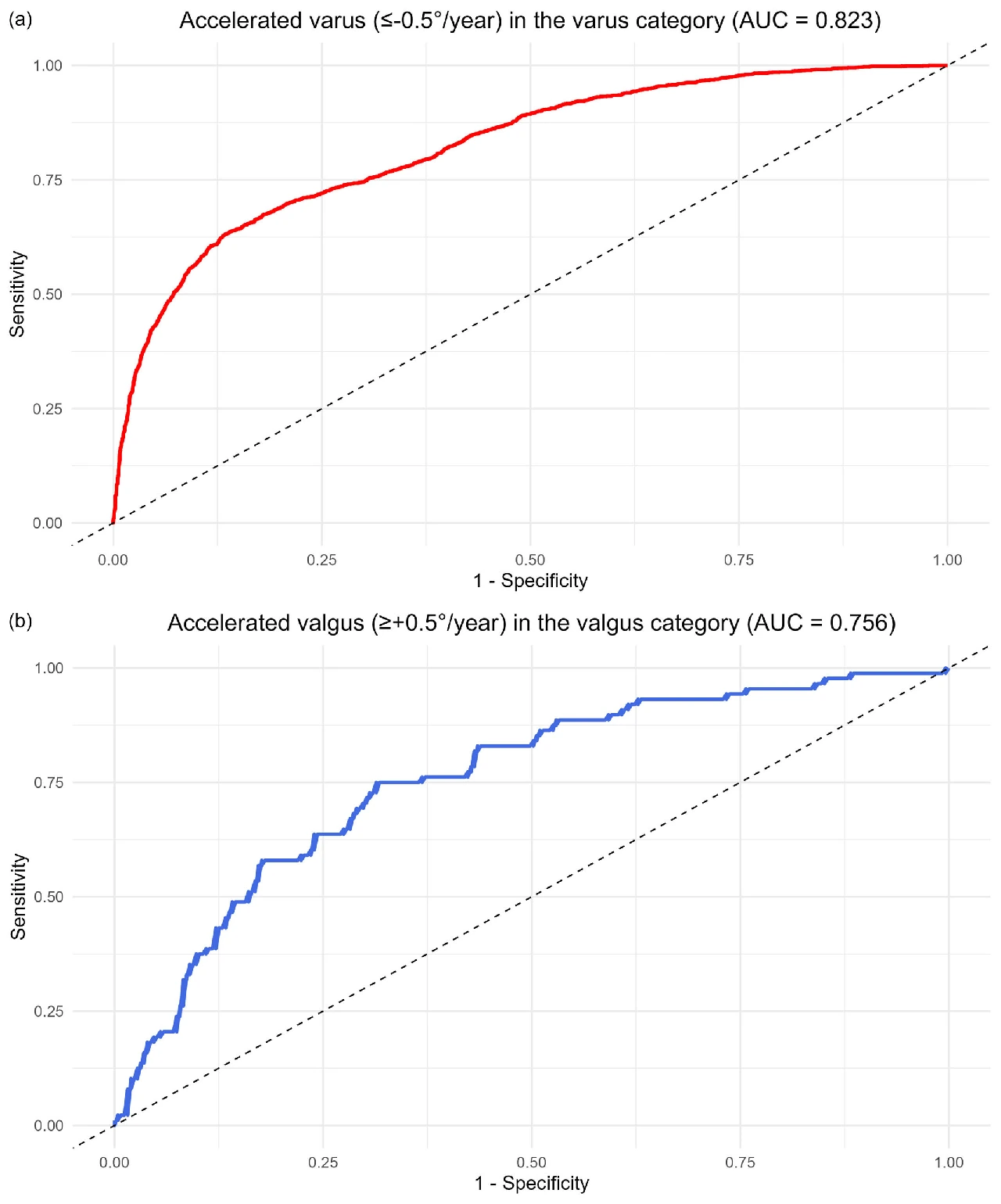
急速な内反・外反進行を識別するROC曲線です。AUCはそれぞれ0.823、0.756です。
Knee Surgery, Sports Traumatology, Arthroscopy (2026). DOI: 10.1002/ksa.70293 · Original Figure 9
研究で問うこと
対象と方法
主な結果
診療・手術で考える点
解釈の限界
簡単に説明しましょう
どの診療上の問いにつながりますか?
OAの追跡でアライメントの進行とJLCAを併せて評価する根拠を示しています。HTO・TKAの目標角度を直接指定する研究ではありません。
Keywords・キーワード
- coronal alignment
- functional knee phenotypes
- hip‐knee‐ankle angle
- joint line convergence angle
- knee osteoarthritis
- alignment
- JLCA
- OA progression
Abstract・原文の抄録
Kee Soo Kang, Sang Yoon Kim, Byung Sun Choi, Hyuk-Soo Han, Chong Bum Chang, Du Hyun Ro. Large joint line convergence angle is associated with accelerated coronal alignment progression in osteoarthritic knees: A longitudinal analysis of 10,841 knees. Knee surgery, sports traumatology, arthroscopy : official journal of the ESSKA. 2026. doi:10.1002/ksa.70293.
PURPOSE
Coronal knee alignment, determined by both joint line orientation and morphology of femur and tibia, alters with osteoarthritic progression, but its rate of change has not been systematically evaluated. This study aimed to categorise limbs according to the rate of hip-knee-ankle angle (HKAA) alteration and identify factors associated with accelerated alignment progression.
METHODS
10,841 limbs from a tertiary hospital were analysed. Alignment parameters and Kellgren-Lawrence (K-L) grades were measured on standing long-leg radiographs. Limbs were grouped by baseline HKAA as varus (HKAA ≤ 177°), neutral (177° < HKAA < 183°), or valgus (HKAA ≥ 183°). Accelerated and mild progression were defined as ≥ 0.50°/year and < 0.50°/year, respectively. Factors associated with accelerated coronal alignment progression were analysed using multivariable logistic regression.
RESULTS
Accelerated varus and valgus progression occurred in 34.0% (95% CI: 32.8%-35.1%) of the varus and 25.7% (21.2%-30.7%) of the valgus category, respectively. After adjustment for age, sex, and body mass index, greater baseline varus alignment, medial proximal tibial angle, and joint line convergence angle (JLCA) were associated with increased odds of accelerated varus progression by 4.9% (4.8%-5.0%), 10.8% (10.6%-10.9%), and 12.9% (12.7%-13.1%), respectively, in the varus category (n = 6519; AUC = 0.823). Higher K-L grade was associated with increased risk of accelerated varus progression compared with Grade 0 (I: 44.8% [44.5%-45.0%], II: 88.9% [88.6%-89.2%], III: 391.8% [346.1%-443.5%], and IV: 378.0% [305.0%-468.5%]; all p < 0.001). In the valgus category (n = 343), greater baseline HKAA and medially-opened JLCA increased the risk of accelerated valgus progression by 17.4% (3.6%-33.5%) and 19.4% (9.2%-28.8%), respectively (AUC = 0.756).
CONCLUSIONS
Approximately one-third of limbs with baseline HKAA ≤ 177° and about one-quarter of those with HKAA ≥ 183° exhibited ≥0.50° progression toward varus and valgus, respectively. Accelerated alignment change was associated with greater baseline HKAA, JLCA and higher baseline K-L grade, suggesting characteristics of this potential phenotype.
LEVEL OF EVIDENCE
Level III.
オリジナル紙だ
Large joint line convergence angle is associated with accelerated coronal alignment progression in osteoarthritic knees: A longitudinal analysis of 10,841 knees
Kee Soo Kang, Sang Yoon Kim, Byung Sun Choi, Hyuk-Soo Han, Chong Bum Chang, Du Hyun Ro
Knee Surgery, Sports Traumatology, Arthroscopy · 2026