2026 · Bone & Joint Open
OA가 심할수록 실제 관절선과 산술적으로 추정한 본래 관절선은 같은 방식으로 변할까?
내측 OA에서 TJLA는 KL 3에서 내측 하강 방향에서 내측 상승 방향으로 바뀌었습니다. 내·외측 OA 모두 KL 3–4에서 TJLA 변화가 관찰됐습니다(P < 0.001).
연구 질문과 설계
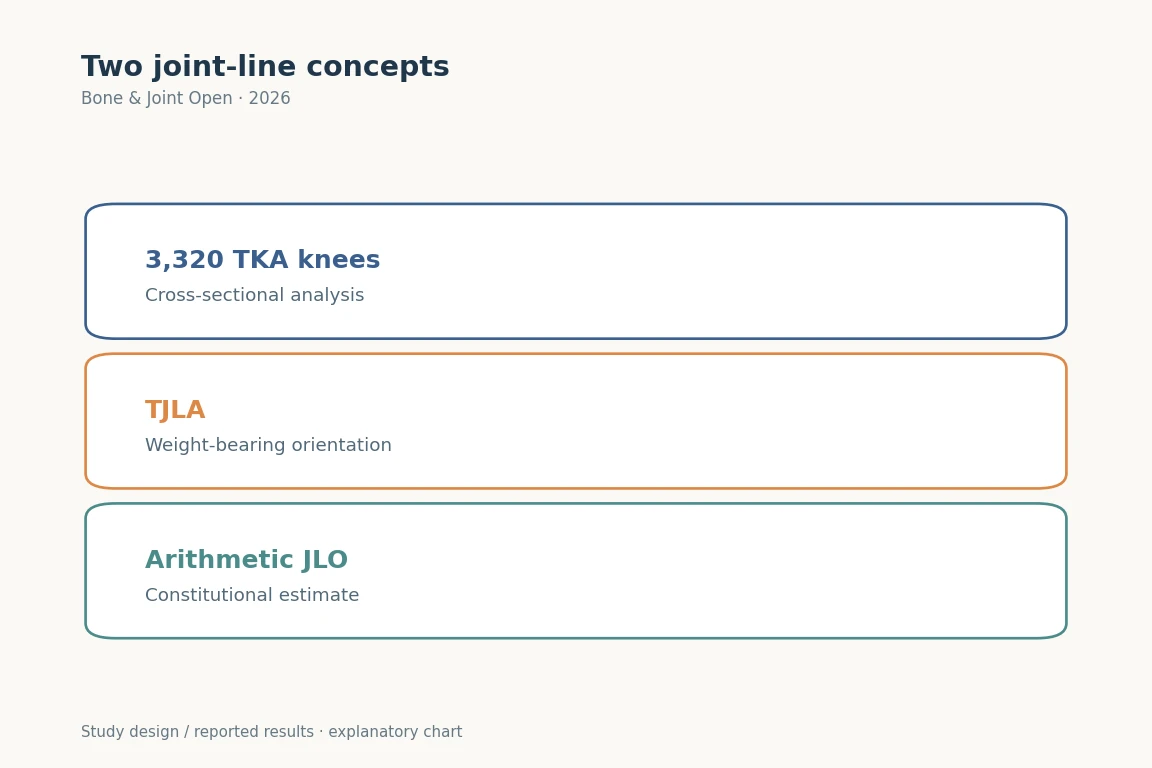 그림 크게 보기
체중부하 관절선 TJLA와 산술 aJLO를 비교했습니다. KL 3–4에서 TJLA 차이가 나타났고 aJLO는 비교적 유지됐습니다.
Bone & Joint Open (2026). DOI: 10.1302/2633-1462.72.BJO-2025-0370.R1 · Original explanatory chart based on reported data
연구에서 묻는 질문
대상과 방법
주요 결과
진료와 수술에서 읽을 지점
해석의 제한
짧게 정리하면
어떤 진료 질문과 연결되나요?
개인별 TKA 정렬 연구에서 체중부하 TJLA와 산술 aJLO를 같은 관절선 개념으로 취급하지 않도록 하는 근거입니다.
Keywords · 주제어
- Tibiofemoral joint line
- Osteoarthritis severity
- Constitutional alignment
- Radiological analysis
- TKA
- alignment
- CPAK
- aJLO
Abstract · 원문 초록
John E Farey, Benjamin J Leong, Jil A Wood, Do W Lee, Seyun Kim, Darren B Chen, Du H Ro, Samuel J MacDessi. Dynamic changes to the tibiofemoral joint line with increasing osteoarthritis severity and its relationship to constitutional alignment : a radiological analysis of 3,320 knees. Bone & joint open. 2026;7(2):249-258. doi:10.1302/2633-1462.72.BJO-2025-0370.R1.
AIMS
Changes in both native and dynamic joint line obliquity may influence the pathogenesis of osteoarthritis (OA) and subsequent development of coronal limb alignment deformity. This study aimed to characterize joint line alterations relative to OA severity and constitutional alignment.
METHODS
A retrospective, cross-sectional analysis of 3,320 preoperative weightbearing long-leg radiographs from patients undergoing total knee arthroplasty was performed using deep learning software. OA severity was assessed using the Kellgren-Lawrence (KL) grading system. Constitutional alignment parameters included lateral distal femoral angle (LDFA), medial proximal tibial angle (MPTA), arithmetic hip-knee-ankle (aHKA) angle, and arithmetic joint line obliquity (aJLO). Tibiofemoral joint line alterations were assessed using the mechanical hip-knee-ankle (mHKA) angle, tibial joint line angle (TJLA), femoral joint line angle (FJLA), and joint line congruence angle (JLCA). The primary outcome was the difference in the TJLA relative to the aJLO across KL grades, stratified for the presence of medial or lateral compartment OA.
RESULTS
Alterations in TJLA were observed in moderate (KL Grade 3) and severe (Grade 4) OA for medial and lateral compartment OA (both p < 0.001). In medial OA, the TJLA reversed orientation at Grade 3 from medially declined to medially inclined relative to aJLO. The aJLO maintained its constitutional orientation until Grade 4, when non-clinically significant changes (< 1°) were observed (p < 0.001). In lateral OA, the TJLA became more medially inclined in moderate and severe OA, while the aJLO remained stable. Significant changes in aHKA were observed in moderate and severe OA, indicating an apparent change in constitutional limb alignment (p < 0.001 for both medial and lateral OA).
CONCLUSION
The tibiofemoral joint line angle changes dynamically with OA progression, while the constitutional aJLO remains stable until advanced disease occurs. Understanding this distinction between constitutional and dynamic joint line orientation is important when communicating and studying outcomes related to knee alignment.
© 2026 Farey et al.
원래 논문
Dynamic changes to the tibiofemoral joint line with increasing osteoarthritis severity and its relationship to constitutional alignment: a radiological analysis of 3,320 knees
John E Farey, Benjamin J Leong, Jil A Wood, Do W Lee, Seyun Kim, Darren B Chen, Du Hyun Ro, Samuel J MacDessi
Bone & Joint Open · 2026