2026 · Bone & Joint Open
OAが重症化すると、実際の関節線と算術的に推定した本来の関節線は同じように変わるか?
内側型OAでは、TJLAはKL 3で内側下がりから内側上がりに変わりました。内側型・外側型OAともに、KL 3–4でTJLAの変化が認められました(P < 0.001)。
研究の問いと設計
 図を拡大する
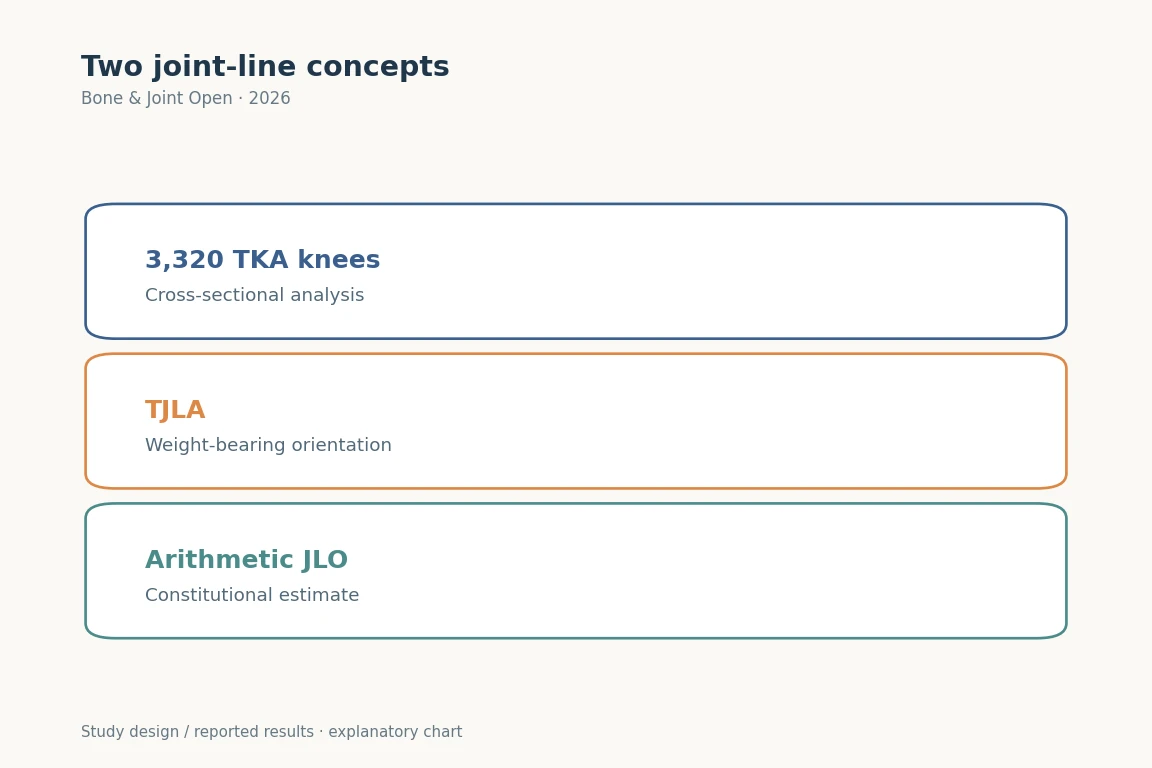
荷重下関節線角(TJLA)と算術的aJLOを比較しました。KL 3–4ではTJLAに差がみられ、aJLOは比較的保たれていました。
Bone & Joint Open (2026). DOI: 10.1302/2633-1462.72.BJO-2025-0370.R1 · Original explanatory chart based on reported data
研究で問うこと
対象と方法
主な結果
診療・手術で考える点
解釈の限界
簡単に説明しましょう
どの診療上の問いにつながりますか?
個別化TKAアライメントの研究で、荷重位TJLAと算術的aJLOを同じ関節線の概念として扱わないための根拠です。
Keywords・キーワード
- Tibiofemoral joint line
- Osteoarthritis severity
- Constitutional alignment
- Radiological analysis
- TKA
- alignment
- CPAK
- aJLO
Abstract・原文の抄録
John E Farey, Benjamin J Leong, Jil A Wood, Do W Lee, Seyun Kim, Darren B Chen, Du H Ro, Samuel J MacDessi. Dynamic changes to the tibiofemoral joint line with increasing osteoarthritis severity and its relationship to constitutional alignment : a radiological analysis of 3,320 knees. Bone & joint open. 2026;7(2):249-258. doi:10.1302/2633-1462.72.BJO-2025-0370.R1.
AIMS
Changes in both native and dynamic joint line obliquity may influence the pathogenesis of osteoarthritis (OA) and subsequent development of coronal limb alignment deformity. This study aimed to characterize joint line alterations relative to OA severity and constitutional alignment.
METHODS
A retrospective, cross-sectional analysis of 3,320 preoperative weightbearing long-leg radiographs from patients undergoing total knee arthroplasty was performed using deep learning software. OA severity was assessed using the Kellgren-Lawrence (KL) grading system. Constitutional alignment parameters included lateral distal femoral angle (LDFA), medial proximal tibial angle (MPTA), arithmetic hip-knee-ankle (aHKA) angle, and arithmetic joint line obliquity (aJLO). Tibiofemoral joint line alterations were assessed using the mechanical hip-knee-ankle (mHKA) angle, tibial joint line angle (TJLA), femoral joint line angle (FJLA), and joint line congruence angle (JLCA). The primary outcome was the difference in the TJLA relative to the aJLO across KL grades, stratified for the presence of medial or lateral compartment OA.
RESULTS
Alterations in TJLA were observed in moderate (KL Grade 3) and severe (Grade 4) OA for medial and lateral compartment OA (both p < 0.001). In medial OA, the TJLA reversed orientation at Grade 3 from medially declined to medially inclined relative to aJLO. The aJLO maintained its constitutional orientation until Grade 4, when non-clinically significant changes (< 1°) were observed (p < 0.001). In lateral OA, the TJLA became more medially inclined in moderate and severe OA, while the aJLO remained stable. Significant changes in aHKA were observed in moderate and severe OA, indicating an apparent change in constitutional limb alignment (p < 0.001 for both medial and lateral OA).
CONCLUSION
The tibiofemoral joint line angle changes dynamically with OA progression, while the constitutional aJLO remains stable until advanced disease occurs. Understanding this distinction between constitutional and dynamic joint line orientation is important when communicating and studying outcomes related to knee alignment.
© 2026 Farey et al.
オリジナル紙だ
Dynamic changes to the tibiofemoral joint line with increasing osteoarthritis severity and its relationship to constitutional alignment: a radiological analysis of 3,320 knees
John E Farey, Benjamin J Leong, Jil A Wood, Do W Lee, Seyun Kim, Darren B Chen, Du Hyun Ro, Samuel J MacDessi
Bone & Joint Open · 2026