2023 · KSSTA
下肢全長X線で15個のランドマークを検出すると、アライメント角度を自動的に再現できるか?
自動モデルの角度別の検者間ICCは≥0.98、反復測定ICCは1.00でした。
研究の数値から読む結果
 図を拡大する
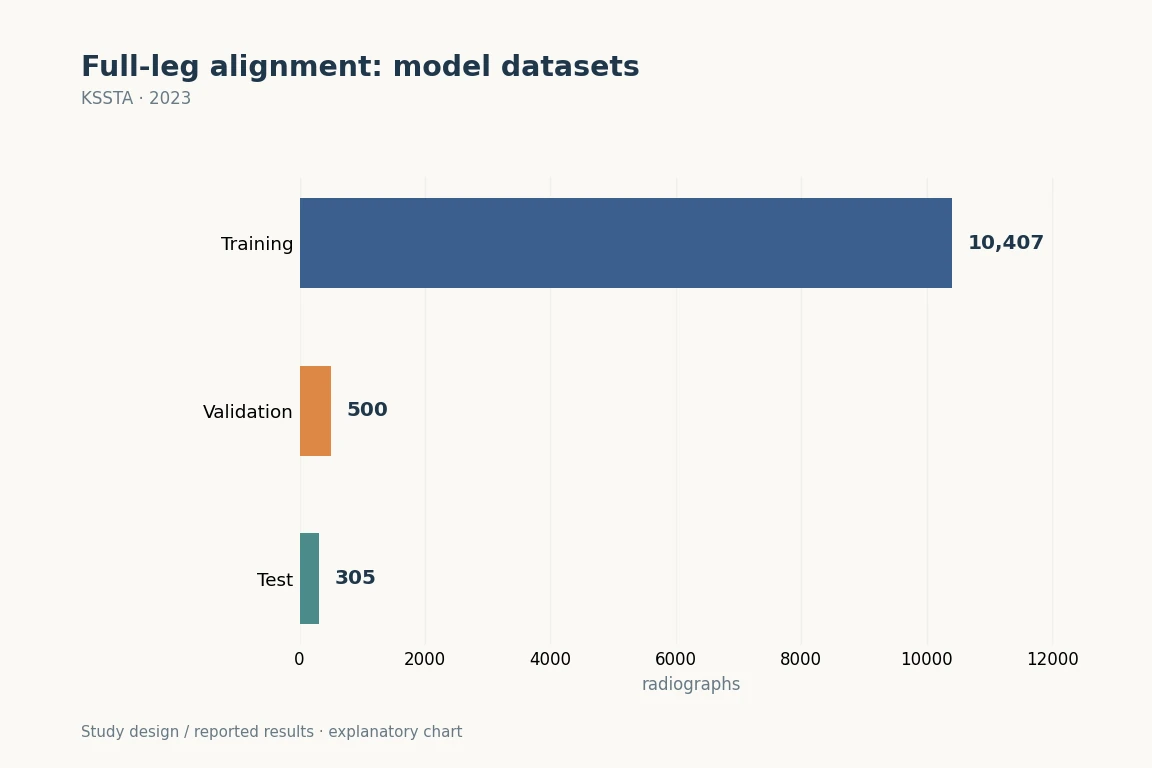
単施設で学習10,407件、検証500件、試験305件を用いました。図は資料の分割を示します。3施設の外部検証は2024年の後続研究で別に実施しました。
KSSTA (2023). DOI: 10.1007/s00167-022-07124-x · Original explanatory chart based on reported data
研究で問うこと
対象と方法
主な結果
診療・手術で考える点
解釈の限界
簡単に説明しましょう
どの診療上の問いにつながりますか?
HTO・TKA計画の出発点となるmLDFA・MPTA・HKAA測定を標準化する基盤です。自動測定は、撮影の標準化、関節内変形の解釈、術者の最終計画を代替しません。
Keywords・キーワード
- Angle measurement
- Deep learning
- Hip knee ankle angle (HKAA)
- Joint line convergence angle (JLCA)
- Landmark recognition
- Lower extremity
- Mechanical lateral distal femoral angle (mLDFA)
- Medial proximal tibial angle (MPTA)
Abstract・原文の抄録
Changwung Jo, Doohyun Hwang, Sunho Ko, Myung Ho Yang, Myung Chul Lee, Hyuk-Soo Han, Du Hyun Ro. Deep learning-based landmark recognition and angle measurement of full-leg plain radiographs can be adopted to assess lower extremity alignment. Knee surgery, sports traumatology, arthroscopy : official journal of the ESSKA. 2023;31(4):1388-1397. doi:10.1007/s00167-022-07124-x.
PURPOSE
Evaluating lower extremity alignment using full-leg plain radiographs is an essential step in diagnosis and treatment of patients with knee osteoarthritis. The study objective was to present a deep learning-based anatomical landmark recognition and angle measurement model, using full-leg radiographs, and validate its performance.
METHODS
A total of 11,212 full-leg plain radiographs were used to create the model. To train the data, 15 anatomical landmarks were marked by two orthopaedic surgeons. Mechanical lateral distal femoral angle (mLDFA), medial proximal tibial angle (MPTA), joint line convergence angle (JLCA), and hip-knee-ankle angle (HKAA) were then measured. For inter-observer reliability, the inter-observer intraclass correlation coefficient (ICC) was evaluated by comparing measurements from the model, surgeons, and students, to ground truth measurements annotated by an orthopaedic specialist with 14 years of experience. To evaluate test-retest reliability, all measurements were made twice by each measurer. Intra-observer ICCs were then derived. Performance evaluation metrics used in previous studies were also derived for direct comparison of the model's performance.
RESULTS
Inter-observer ICCs for all angles of the model were 0.98 or higher (p < 0.001). Intra-observer ICCs for all angles were 1.00, which was higher than that of the orthopaedic specialist (0.97-1.00). Measurements made by the model showed no significant systemic variation. Except for JLCA, angles were precisely measured with absolute error averages under 0.52 degrees and proportion of outliers under 4.26%.
CONCLUSIONS
The deep learning model is capable of evaluating lower extremity alignment with performance as accurate as an orthopaedic specialist with 14 years of experience.
LEVEL OF EVIDENCE
III, retrospective cohort study.
オリジナル紙だ
Deep learning-based landmark recognition and angle measurement of full-leg plain radiographs can be adopted to assess lower extremity alignment
Jo C, Hwang D, Ko S, Yang MH, Lee MC, Han HS, Ro DH
KSSTA · 2023 · online 2022