2024 · Journal of ISAKOS
스포츠의학에서 머신러닝과 딥러닝은 어떤 질문에 답할 수 있을까요?
표 형태 임상 자료를 이용한 예후 예측, 영상의 구조 인식, 수술 기록의 자연어 처리로 적용 영역을 나눴습니다.
연구 질문과 설계
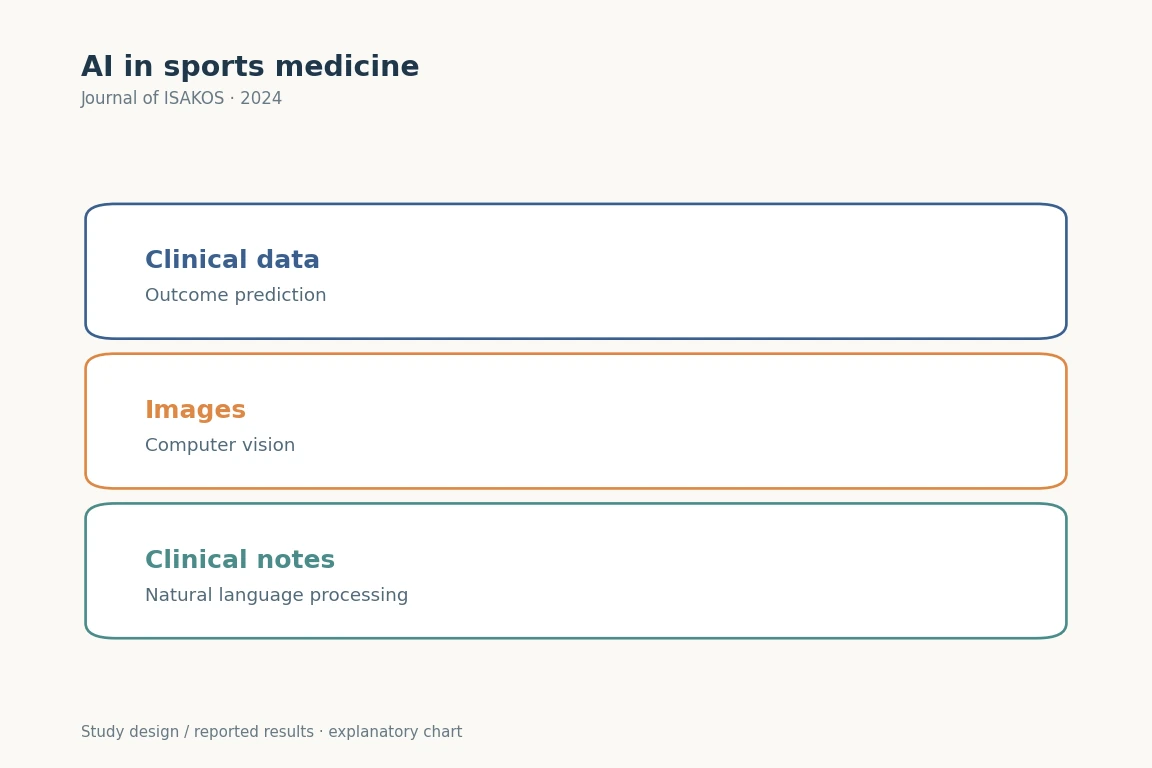 그림 크게 보기
표 형태 자료의 예후 예측, 영상 분석, 자연어 처리 연구를 구분한 설명 도표입니다.
Journal of ISAKOS (2024). DOI: 10.1016/j.jisako.2024.01.013 · Original explanatory chart based on reported data
연구에서 묻는 질문
대상과 방법
주요 결과
진료와 수술에서 읽을 지점
해석의 제한
짧게 정리하면
어떤 진료 질문과 연결되나요?
수술 전 예후 상담에 필요한 예측 질문과 영상 판독의 질문을 구분하는 데 도움이 됩니다. 임상에서 알고 싶은 결과를 먼저 정하고, 그 결과에 맞는 자료와 검증 방법을 선택하는 것이 출발점입니다.
Keywords · 주제어
- Artificial intelligence
- Deep learning
- Machine learning
- Orthopaedic surgery
- Predictive models
- Sports medicine
- Machine Learning
- Sports Medicine
Abstract · 원문 초록
Ayoosh Pareek, Du Hyun Ro, Jón Karlsson, R Kyle Martin. Machine learning/artificial intelligence in sports medicine: state of the art and future directions. Journal of ISAKOS : joint disorders & orthopaedic sports medicine. 2024;9(4):635-644. doi:10.1016/j.jisako.2024.01.013.
Machine learning (ML) is changing the way health care is practiced and recent applications of these novel statistical techniques have started to impact orthopaedic sports medicine. Machine learning enables the analysis of large volumes of data to establish complex relationships between "input" and "output" variables. These relationships may be more complex than could be established through traditional statistical analysis and can lead to the ability to predict the "output" with high levels of accuracy. Supervised learning is the most common ML approach for healthcare data and recent studies have developed algorithms to predict patient-specific outcome after surgical procedures such as hip arthroscopy and anterior cruciate ligament reconstruction. Deep learning is a higher-level ML approach that facilitates the processing and interpretation of complex datasets through artificial neural networks that are inspired by the way the human brain processes information. In orthopaedic sports medicine, deep learning has primarily been used for automatic image (computer vision) and text (natural language processing) interpretation. While applications in orthopaedic sports medicine have been increasing exponentially, one significant barrier to widespread adoption of ML remains clinician unfamiliarity with the associated methods and concepts. The goal of this review is to introduce these concepts, review current machine learning models in orthopaedic sport medicine, and discuss future opportunities for innovation within the specialty.
원래 논문
Machine learning/artificial intelligence in sports medicine: state of the art and future directions
Ayoosh Pareek, Du Hyun Ro, Jón Karlsson, R. Kyle Martin
Journal of ISAKOS · 2024