2024 · Journal of ISAKOS
スポーツ医学で機械学習と深層学習はどの問いに答えられますか?
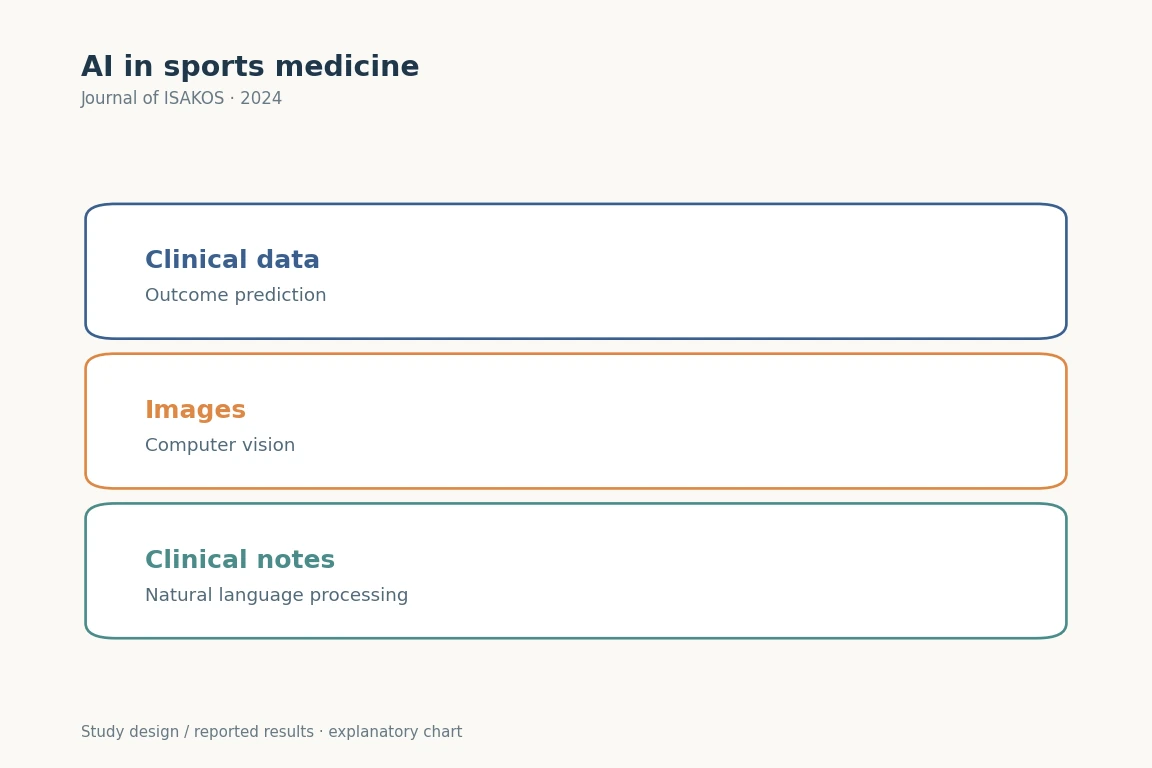
適用領域を臨床表資料の予後予測、画像の構造認識、手術記録の自然言語処理に分けました。
研究の問いと設計
 図を拡大する
表形式データによる予後予測、画像解析、自然言語処理の研究を区別した説明図です。
Journal of ISAKOS (2024). DOI: 10.1016/j.jisako.2024.01.013 · Original explanatory chart based on reported data
研究で問うこと
対象と方法
主な結果
診療・手術で考える点
解釈の限界
簡単に説明しましょう
どの診療上の問いにつながりますか?
術前の予後相談と画像読影の問いを区別する助けになります。知りたい臨床結果をまず定め、それに合う資料と検証法を選ぶことが出発点です。
Keywords・キーワード
- Artificial intelligence
- Deep learning
- Machine learning
- Orthopaedic surgery
- Predictive models
- Sports medicine
- Machine Learning
- Sports Medicine
Abstract・原文の抄録
Ayoosh Pareek, Du Hyun Ro, Jón Karlsson, R Kyle Martin. Machine learning/artificial intelligence in sports medicine: state of the art and future directions. Journal of ISAKOS : joint disorders & orthopaedic sports medicine. 2024;9(4):635-644. doi:10.1016/j.jisako.2024.01.013.
Machine learning (ML) is changing the way health care is practiced and recent applications of these novel statistical techniques have started to impact orthopaedic sports medicine. Machine learning enables the analysis of large volumes of data to establish complex relationships between "input" and "output" variables. These relationships may be more complex than could be established through traditional statistical analysis and can lead to the ability to predict the "output" with high levels of accuracy. Supervised learning is the most common ML approach for healthcare data and recent studies have developed algorithms to predict patient-specific outcome after surgical procedures such as hip arthroscopy and anterior cruciate ligament reconstruction. Deep learning is a higher-level ML approach that facilitates the processing and interpretation of complex datasets through artificial neural networks that are inspired by the way the human brain processes information. In orthopaedic sports medicine, deep learning has primarily been used for automatic image (computer vision) and text (natural language processing) interpretation. While applications in orthopaedic sports medicine have been increasing exponentially, one significant barrier to widespread adoption of ML remains clinician unfamiliarity with the associated methods and concepts. The goal of this review is to introduce these concepts, review current machine learning models in orthopaedic sport medicine, and discuss future opportunities for innovation within the specialty.
オリジナル紙だ
Machine learning/artificial intelligence in sports medicine: state of the art and future directions
Ayoosh Pareek, Du Hyun Ro, Jón Karlsson, R. Kyle Martin
Journal of ISAKOS · 2024