2025 · Knee Surgery & Related Research
Two-stage reimplantation 후 PJI 재발 위험 요인은 무엇일까?
15/65명(23.1%)에서 감염이 재발했습니다. 재발 시점 중앙값은 11개월(범위 4–108개월)이었습니다.
원문 Fig. 4
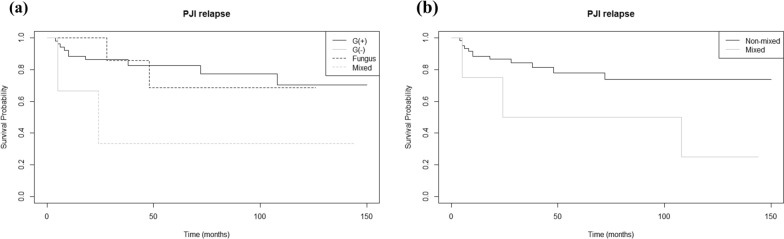 그림 크게 보기
두 단계 재치환술 후 균 종류별 감염 재발 없는 생존곡선입니다.
Do Weon Lee, Hyuk-Soo Han, Du Hyun Ro. Risk factors of recurrent periprosthetic joint infection of the knee after two-stage reimplantation. Knee Surgery & Related Research (2025). DOI: 10.1186/s43019-025-00258-5. © The Author(s) 2025
원문 캡션
PJI relapse survival curve of the patients according to the type of pathogen that caused the initial PJI; comparison between …
대상과 방법
그림을 읽는 순서
주요 결과
진료·수술에서 읽을 지점
해석의 제한
짧게 정리하면
이 연구가 확인한 것은 무엇인가요?
15/65명(23.1%)에서 감염이 재발했습니다. 재발 시점 중앙값은 11개월(범위 4–108개월)이었습니다.
개별 환자의 치료 결정에 바로 적용할 수 있나요?
작은 표본과 15건의 재발 사건입니다. HR 40.29를 안정적인 일반 인구의 위험 배수로 외삽해서는 안 됩니다. 치료 전략의 무작위시험이 아닙니다.
Keywords · 주제어
- Prosthesis-related infection
- Survival analysis
- Total knee arthroplasty
- TKA
- revision
- PJI
Abstract · 원문 초록
Do Weon Lee, Hyuk-Soo Han, Du Hyun Ro. Risk factors of recurrent periprosthetic joint infection of the knee after two-stage reimplantation. Knee surgery & related research. 2025;37(1):4. doi:10.1186/s43019-025-00258-5.
INTRODUCTION
Prosthetic joint infection (PJI) is one of the most common and detrimental complications of total knee replacement arthroplasty (TKA). Despite extensive efforts, including two-stage reimplantation, to eradicate PJI, it still recurs in a substantial number of patients. However, the risk factors of recurrence after two-stage reimplantation of the knee have not been established. In this study, it is hypothesized that there will be certain risk factors of recurrence after two-stage reimplantation for PJI of the knee.
MATERIALS AND METHODS
From March 2002 to December 2022, 65 knees that underwent two-stage reimplantation for PJIs in a single, tertiary hospital were retrospectively reviewed, and 44 patient-related, laboratory-related, and surgery-related factors, including body mass index, pathogen type, and the usage of transfusions, were selected as the potential risk factors for recurrence. Survival analysis using the Kaplan-Meier method and subsequent Cox proportional hazard regression were performed.
RESULTS
Out of the 65 knees that underwent two-stage reimplantation, infection recurred in 15 knees (23.1%) in a median 11 (range 4-108) months. The Cox proportional hazards regression showed that infection of revision TKA, mixed pathogen-type infection, and higher serum erythrocyte sedimentation rate (ESR, mm/h) level increases the risk of recurrence (p-values < 0.001, 0.04, and 0.009; hazard ratios 40.29, 1.53, and 1.03, respectively).
CONCLUSIONS
A significant portion of PJI of the knees recurred after two-stage reimplantation. Revision TKA at the time of initial PJI, mixed pathogen-type infection, and higher serum ESR level were three significant risk factors of PJI recurrence. Surgeons should be more cautious in suspecting PJI relapse for these specific occasions.
LEVEL OF EVIDENCE
III, retrospective cohort study.
© The Author(s) 2025
원래 논문
Risk factors of recurrent periprosthetic joint infection of the knee after two-stage reimplantation
Do Weon Lee, Hyuk-Soo Han, Du Hyun Ro
Knee Surgery & Related Research · 2025