2025 · Knee Surgery & Related Research
二期的再置換術後のPJI再発リスク因子は何か?
15/65人(23.1%)で感染が再発しました。再発時期の中央値は11か月(範囲4–108か月)でした。
図4はオリジナルです
 図を拡大する
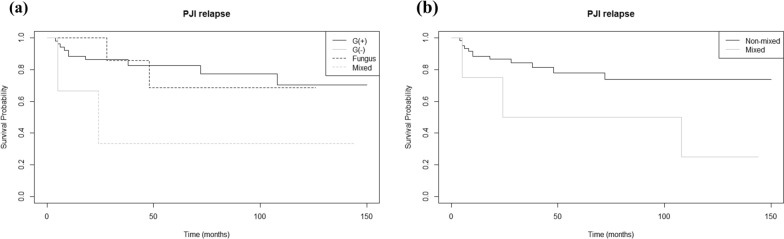
二期的再置換術後の、菌種別感染非再発生存曲線です。
Do Weon Lee, Hyuk-Soo Han, Du Hyun Ro. Risk factors of recurrent periprosthetic joint infection of the knee after two-stage reimplantation. Knee Surgery & Related Research (2025). DOI: 10.1186/s43019-025-00258-5. © The Author(s) 2025
原著の図の説明
PJI relapse survival curve of the patients according to the type of pathogen that caused the initial PJI; comparison between …
対象と方法
絵を読んだ順序です
主な結果
手術に関する読書のポイント
解釈の限界
簡単に説明しましょう
この研究で何が確認されましたか?
15/65人(23.1%)で感染が再発しました。再発時期の中央値は11か月(範囲4–108か月)でした。
治療決定に直接適用できるか?
小規模標本で再発は15件です。HR 40.29を一般集団の安定したリスク倍率として外挿してはいけません。治療戦略の無作為化試験ではありません。
Keywords・キーワード
- Prosthesis-related infection
- Survival analysis
- Total knee arthroplasty
- TKA
- revision
- PJI
Abstract・原文の抄録
Do Weon Lee, Hyuk-Soo Han, Du Hyun Ro. Risk factors of recurrent periprosthetic joint infection of the knee after two-stage reimplantation. Knee surgery & related research. 2025;37(1):4. doi:10.1186/s43019-025-00258-5.
INTRODUCTION
Prosthetic joint infection (PJI) is one of the most common and detrimental complications of total knee replacement arthroplasty (TKA). Despite extensive efforts, including two-stage reimplantation, to eradicate PJI, it still recurs in a substantial number of patients. However, the risk factors of recurrence after two-stage reimplantation of the knee have not been established. In this study, it is hypothesized that there will be certain risk factors of recurrence after two-stage reimplantation for PJI of the knee.
MATERIALS AND METHODS
From March 2002 to December 2022, 65 knees that underwent two-stage reimplantation for PJIs in a single, tertiary hospital were retrospectively reviewed, and 44 patient-related, laboratory-related, and surgery-related factors, including body mass index, pathogen type, and the usage of transfusions, were selected as the potential risk factors for recurrence. Survival analysis using the Kaplan-Meier method and subsequent Cox proportional hazard regression were performed.
RESULTS
Out of the 65 knees that underwent two-stage reimplantation, infection recurred in 15 knees (23.1%) in a median 11 (range 4-108) months. The Cox proportional hazards regression showed that infection of revision TKA, mixed pathogen-type infection, and higher serum erythrocyte sedimentation rate (ESR, mm/h) level increases the risk of recurrence (p-values < 0.001, 0.04, and 0.009; hazard ratios 40.29, 1.53, and 1.03, respectively).
CONCLUSIONS
A significant portion of PJI of the knees recurred after two-stage reimplantation. Revision TKA at the time of initial PJI, mixed pathogen-type infection, and higher serum ESR level were three significant risk factors of PJI recurrence. Surgeons should be more cautious in suspecting PJI relapse for these specific occasions.
LEVEL OF EVIDENCE
III, retrospective cohort study.
© The Author(s) 2025
オリジナル紙だ
Risk factors of recurrent periprosthetic joint infection of the knee after two-stage reimplantation
Do Weon Lee, Hyuk-Soo Han, Du Hyun Ro
Knee Surgery & Related Research · 2025