
2025 · Journal of Orthopaedic Research
편측 OA 환자에서 반대측 KL ≥2 발생을 예측할 수 있을까?
반대측 OA는 OAI 172/900명(19.1%), MOST 178/453명(39.3%)에서 발생했습니다.
원문 Figure 1
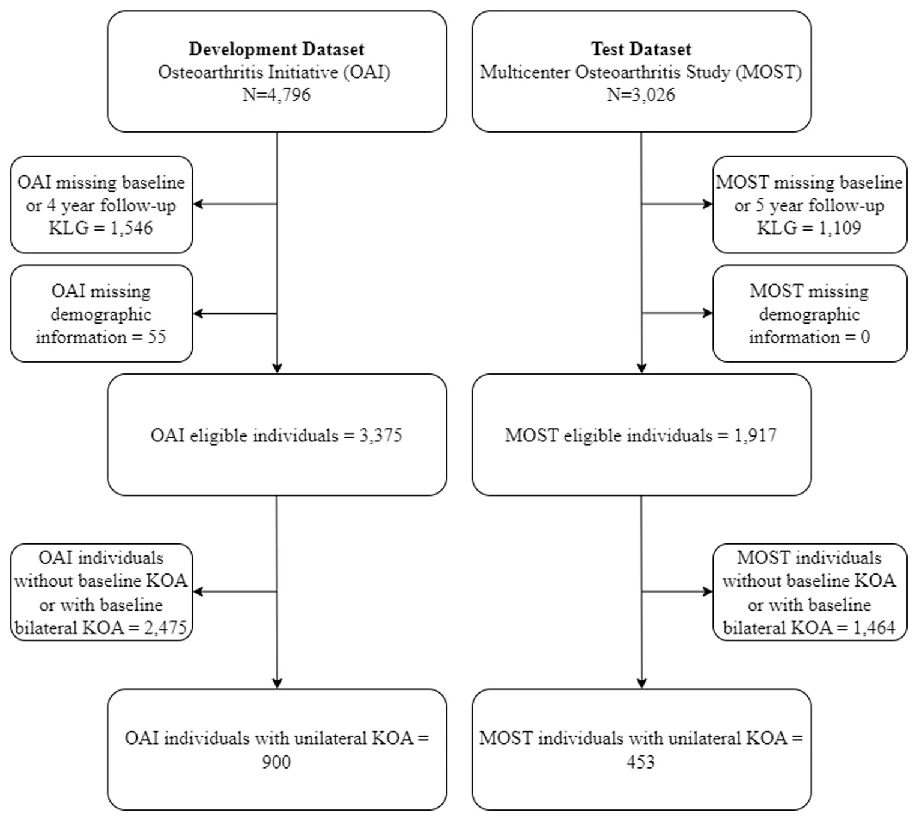 그림 크게 보기
OAI 개발군과 MOST 시험군의 선정 흐름입니다. 최종 분석은 편측 관절염이 있는 900명과 453명을 대상으로 했습니다.
Journal of Orthopaedic Research (2025). DOI: 10.1002/jor.26018 · Original Figure 1
원문 Figure 2
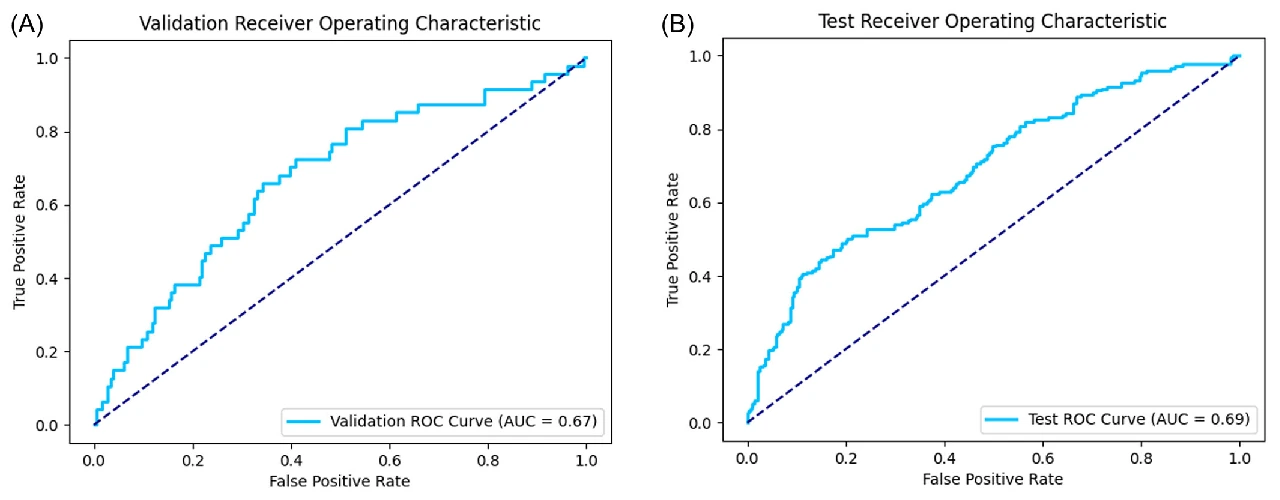 그림 크게 보기
검증군과 독립 시험군의 ROC 곡선입니다. MOST 시험군 AUC는 0.69로 반대쪽 무릎의 관절염 발생을 구분했습니다.
Journal of Orthopaedic Research (2025). DOI: 10.1002/jor.26018 · Original Figure 2
원문 Figure 4
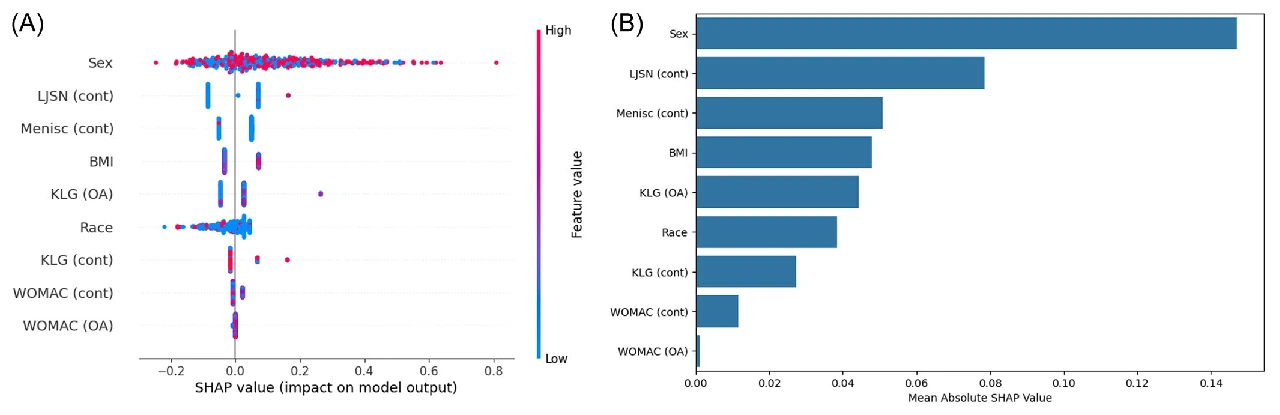 그림 크게 보기
9개 예측 변수의 SHAP 분석입니다. 반대쪽 무릎의 초기 외측 관절간격 협소가 주요 변수로 나타났습니다.
Journal of Orthopaedic Research (2025). DOI: 10.1002/jor.26018 · Original Figure 4
연구에서 묻는 질문
대상과 방법
주요 결과
진료와 수술에서 읽을 지점
해석의 제한
짧게 정리하면
어떤 진료 질문과 연결되나요?
편측 OA 관리 중 반대측 무릎도 함께 추적하는 위험 분류 연구입니다.
Keywords · 주제어
- knee
- machine learning
- osteoarthritis
- risk factor
- Osteoarthritis, Knee
- Machine Learning
- Risk Factors
- contralateral knee
Abstract · 원문 초록
Ji-Sahn Kim, Byung Sun Choi, Sung Eun Kim, Yong Seuk Lee, Do Weon Lee, Du Hyun Ro. Machine learning-based prediction of contralateral knee osteoarthritis development using the Osteoarthritis Initiative and the Multicenter Osteoarthritis Study dataset. Journal of orthopaedic research : official publication of the Orthopaedic Research Society. 2025;43(3):576-585. doi:10.1002/jor.26018.
Having osteoarthritis in one knee is reported as an independent risk factor for developing contralateral knee osteoarthritis (KOA). However, no study has been designed to predict the development of contralateral KOA (cKOA). The authors hypothesized that specific risk factors for cKOA development exist and that it could be accurately predicted with the assistance of machine learning. KOA was defined using the Kellgren-Lawrence grade (KLG) of 2 or higher. Data from 1353 unilateral KOA patients (900 from the Osteoarthritis Initiative [OAI] and 453 from the Multicenter Osteoarthritis Study [MOST]) over 4-5 years of follow-up were examined. The risk factors for cKOA development were analyzed, and a machine learning model was developed to predict cKOA using OAI as the development data set and MOST as the test data set. cKOA developed in 172 (19.1%) and 178 (39.3%) of the patients (OAI and MOST, respectively) over a period of 4-5 years. A machine learning model was developed using the Tree-based Pipeline Optimization Tool algorithm. This model utilized nine variables, including baseline lateral joint space narrowing grade of the contralateral knee (odds ratio 4.475). The area under the curve of the receiver operating characteristics curve, along with accuracy, precision, and F1-score, were recorded as 0.69, 0.60, 0.50, and 0.58, respectively, in the test data set. The development of cKOA could be effectively predicted using a limited number of variables through machine learning. Surgeons should consider the development of cKOA in patients with identified risk factors when managing KOA patients.
원래 논문
Machine learning-based prediction of contralateral knee osteoarthritis development using the Osteoarthritis Initiative and the Multicenter Osteoarthritis Study dataset
Ji-Sahn Kim, Byung Sun Choi, Sung Eun Kim, Yong Seuk Lee, Do Weon Lee, Du Hyun Ro
Journal of Orthopaedic Research · 2025 · online 2024