
2025 · Journal of Orthopaedic Research
片側OA患者で、反対側のKL ≥2の発生を予測できるか?
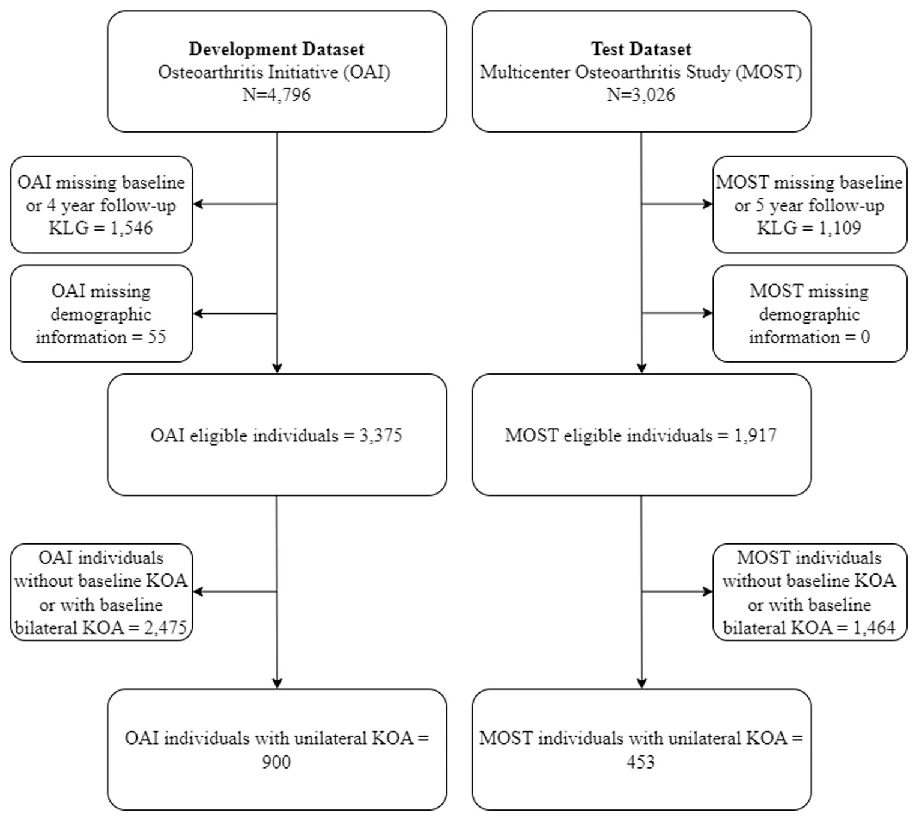
反対側OAはOAI 172/900人(19.1%)、MOST 178/453人(39.3%)で発症しました。
原図Figure 1
 図を拡大する
OAI開発群とMOST試験群の選択フローです。最終解析は片側関節症のある900人と453人が対象でした。
Journal of Orthopaedic Research (2025). DOI: 10.1002/jor.26018 · Original Figure 1
原図Figure 2
 図を拡大する
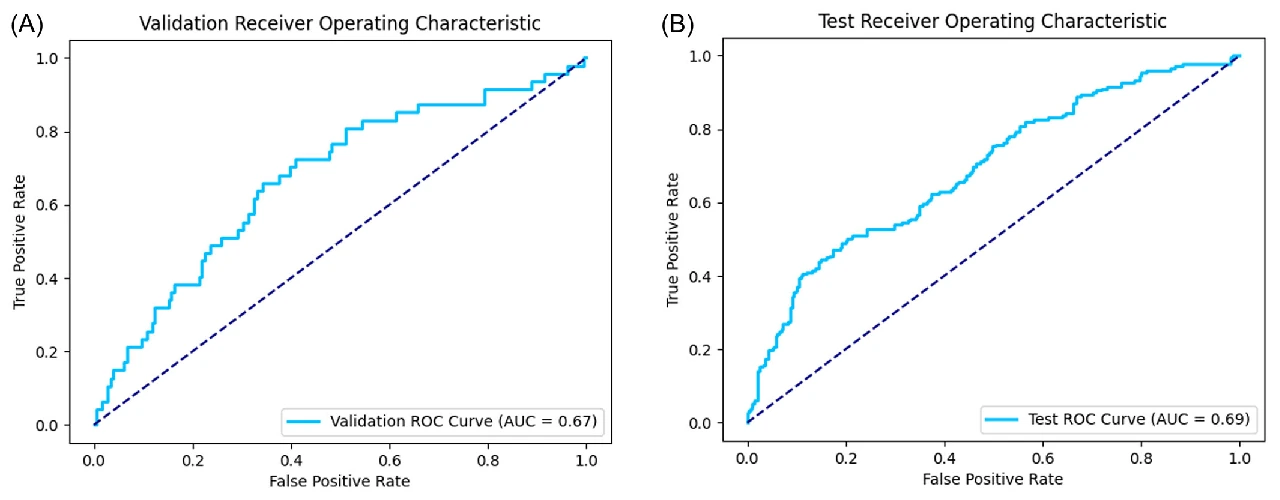
検証群と独立試験群のROC曲線です。MOST試験群のAUCは0.69で、反対側関節症の発症を識別しました。
Journal of Orthopaedic Research (2025). DOI: 10.1002/jor.26018 · Original Figure 2
原図Figure 4
 図を拡大する
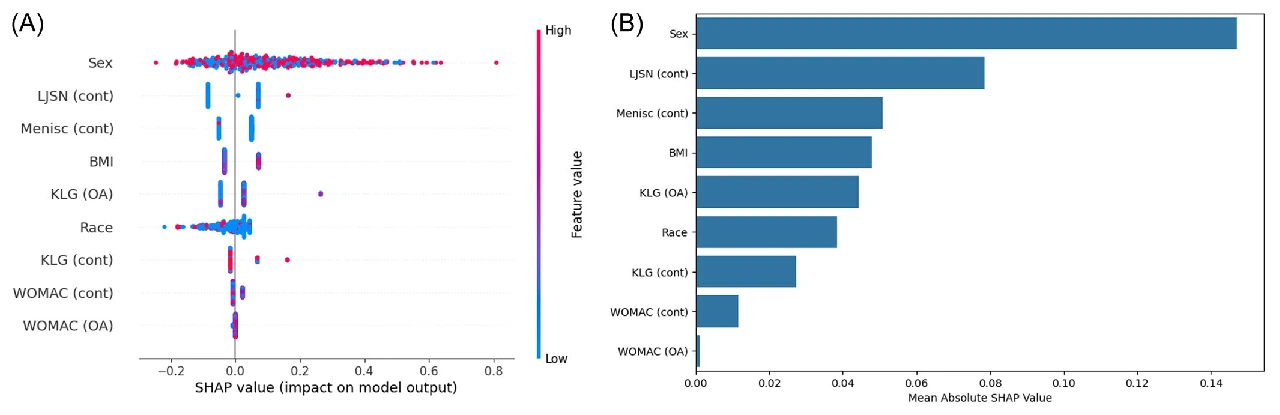
9つの予測変数のSHAP解析です。反対側の初期外側関節裂隙狭小化が主要変数でした。
Journal of Orthopaedic Research (2025). DOI: 10.1002/jor.26018 · Original Figure 4
研究で問うこと
対象と方法
主な結果
診療・手術で考える点
解釈の限界
簡単に説明しましょう
どの診療上の問いにつながりますか?
片側OAの管理中に、反対側の膝も併せて追跡するためのリスク分類研究です。
Keywords・キーワード
- knee
- machine learning
- osteoarthritis
- risk factor
- Osteoarthritis, Knee
- Machine Learning
- Risk Factors
- contralateral knee
Abstract・原文の抄録
Ji-Sahn Kim, Byung Sun Choi, Sung Eun Kim, Yong Seuk Lee, Do Weon Lee, Du Hyun Ro. Machine learning-based prediction of contralateral knee osteoarthritis development using the Osteoarthritis Initiative and the Multicenter Osteoarthritis Study dataset. Journal of orthopaedic research : official publication of the Orthopaedic Research Society. 2025;43(3):576-585. doi:10.1002/jor.26018.
Having osteoarthritis in one knee is reported as an independent risk factor for developing contralateral knee osteoarthritis (KOA). However, no study has been designed to predict the development of contralateral KOA (cKOA). The authors hypothesized that specific risk factors for cKOA development exist and that it could be accurately predicted with the assistance of machine learning. KOA was defined using the Kellgren-Lawrence grade (KLG) of 2 or higher. Data from 1353 unilateral KOA patients (900 from the Osteoarthritis Initiative [OAI] and 453 from the Multicenter Osteoarthritis Study [MOST]) over 4-5 years of follow-up were examined. The risk factors for cKOA development were analyzed, and a machine learning model was developed to predict cKOA using OAI as the development data set and MOST as the test data set. cKOA developed in 172 (19.1%) and 178 (39.3%) of the patients (OAI and MOST, respectively) over a period of 4-5 years. A machine learning model was developed using the Tree-based Pipeline Optimization Tool algorithm. This model utilized nine variables, including baseline lateral joint space narrowing grade of the contralateral knee (odds ratio 4.475). The area under the curve of the receiver operating characteristics curve, along with accuracy, precision, and F1-score, were recorded as 0.69, 0.60, 0.50, and 0.58, respectively, in the test data set. The development of cKOA could be effectively predicted using a limited number of variables through machine learning. Surgeons should consider the development of cKOA in patients with identified risk factors when managing KOA patients.
オリジナル紙だ
Machine learning-based prediction of contralateral knee osteoarthritis development using the Osteoarthritis Initiative and the Multicenter Osteoarthritis Study dataset
Ji-Sahn Kim, Byung Sun Choi, Sung Eun Kim, Yong Seuk Lee, Do Weon Lee, Du Hyun Ro
Journal of Orthopaedic Research · 2025 · online 2024