2024 · Knee Surgery & Related Research
장비와 촬영 방식이 다른 병원에서도 하지 정렬을 같은 기준으로 측정할 수 있을까요?
전문의 측정과의 inter-observer ICC는 0.936–0.997이었고 같은 영상의 반복 측정 ICC는 1.000이었습니다.
원문 Figure 2 · 서로 다른 세 기관의 X-ray
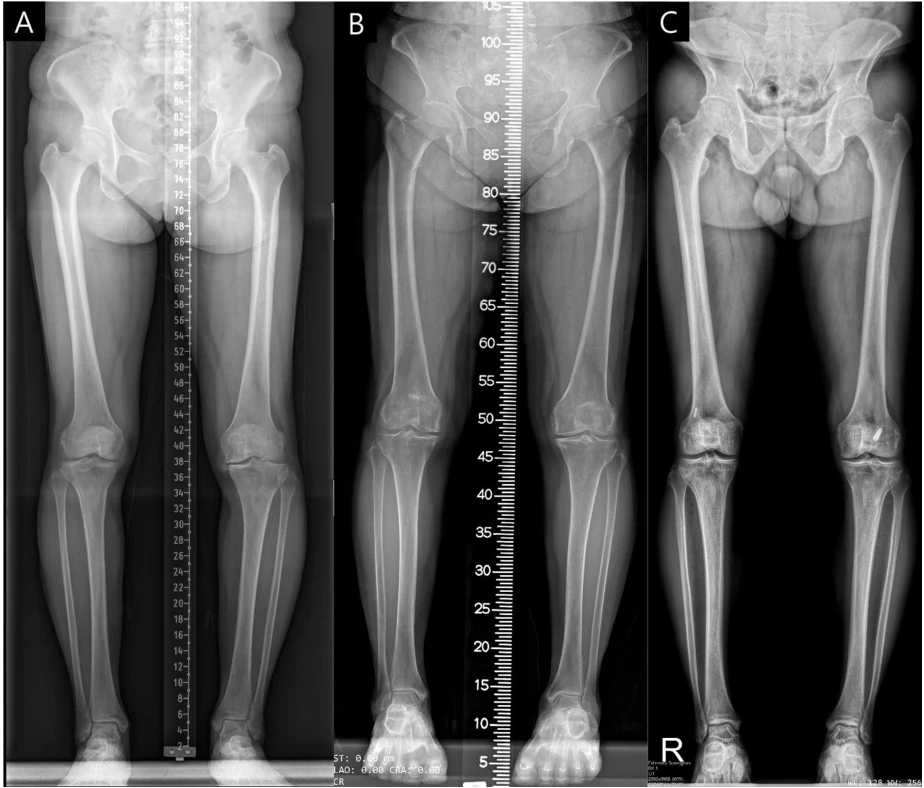 그림 크게 보기
외부 검증에 사용한 세 기관(A·B·C)의 촬영 영상입니다. 명암과 촬영 범위에 따른 기준점 인식 성능을 평가했습니다.
Sung Eun Kim, Jun Woo Nam, Joong Il Kim, Jong-Keun Kim, Du Hyun Ro. Knee Surgery & Related Research (2024). DOI: 10.1186/s43019-023-00209-y
연구에서 묻는 질문
대상과 방법
주요 결과
진료와 수술에서 읽을 지점
해석의 제한
짧게 정리하면
어떤 진료 질문과 연결되나요?
CONNEVO Metric의 측정 기술과 연결되는 외부 검증입니다. 빠르게 반복 측정하되 기준점 표시를 원본 영상에서 확인하고, 촬영 자세와 관절 내 변형을 함께 읽는 과정이 중요합니다.
Keywords · 주제어
- Accuracy
- Alignment measurement
- Deep learning
- Full-leg radiographs
- Imaging protocol
- AI
- Metric
- alignment
Abstract · 원문 초록
Sung Eun Kim, Jun Woo Nam, Joong Il Kim, Jong-Keun Kim, Du Hyun Ro. Enhanced deep learning model enables accurate alignment measurement across diverse institutional imaging protocols. Knee surgery & related research. 2024;36(1):4. doi:10.1186/s43019-023-00209-y.
BACKGROUND
Achieving consistent accuracy in radiographic measurements across different equipment and protocols is challenging. This study evaluates an advanced deep learning (DL) model, building upon a precursor, for its proficiency in generating uniform and precise alignment measurements in full-leg radiographs irrespective of institutional imaging differences.
METHODS
The enhanced DL model was trained on over 10,000 radiographs. Utilizing a segmented approach, it separately identified and evaluated regions of interest (ROIs) for the hip, knee, and ankle, subsequently integrating these regions. For external validation, 300 datasets from three distinct institutes with varied imaging protocols and equipment were employed. The study measured seven radiologic parameters: hip-knee-ankle angle, lateral distal femoral angle, medial proximal tibial angle, joint line convergence angle, weight-bearing line ratio, joint line obliquity angle, and lateral distal tibial angle. Measurements by the model were compared with an orthopedic specialist's evaluations using inter-observer and intra-observer intraclass correlation coefficients (ICCs). Additionally, the absolute error percentage in alignment measurements was assessed, and the processing duration for radiograph evaluation was recorded.
RESULTS
The DL model exhibited excellent performance, achieving an inter-observer ICC between 0.936 and 0.997, on par with an orthopedic specialist, and an intra-observer ICC of 1.000. The model's consistency was robust across different institutional imaging protocols. Its accuracy was particularly notable in measuring the hip-knee-ankle angle, with no instances of absolute error exceeding 1.5 degrees. The enhanced model significantly improved processing speed, reducing the time by 30-fold from an initial 10-11 s to 300 ms.
CONCLUSIONS
The enhanced DL model demonstrated its ability for accurate, rapid alignment measurements in full-leg radiographs, regardless of protocol variations, signifying its potential for broad clinical and research applicability.
© The Author(s) 2024
원래 논문
Enhanced deep learning model enables accurate alignment measurement across diverse institutional imaging protocols
Sung Eun Kim, Jun Woo Nam, Joong Il Kim, Jong-Keun Kim, Du Hyun Ro
Knee Surgery & Related Research · 2024