2025 · The Spine Journal
側弯のある脊椎のX線画像でも、骨盤と腰椎の角度を自動測定できるか?
反復測定のICCはすべての角度で1.00でした。基準値との一致度と交差検証のICCは0.96–0.99でした。
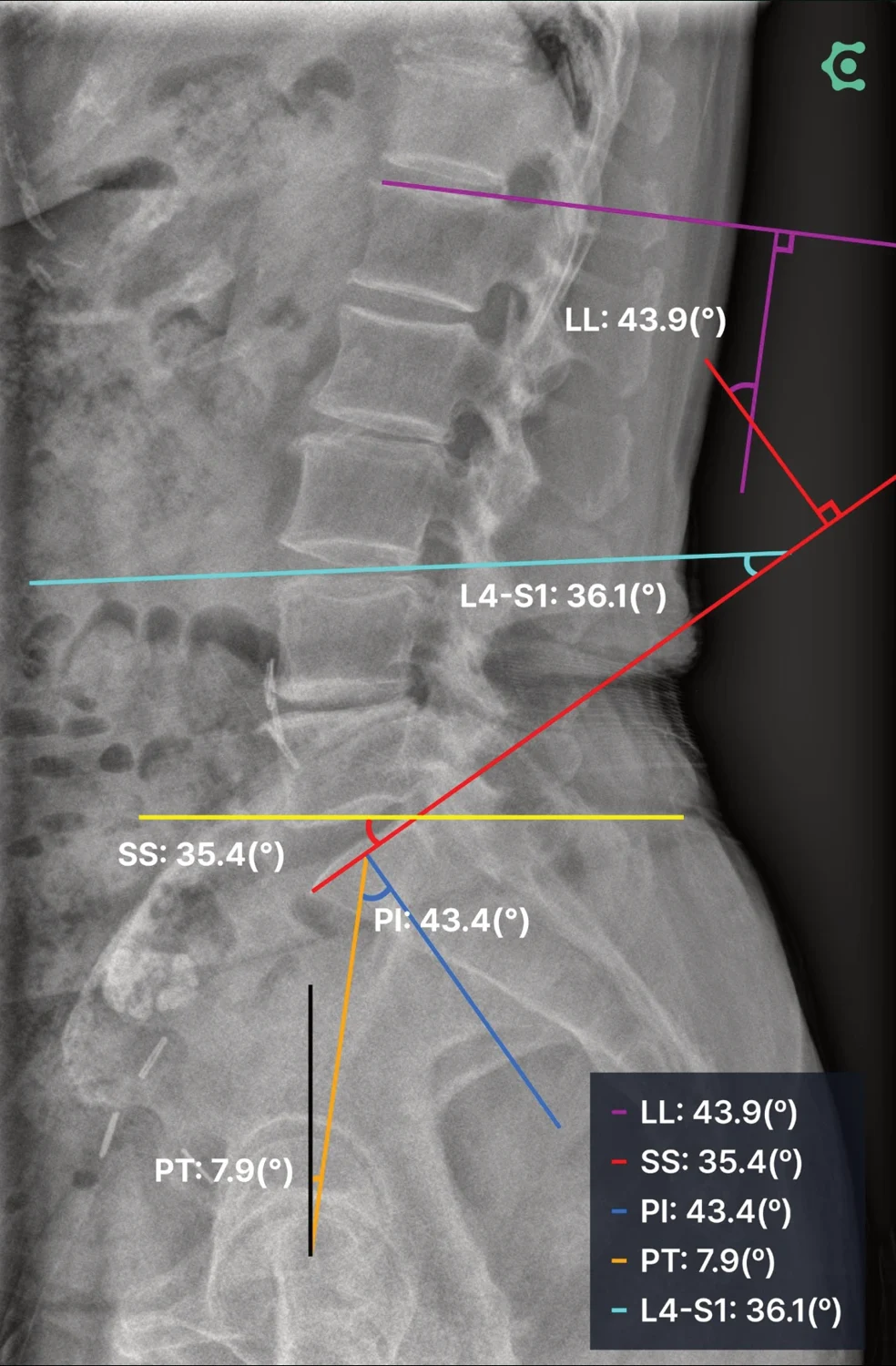
脊椎・骨盤角度を読む側面X線
 図を拡大する
LL・PI・PT・SSと基準点を示した側面X線画像です。
CONNECTEVE · CONNEVO SPIN · Owner-supplied product brochure
研究の数値から読む結果
 図を拡大する
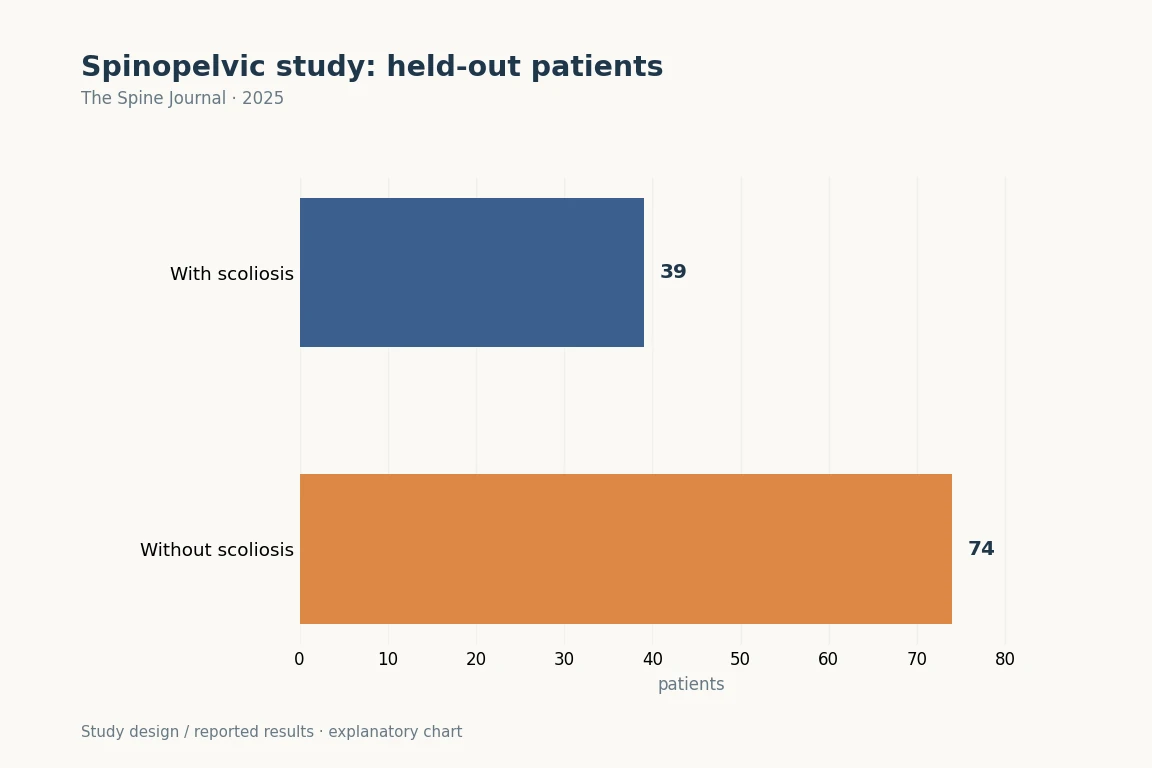
試験113人中39人が変性側弯症でした。LL・PI・PT・SSの測定は分類診断とは異なります。同じ画像の反復ICC 1.00と専門医基準値との一致度を区別する必要があります。
The Spine Journal (2025). DOI: 10.1016/j.spinee.2025.01.020 · Original explanatory chart based on reported data
研究で問うこと
対象と方法
主な結果
診療・手術で考える点
解釈の限界
簡単に説明しましょう
どの診療上の問いにつながりますか?
脊椎骨盤アライメントを繰り返し測定する負担を減らせる可能性があります。PI–LLミスマッチと代償性PTを読む際は、画像品質、大腿骨頭の検出、個々の画像の誤差を先に確認します。
Keywords・キーワード
- Artificial intelligence
- Convolutional neural network
- Coronal deformity
- Keypoint detection
- Pelvic parameter
- Sagittal alignment
- Segmentation
- Neural Networks, Computer
Abstract・原文の抄録
Dong-Ho Kang, Ye-Jin Jeong, Sung Taeck Kim, Younguk Kim, Bong-Soon Chang, Hyoungmin Kim, Sam Yeol Chang, Du Hyun Ro. Automated measurement of pelvic parameters using convolutional neural network in complex spinal deformities: overcoming challenges in coronal deformity cases. The spine journal : official journal of the North American Spine Society. 2025;25(8):1688-1697. doi:10.1016/j.spinee.2025.01.020.
BACKGROUND CONTEXT
Accurate and consistent measurement of sagittal alignment is challenging, particularly in patients with severe coronal deformities, including degenerative lumbar scoliosis (DLS).
PURPOSE
This study aimed to develop and validate an artificial intelligence (AI)-based system for automating the measurement of key sagittal parameters, including lumbar lordosis, pelvic incidence, pelvic tilt, and sacral slope, with a focus on its applicability across a wide range of deformities, including severe coronal deformities, such as DLS.
DESIGN
Retrospective observational study.
PATIENT SAMPLE
A total of 1,011 standing lumbar lateral radiographs, including DLS.
OUTCOME MEASURE
Interclass and intraclass correlation coefficients (CC), and Bland-Altman plots.
METHODS
The model utilizes a deep-learning framework, incorporating a U-Net for segmentation and a Keypoint Region-based Convolutional Neural Network for keypoint detection. The ground truth masks were annotated by an experienced orthopedic specialist. The performance of the model was evaluated against ground truth measurements and assessments from two expert raters using interclass and intraclass CC, and Bland-Altman plots.
RESULTS
In the test set of 113 patients, 39 (34.5%) had DLS, with a mean Cobb's angle of 14.8°±4.4°. The AI model achieved an intraclass CC of 1.00 across all parameters, indicating perfect consistency. Interclass CCs comparing the AI model to ground truth ranged from 0.96 to 0.99, outperforming experienced orthopedic surgeons. Bland-Altman analysis revealed no significant systemic bias, with most differences falling within clinically acceptable ranges. A 5-fold cross-validation further demonstrated robust performance, with interclass CCs ranging from 0.96 to 0.99 across diverse subsets.
CONCLUSION
This AI-based system offers a reliable and efficient automated measurement of sagittal parameters in spinal deformities, including severe coronal deformities. The superior performance of the model compared with that of expert raters highlights its potential for clinical applications.
オリジナル紙だ
Automated measurement of pelvic parameters using convolutional neural network in complex spinal deformities: overcoming challenges in coronal deformity cases
Kang DH, Jeong YJ, Kim ST, Kim Y, Chang BS, Kim H, Chang SY, Ro DH
The Spine Journal · 2025