2025 · Orthopaedic Journal of Sports Medicine
韓国で開発したPTSモデルは、ノルウェーのACL損傷患者の撮影範囲の短いX線画像にも適用できるか?
自動と手動のICC 0.73–0.80、手動評価者間ICC 0.86、評価者内ICC 0.92、モデル反復ICC 1.00でした。
元の図1
 図を拡大する
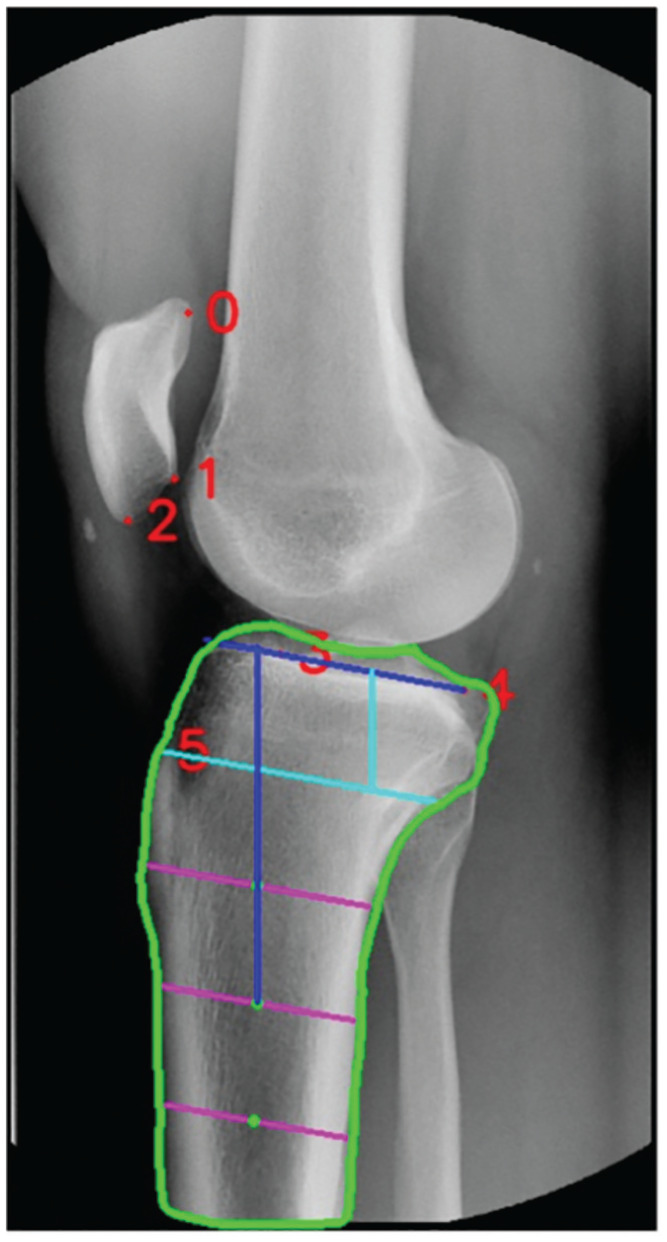
撮影範囲の短い側面X線画像で、脛骨の輪郭と2A・3Aの基準から軸を求める例です。画像上の点と線を直接確認できます。
Kyle R Martin, Sanna Haaland, Andreas Persson, Sung Eun Kim, ByeongYeong Ryu, Jun Woo Nam, Du Hyun Ro, Eivind Inderhaug. External Validation of a Novel Landmark-Based Deep Learning Automated Tibial Slope Measurement Algorithm Applied on Short Radiographs Obtained in Patients With ACL Injuries. Orthopaedic Journal of Sports Medicine (2025). DOI: 10.1177/23259671251333607. © The Author(s) 2025
原著の図の説明
Automated measurement of the posterior tibial slope on a short lateral knee radiograph using the 2A/3A method, demonstrating a slope …
研究で問うこと
対象と方法
主な結果
診療・手術で考える点
解釈の限界
簡単に説明しましょう
どの診療上の問いにつながりますか?
ACL手術評価で外部性能を検討し、外れ値を手動で確認する必要性も示しています。
Keywords・キーワード
- anterior cruciate ligament
- artificial intelligence
- automated reading
- deep learning
- posterior tibial slope
- radiographs
- AI
- external validation
Abstract・原文の抄録
Kyle R Martin, Sanna Haaland, Andreas Persson, Sung Eun Kim, ByeongYeong Ryu, Jun Woo Nam, Du Huy Ro, Eivind Inderhaug. External Validation of a Novel Landmark-Based Deep Learning Automated Tibial Slope Measurement Algorithm Applied on Short Radiographs Obtained in Patients With ACL Injuries. Orthopaedic journal of sports medicine. 2025;13(5):23259671251333607. doi:10.1177/23259671251333607.
BACKGROUND
Deep learning algorithms can aid medical decision-making by performing routine tasks without any human error. Reading of standardized radiographs lends itself well to a computerized approach. The posterior tibial slope is increasingly recognized as a factor in lower leg biomechanics. Slope readings should, therefore, be readily available when considering knee ligament or knee replacement surgery.
PURPOSE/HYPOTHESIS
The purpose was to externally validate a deep learning model developed for posterior tibial slope readings by applying an independent data set, not included in initial development, for testing the reliability of the model, compared with human performance testing. It was hypothesized that a computerized approach would yield a reliability similar to that of human analyses.
STUDY DESIGN
Descriptive laboratory study.
METHODS
A consecutive series of lateral knee radiographs obtained in patients undergoing anterior cruciate ligament surgery were eligible for inclusion. Two independent experienced clinicians individually assessed the tibial slope measurement to establish the interreader reliability. Furthermore, all images were processed by the newly developed model for the automated readings. Intrarater and interrater reliability were thereafter established between readers and between manual and automated readings, measured by intraclass correlation coefficients (ICCs). Time consumption between methods was noted. Extreme differences between the 2 methods were analyzed for potential errors.
RESULTS
A total of 289 radiographs were included in the study and therefore analyzed by both the manual and the automated method. A mean tibial slope of 9.7° (SD, 2.7°; range, 3.0°-19.1°) was found. The interrater and intrarater measurements between the independent measurers for the 2-circle method were 0.86 and 0.92. Furthermore, the intrarater agreement of the model was 1.00, while an ICC between 0.73 and 0.80 was found when comparing automated with manual measurement. The mean time consumption for manual readings was 52.5 seconds, while for automated readings it was 28.2 seconds.
CONCLUSION
In this external validation of a newly developed model for automated readings of tibial slope measures, a perfect intrarater reliability and a good interrater reliability were seen. Although the model needs further refinement in reporting the tibial slope as compared with a gold standard manual measurement, it clearly demonstrates the elimination of human variance with repeat readings and less time consumption than that with human effort.
© The Author(s) 2025
オリジナル紙だ
External Validation of a Novel Landmark-Based Deep Learning Automated Tibial Slope Measurement Algorithm Applied on Short Radiographs Obtained in Patients With ACL Injuries
Kyle R Martin, Sanna Haaland, Andreas Persson, Sung Eun Kim, ByeongYeong Ryu, Jun Woo Nam, Du Hyun Ro, Eivind Inderhaug
Orthopaedic Journal of Sports Medicine · 2025