2025 · Orthopaedic Journal of Sports Medicine
スケールがない、または撮影範囲の短い側面X線画像でも、ランドマークを基準にPTSを測定できるか?
手動計測とのICCは短軸0.91、長軸0.92で、自動反復計測のICCは1.00でした。
研究の数値から読む結果
 図を拡大する
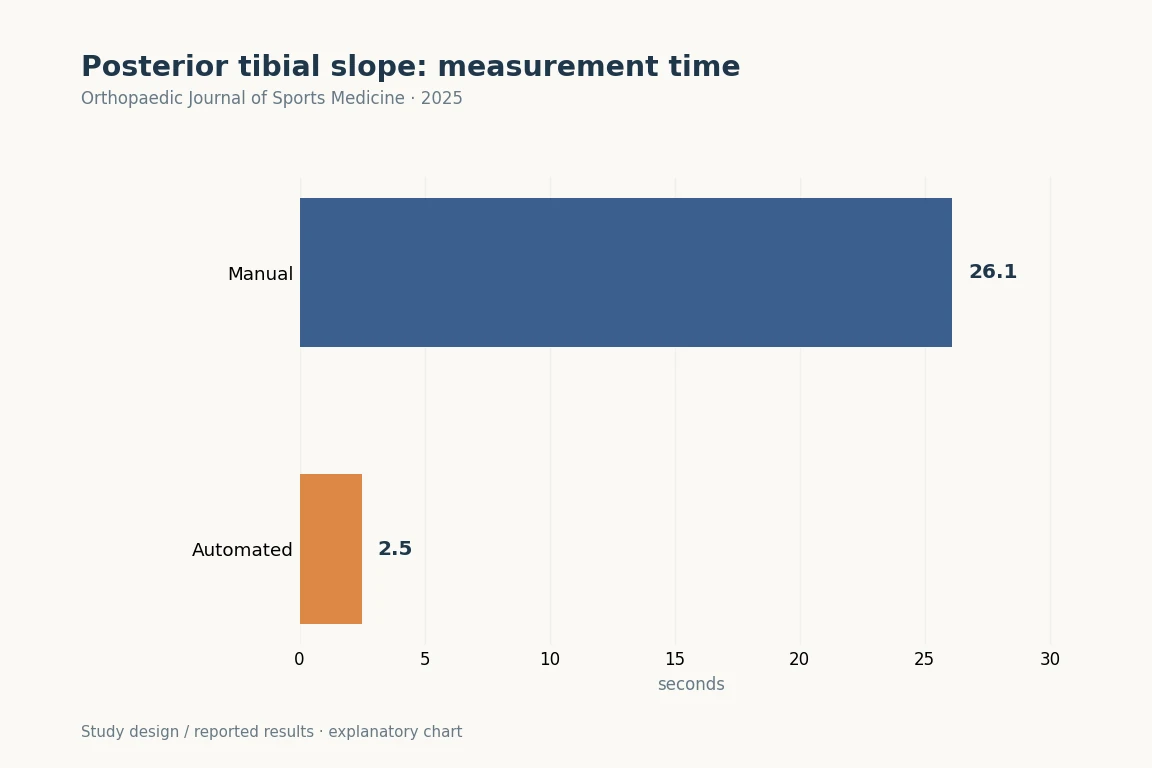
手動計測は26.1秒、自動計測は2.5秒でした。
Orthopaedic Journal of Sports Medicine (2025). DOI: 10.1177/23259671251331067 · Original explanatory chart based on reported data
研究で問うこと
対象と方法
主な結果
診療・手術で考える点
解釈の限界
簡単に説明しましょう
どの診療上の問いにつながりますか?
PTS測定の標準化研究です。異なる骨幹軸プロトコル間で臨床基準をそのまま置き換えてはいけません。
Keywords・キーワード
- automated measurement
- computer vision model
- deep learning
- landmark-based
- posterior tibial slope
- AI
- ACL
- HTO
Abstract・原文の抄録
ByeongYeong Ryu, Jun Woo Nam, Du Hyun Ro, R Kyle Martin, Eivind Inderhaug, Andreas Persson, Sanna Haland, Sung Eun Kim. Automated Posterior Tibial Slope Measurement Using Lateral Knee Radiographs: A Novel Landmark-Based Approach Using Deep Learning. Orthopaedic journal of sports medicine. 2025;13(4):23259671251331067. doi:10.1177/23259671251331067.
BACKGROUND
A single universally accepted protocol does not exist for measuring the posterior tibial slope (PTS), limiting the application of cutoff values for surgical decision-making and risk stratification.
PURPOSE/HYPOTHESIS
This purpose of this study was to validate an online computer vision model using anatomic landmarks for PTS measurement on uncalibrated lateral knee radiographs. It was hypothesized that this model would achieve similar accuracy to manual measurement.
STUDY DESIGN
Cohort study; Level of evidence, 2.
METHODS
A total of 10,007 lateral knee radiographs collected between January 2009 and December 2019 were utilized. The data set comprised 9277 (93%) training, 500 (5%) validation, and 230 (2%) test radiographs. After defining "A" as the distance from the tibial joint line to the proximal aspect of the tibial tuberosity, 2 landmark-based methods for determining the tibial shaft axis were developed based on lines connecting the tibia midpoints at distances: (1) 2A and 3A (short method) and (2) 2A and 4A (long method). The PTS was then calculated using each tibial shaft axis. Model performance was evaluated against orthopaedic specialists' measurements using inter- and intraobserver intraclass correlation coefficients (ICCs). Model performance on shortened images, subcategorized into normal, osteoarthritic, and implant-embedded knees, was also assessed, along with time efficiency comparisons.
RESULTS
The overall interobservers ICCs were 0.91 for the short method and 0.92 for the long method against manual measurement. The ICCs for normal, osteoarthritic, and implant-embedded radiographs were 0.84, 0.90, and 0.97 for the short method and 0.88, 0.91, and 0.97 for the long method, respectively. The intraobserver ICC for the computer vision model was a perfect 1.00, while manual measurements showed ICCs of 0.89 for the short method and 0.95 for the long method. The mean model measurement time was 2.5 ± 0.7 seconds, compared with 26.1 ± 1.9 seconds for the manual measurement (P < .001).
CONCLUSION
A novel, time-efficient, deep learning model for measuring PTS demonstrated excellent accuracy and consistency across various lateral knee radiographs. If externally validated, this model may enable a pathway for direct clinical translation of research findings by providing a standardized measurement tool.
© 2025 The Author(s)
オリジナル紙だ
Automated Posterior Tibial Slope Measurement Using Lateral Knee Radiographs: A Novel Landmark-Based Approach Using Deep Learning
ByeongYeong Ryu, Jun Woo Nam, Du Hyun Ro, R Kyle Martin, Eivind Inderhaug, Andreas Persson, Sanna Haland, Sung Eun Kim
Orthopaedic Journal of Sports Medicine · 2025