2022 · Journal of Clinical Medicine
全下肢X線の筋肉領域から術前サルコペニアをスクリーニングできますか?
分割モデルの試験IoUは0.926でした。PMVと骨格筋指数の相関係数は0.654でした。
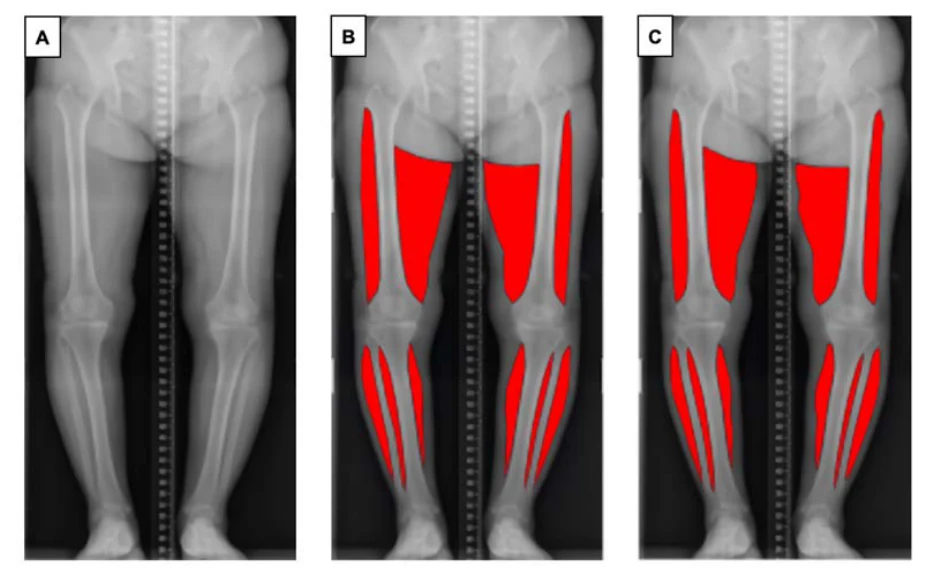
原論文Figure 1・X線の筋肉領域を分割します
 図を拡大する
Aは原画像、Bは研究者がラベルした筋領域、Cはモデルの予測領域で、X線画像から筋形態を定量化する方法を示しています。
Doohyun Hwang, Sungho Ahn, Yong-Beom Park, Seong Hwan Kim, Hyuk-Soo Han, Myung Chul Lee, Du Hyun Ro. Journal of Clinical Medicine (2022). DOI: 10.3390/jcm11133612
研究で問うこと
対象と方法
主な結果
診療・手術で考える点
解釈の限界
簡単に説明しましょう
どの診療上の問いにつながりますか?
既存の術前画像と血液検査でサルコペニアリスクを調べる研究です。栄養状態、筋力、歩行の評価と合わせて活用可能性を検討できます。
Keywords・キーワード
- deep learning
- osteoarthritis
- plain radiograph
- sarcopenia
- screening
- segmentation
- total knee arthroplasty
- AI
Abstract・原文の抄録
Doohyun Hwang, Sungho Ahn, Yong-Beom Park, Seong Hwan Kim, Hyuk-Soo Han, Myung Chul Lee, Du Hyun Ro. Deep Learning-Based Muscle Segmentation and Quantification of Full-Leg Plain Radiograph for Sarcopenia Screening in Patients Undergoing Total Knee Arthroplasty. Journal of clinical medicine. 2022;11(13):3612. doi:10.3390/jcm11133612.
Sarcopenia, an age-related loss of skeletal muscle mass and function, is correlated with adverse outcomes after some surgeries. Here, we present a deep-learning-based model for automatic muscle segmentation and quantification of full-leg plain radiographs. We illustrated the potential of the model to predict sarcopenia in patients undergoing total knee arthroplasty (TKA). A U-Net-based deep learning model for automatic muscle segmentation was developed, trained and validated on the plain radiographs of 227 healthy volunteers. The radiographs of 403 patients scheduled for primary TKA were reviewed to test the developed model and explore its potential to predict sarcopenia. The proposed deep learning model achieved mean IoU values of 0.959 (95% CI 0.959-0.960) and 0.926 (95% CI 0.920-0.931) in the training set and test set, respectively. The fivefold AUC value of the sarcopenia classification model was 0.988 (95% CI 0.986-0.989). Of seven key predictors included in the model, the predicted muscle volume (PMV) was the most important of these features in the decision process. In the preoperative clinical setting, wherein laboratory tests and radiographic imaging are available, the proposed deep-learning-based model can be used to screen for sarcopenia in patients with knee osteoarthritis undergoing TKA with high sarcopenia screening performance.
© 2022 by the authors.
オリジナル紙だ
Deep Learning-Based Muscle Segmentation and Quantification of Full-Leg Plain Radiograph for Sarcopenia Screening in Patients Undergoing Total Knee Arthroplasty
Doohyun Hwang, Sungho Ahn, Yong-Beom Park, Seong Hwan Kim, Hyuk-Soo Han, Myung Chul Lee, Du Hyun Ro
Journal of Clinical Medicine · 2022