
2023 · Journal of Orthopaedic Research
関節症の特徴を再現する合成X線を作れますか?
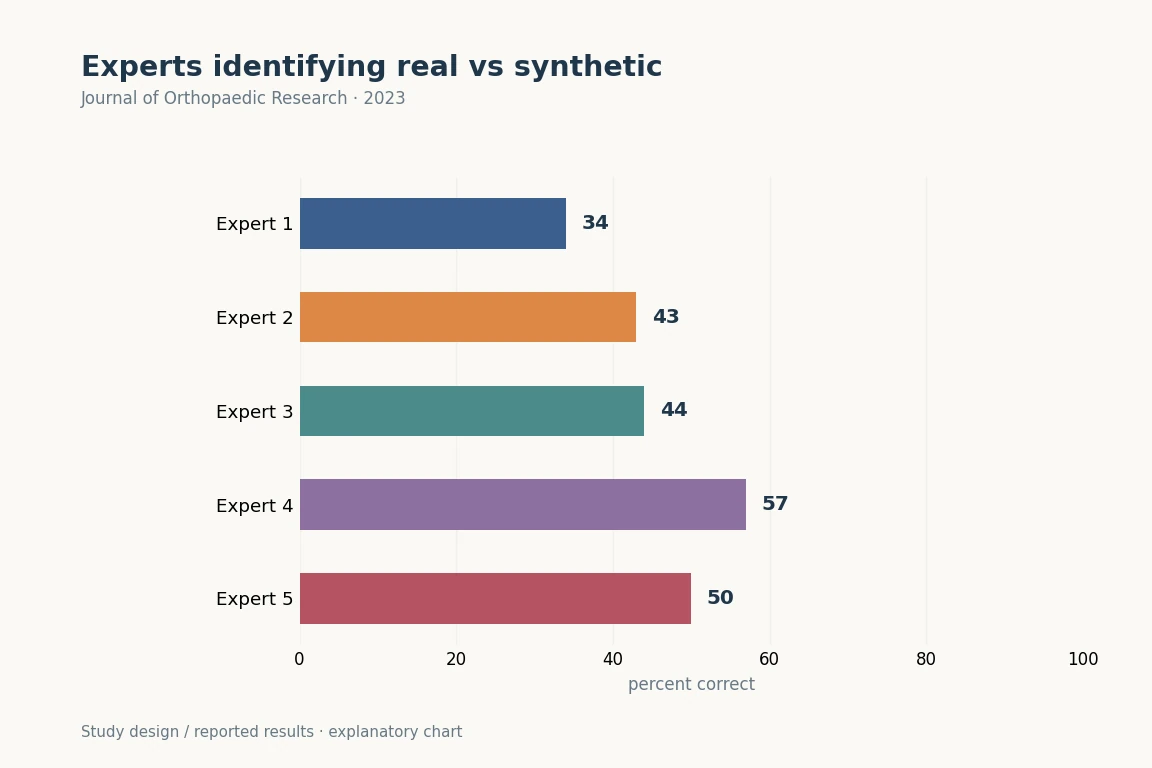
StyleGAN2-ADAと実画像のFIDは2.96でした。専門家の実・生成画像の識別正確度は34%、43%、44%、57%、50%でした。
研究の数値から読む結果
 図を拡大する
5人の専門家による実画像・合成画像の識別精度です。
Journal of Orthopaedic Research (2023). DOI: 10.1002/jor.25325 · Original explanatory chart based on reported data
研究で問うこと
対象と方法
主な結果
診療・手術で考える点
解釈の限界
簡単に説明しましょう
どの診療上の問いにつながりますか?
研究画像の不足や種類の偏りを解決する試みです。合成画像は患者の検査結果として提示せず、原資料と区別して品質と偏りを確認する必要があります。
Keywords・キーワード
- diagnostic imaging
- knee
- Artificial Intelligence
- Arthritis
- Retrospective Studies
- Knee Joint
- Radiography
- AI
Abstract・原文の抄録
Gun Ahn, Byung Sun Choi, Sunho Ko, Changwung Jo, Hyuk-Soo Han, Myung Chul Lee, Du Hyun Ro. High-resolution knee plain radiography image synthesis using style generative adversarial network adaptive discriminator augmentation. Journal of orthopaedic research : official publication of the Orthopaedic Research Society. 2023;41(1):84-93. doi:10.1002/jor.25325.
In this retrospective study, 10,000 anteroposterior (AP) radiography of the knee from a single institution was used to create medical data set that are more balanced and cheaper to create. Two types of convolutional networks were used, deep convolutional GAN (DCGAN) and Style GAN Adaptive Discriminator Augmentation (StyleGAN2-ADA). To verify the quality of generated images from StyleGAN2-ADA compared to real ones, the Visual Turing test was conducted by two computer vision experts, two orthopedic surgeons, and a musculoskeletal radiologist. For quantitative analysis, the Fréchet inception distance (FID), and principal component analysis (PCA) were used. Generated images reproduced the features of osteophytes, joint space narrowing, and sclerosis. Classification accuracy of the experts was 34%, 43%, 44%, 57%, and 50%. FID between the generated images and real ones was 2.96, which is significantly smaller than another medical data set (BreCaHAD = 15.1). PCA showed that no significant difference existed between the PCs of the real and generated images (p > 0.05). At least 2000 images were required to make reliable images optimally. By performing PCA in latent space, we were able to control the desired PC that show a progression of arthritis. Using a GAN, we were able to generate knee X-ray images that accurately reflected the characteristics of the arthritis progression stage, which neither human experts nor artificial intelligence could discern apart from the real images. In summary, our research opens up the potential to adopt a generative model to synthesize realistic anonymous images that can also solve data scarcity and class inequalities.
オリジナル紙だ
High-resolution knee plain radiography image synthesis using style generative adversarial network adaptive discriminator augmentation
Gun Ahn, Byung Sun Choi, Sunho Ko, Changwung Jo, Hyuk-Soo Han, Myung Chul Lee, Du Hyun Ro
Journal of Orthopaedic Research · 2023